

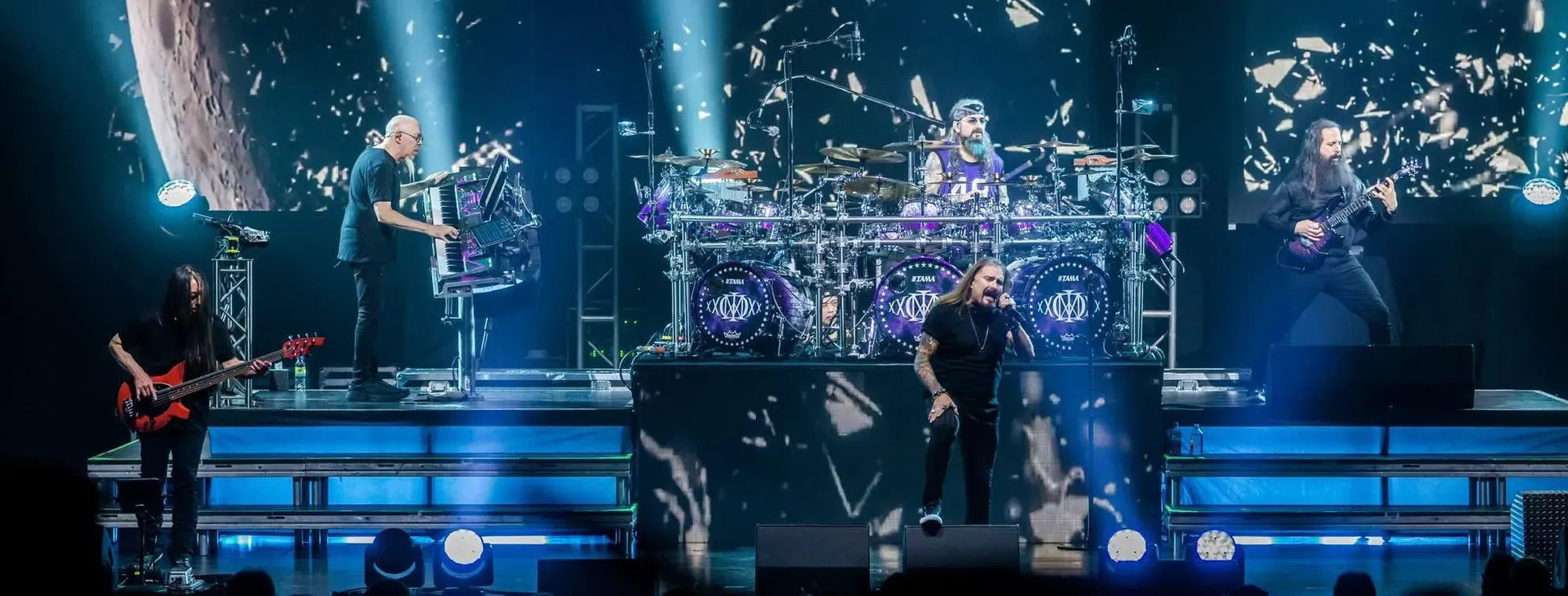
Originally published in Music Players.com · November 2007
Jordan Rudess article-interview (excerpt)
InterviewJordan Rudess5 min read
Taking Jordan’s lead style and sound a step further, we wanted to find out how his sound evolved. Jordan reflected that his lead sound started to evolve years ago while working for Kurzweil. There he met with Chris Martirano, Director of Products Development, and listened to his approach to lead lines and the use of the pitch wheel for vibrato. Most players were bending the pitch and then applying the modulation wheel, which achieved a more canned/controlled sound that produces the same vibrato speed all the time. Chris used the pitch wheel alone to gain better control and produce a more effective type of vibrato. Jordan found this technique to be more effective and incorporated it into his own style.
At the time, Kurzweil was a very powerful leader in the keyboard industry – they were the adventurists when it came to creating new keyboard sounds and applications, according to Jordan. He worked with Chris to develop his ultimate lead sounds. “We spent month’s exchanging files online to collaborate and make adjustments to find just the right sounds.” They incorporated the use of the slider to bring in additional harmonics; added a lag to slowly bring in harmonics where it would drop the fundamental tone and cycle through the harmonics. Many of the lead sounds they created were used when Jordan started with Dream Theater. At that point, Jordan became very conscious of the heavier aspect of his sound and how it blended with the guitar. He worked towards developing a more grungy/cool, almost metal sound, and always wanted to make his sound bigger. Jordan also had a lot of sounds he created on the Novation SuperNova, which was a twelve-voice instrument that had a cool distortion effect. Using primarily Kurzweils at the time, they had to program and sample the sounds of the SuperNova into the Kurzweil.
Shortly thereafter, the Kurzweil business began to get sketchy and Jordan decided it was time to switch to another keyboard – The Korg OASYS. Jordan was then faced with reprogramming everything once again. To help him with this task, he hired Peter Schwartz whom he worked with during his time at Kurweil. Having been a programmer at Kurzweil, Peter worked on Jordan’s lead patches to spec. Jordan communicated what equipment/programs he used to have and what he needed. Peter and Jordan passed program files back forth, tweaking and massaging until Jordan felt they achieved the “ultimate” sounds and reprogrammed them into the OASYS.
Jordan also incorporated the Roland V-Synth into his setup. Jordan was hired by Roland to create a bank of lead patches for the V-Synth. While working on this project, Jordan discovered one cool feature of the V-Synth: a feedback oscillator. Instead of having a pure tone, you have a feedback-generating oscillator. Depending on the amount of depth, the oscillator would provide other harmonic tones and create a grunge effect. He applied the joystick to remove the fundamental tone and add harmonics by moving the joystick forward. This produced a bizarre and cool feedback effect. The V-Synth is currently the sound generator he uses with the Continuum MIDI controller [more about this unique controller in our other Jordan Rudess interview].
Going into the studio for the recent Dream Theater release, Systematic Chaos, Jordan’s arsenal of equipment included the Kurzweil rack, the OASYS and the V-Synth. Jordan explained that this really gave him a multitude of choices and the ability to layer/blend all three keyboards giving him an extended sonic pallet for creativity. The Continuum actually came into play previously when Dream Theater was in the studio working on Octavarium. Drummer Mike Portnoy is a big advocate of trying new things and suggested that Jordan play a lead on the Continuum. Everyone was amazed at the sound – so amazed that the Continuum was used on the beginning of Octavarium as well as during the solo on Systematic Chaos’s “Dark Eternal Night.”
Jordan has also incorporated a few other instruments in his tool belt. While Dream Theater was on tour with Yes, Jordan became intrigued with the lap steel guitar. He observed and grasped as many techniques as possible to help him learn the instrument on his own from watching Steve Howe. Upon return to New York, he purchased his first lap steel guitar, a 1953 Fender model, and began playing on it. During the Octavarium rehearsals, Jordan brought the lap steel to rehearsal. Again, being an advocate of trying new things, Mike Portnoy got him to break it out. They found a slot for it on a song selection and Jordan rehearsed it until he was prepared to go on tour and play it live.
Another cool instrument Jordan is playing on the current Dream Theater world tour is the Zen Riffer – an arguably cool strap-on keyboard controller created by Charles Tentindo. Jordan was turned on to the Zen Riffer by a contact at Korg. He checked it out online and contacted Charles for an in-person look at it. Charles brought the Zen Riffer to a Dream Theater rehearsal in Los Angeles. Time was limited, so they weren’t sure they would have time to check it out, but a slot opened up long enough to generate a positive first impression. “He takes it out of the case and says, ‘Oh no, don’t look yet’” as he’s polishing it and then presents it. It’s this amazing, beautiful, thing. I strapped it on and connected it to the Roland V-Synth. It had a very cool look and provided a pitch/modulation wheel as well.” Jordan had concerns about how the band would receive it – after all, these types of controllers had a chance of conveying the “Eighties cheese” vibe. But as with the Continuum and lap steel guitar, Mike Portnoy wanted Jordan to take a solo on it. It sounded cool and looked equally as cool, or at least menacing, with its dagger edge that seems poised to hack a classic Roland strap-on controller into tiny little pieces. The decision was made to leave the Zen Riffer in Jordan’s care to take on tour.
Jordan was headed back to Europe to resume the Dream Theater tour, and upon return from the tour, he’s got a lot of big things planned for his online conservatory, the most significant perhaps being that they will be adding a guitar program! Jordan informed us that Rusty Cooley is the commissioned guitarist to lead the program, and Charlie Zeleny from the band Behold the Arctopus will be leading drum sessions. Jordan also plans on developing other elements that will include live teaching sessions conducted in real time. And last but not least, keyboard players can look forward to a new edition of Jordan’s Accent magazine.