

Originally published in Screamer Magazine.com · February 2025
Dream Theater – No Rest For The Weary
by Kurt Nelson · February 13, 2025
InterviewJames LaBrie11 min read
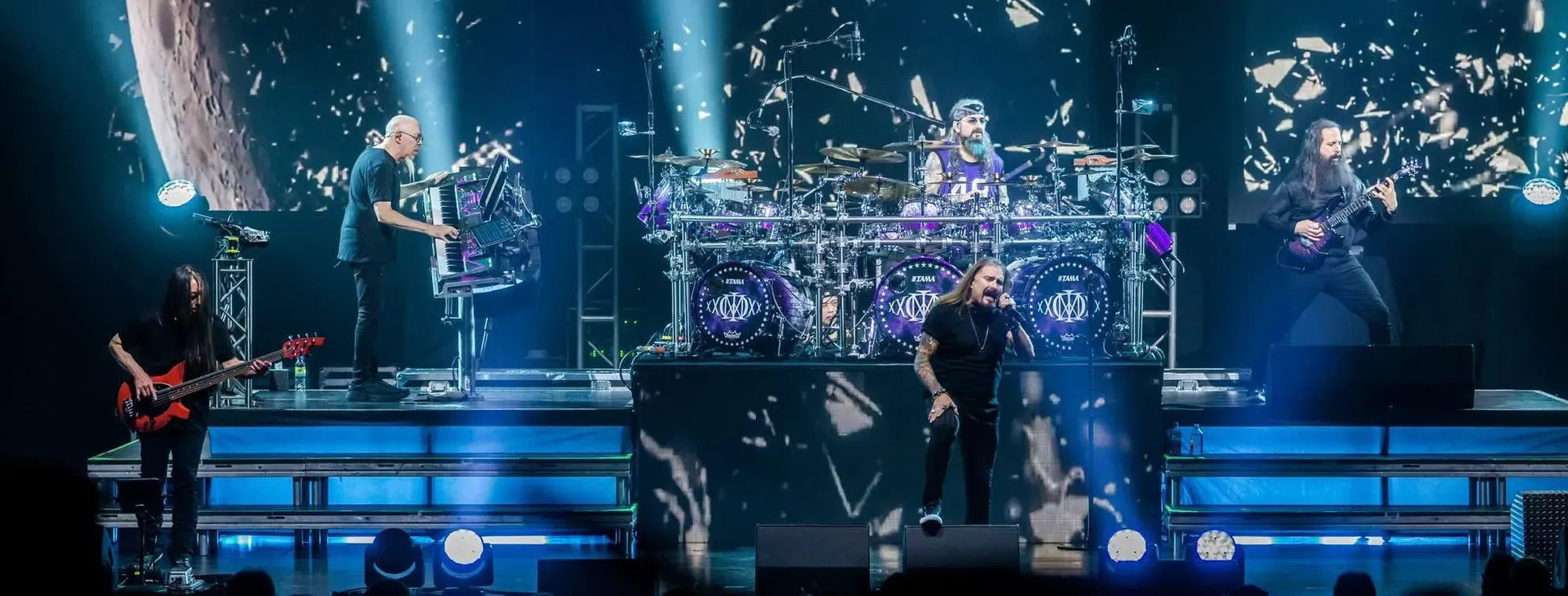
Dream Theater is massive. Cinematic. Bombastic. Complex. Sensory and visceral. Their music plays out in twenty-five minute compositions on thirty-foot screens. Anyone that has followed the forty-plus years of this band knows nothing is shallow about this show. The theater of Dream Theater is the theater of the personal, the individual. It hits hard visually, but the emotional and psychological trip we all commit to with every album shouldn’t be taken for granted. With Parasomnia, Dream Theater has brought back the classic lineup with Mike Portnoy back behind the kit, but don’t fool yourself. This band challenges itself. It challenges its audience. Parasomnia might be the Everest they die on. That you die on. Dream Theater summits on this one. The climb’s not easy, but damn it, it was worth the oxygen tanks.
James LaBrie sat down with Screamer Magazine as the Dream Theater’s 40th Anniversary Tour heats up and Parasomnia, arguably their best among bests albums, drops into the ears of fans worldwide.
Nothing is backward looking about Parasomnia. With a restored lineup, Dream Theater has produced an earth moving album that feels as new as it does familiar. “I think that it is a new chapter for Dream Theater,” LaBrie says. “There’s no doubt about it. I think the best way that I could put it is: we are exactly where we want to be and things are happening exactly the way we want them to be unfolding at this particular moment in our career. And, leaves the doors open for much to come in the future. We’re one hundred percent behind this new album. We all feel extremely confident that our fanbase will embrace this album wholeheartedly.” With fourteen studio albums under their belt, Dream Theater still manages to pull off some surprises.
However, their refusal to follow any well-tread paths can bring out the couch critics—especially for a band with such a long history. “Now, of course, we see it ‘cause we’re already releasing singles, you’re always gonna have your critics out there. You’re always gonna have the trolls that are saying ‘you’re not doing this right’ or ‘it’s regurgitated.’ Whatever. Go find a new hobby, as far as I’m concerned,” he jokes. Going back to Images and Words, fans have grown to expect the unexpected. Defiance of expectation might be the one Dream Theater constant. That and jaw dropping talent.
Since the departure of drummer Mike Portnoy in 2010, the rhythm section had been firmly grounded by Mike Mangini. Portnoy rejoined the band in 2023 with a nearly thirteen year absence. If there was any awkwardness, it was short lived. “The only time it felt weird or surreal was when he [first] walked into the studio. We hadn’t yet gotten back behind the instruments…I think everything leading up to that, there was so much anticipation. Maybe there was a little trepidation. Like, how is this really gonna work out? Is it gonna be what we remember? How it was in the past? Nobody really knew. A lot of time had gone by. But, within the first day…we were all laughing because everything was so familiar. Not even just familiar, but everything was just so smooth and graceful, and seamless. It just felt like we’d taken a break, but not to the extent that we all know what it was, almost thirteen years. It felt like we’d taken a coffee break,” he laughs, “before writing a new album…It was like it picked up from where it left off.” Parasomnia finds the band deeply in sync. There is not a hint of a lengthy disconnect.
Dream Theater is a team effort. To pull off twenty-minute track runtimes in studio, let alone on stage, they have to be. “It was exciting,” LaBrie explains. “Every moment in the studio building these songs. Mike was involved one hundred percent from beginning to end, just like he always has been in the past. That’s the only way that it could have worked out. It would have been disingenuous of us to say, ‘You only do this much, and we’re going to take it over here cause that’s what we’ve been doing.’ No. It had to be full on like it had always been, and that’s why I think we have that album that we do.”
The new album has many fall-out-of-your-chair moments. Parasomnia is fearless. The listener is challenged to go for an oft-surprising series of switchbacks. On the track ‘Dead Asleep’, LaBrie talks about his own challenge with a mid-tune genre shift. “You know what’s funny about that?” he says of walking into an early playthrough. “When [the] guys went into creating that, I was like, ‘No friggin’ way guys! I don’t feel that shit at all!’ I don’t know what just happened. I felt like, hey, I just arrived here at the circus. They start going off on this thing, and John Petrucci is looking at me,” he chuckles. “He’s saying, ‘I knew you were going to do that! Fucking James, I knew you were going to say, whoa, whoa, whoa…’ And Mike’s in the background laughing. John’s just like, ‘Let us feel this for everything that it’s worth. Let us bring it to complete fruition then you can say your thing.’ I was like, ‘Ok. You guys do your thing. I digress.’ What is funny is that when it was done and within the entire context of the song, I was like, ‘Okay. Alright. I see it, man.’ That is true Dream Theater. You’re going ahead full speed…then you go at a ninety-degree angle. I get it. That’s who we are. So, I came to love it. That just epitomizes who the hell we are as a band.” A band that can shift from balls-to-the-wall speed to a melodic blues breakdown to a neo-classical keyboard interlude and isn’t worried about your rules.
You can love it or hate it, but Dream Theater isn’t thinking about anything outside of this group of guys. “I think we’ve always done whatever the hell we want. We’ve always done whatever we want to achieve what the music needs. We’ve never said, ‘We can’t do that because it’s gonna push the boundaries…’ There are no boundaries. We have absolute creative freedom with wherever we want to go. That’s why our music is eclectic. That’s why our songs are anywhere from two-minutes and thirty-seconds to twenty-five minutes to forty-two minutes when you put them all together in a conceptual piece. It’s always been who we are.” Still, LaBrie and crew might be harder on the output than any internet troll. They’re five musicians as critical and precise as any scalpel wielding surgeon. “We’re constantly listening back to what we’re doing. We’re constantly analyzing what we’re doing. There will be situations when we say, ‘we need to lose that and maybe bring something else in.’ But there is a purpose, a reason behind everything that we do. I think that people expect the unpredictable when it comes to a band like this.” Unpredictable by design.
Dream Theater is, justly, known for their live shows. With interconnected concepts, surprising covers, and decades worth of fan favorites, it is a massive task to create a setlist that works—for audience and band. “Well, we hand off that baton to Mike Portnoy who does it best. First and foremost, and I say this [in] every interview, he’s the biggest fan of Dream Theater because he’s not just a band member. He’s so thoroughly driven by making sure we got the list no matter what he’s doing. Even when writing the album, he’s fully invested,” LaBrie says of his returned bandmate. It’s easy to hear the camaraderie, the appreciation in his voice. “When it comes to creating a setlist, he analyzes every aspect of why the setlist should be what it is. What did we play last time we played in this territory? How long has it been since the band played this song? Hey, we’re gonna be in Dallas, Texas. What did we play in Dallas, Texas, last time? Or Stockholm, Sweden? So, everything is considered as a whole. We don’t play a different setlist every night…but as the tour goes on, we will be introducing new songs. Obviously, more songs from Parasomnia. We’re all excited to play the epic ‘The Shadow Man Incident’. There’s no way we can’t play that! Mike has always really considered every aspect of why we should play this [or that] particular song. That is why the setlist is what it is. He’s thought of everything.” The detail. The care. The why is always forefront for a band that is emblematic of musical freedom.
Outside of Dream Theater, LaBrie has worked with several artists and released solo albums under various names. “It just allows me to do what I love to do. Be an artist and write these songs. I have several ideas musically all the time. Several ideas melodically, lyrically. These solo albums are a template for me to explore all these other areas of what I am as a musician and work with other incredible musicians. So whether I’m doing an album like Beautiful Shade of Gray, or I’m doing an album like Elements of Persuasion, Static Impulse, or whatever it might be, that’s another part of who and what I am as a musician. If anything, it allows me to continue to grow…and I’m able to bring those experiences back into the Dream Theater fold.” Rather than a break from the band, LaBrie’s peripheral explorations inform his return.
Dream Theater’s work is, at its center, a complex exploration of the human interior. It is a combination of individuals bringing complex experiences to the writing. “When I write a melody for Dream Theater, when I write a lyric for Dream Theater, it’s there because of those experiences. With the solo albums, it allows people to hear that there are other layers to me as a musician. It also allows me to express myself vocally in all the different areas that I’ve grown up loving. I can say, ‘You might not have heard this with Dream Theater,’ maybe something similar, but I’m able to explore it even further because of the music I’ve written on this solo album.” The results are both epic in size and personal in expression.
As an iconic vocalist and frontman, LaBrie cites singers that bring more to the stage than their musical chops as influential. “I grew up listening to Robert Plant, Steve Perry, Lou Gramm, Freddie Mercury, even Rod Stewart. I remember listening to [Stewart] thinking, ‘Holy shit, this guy’s got such a unique sound singing in the upper register.’ Steven Tyler was huge. I still remember hearing ‘Lord of the Thighs’ for the first time. At the time, I was a drummer too. I played drums from the age of five until I was seventeen. I remember hearing [the drum intro], and [Tyler] comes in and starts to sing that. I’m like, who the fuck is this? Because he had attitude. He had charisma,” he says with reverence. “Guys like that really really grabbed my attention. Even earlier stuff from Rob Halford. It was kinda like, holy shit, these guys! It wasn’t just that they had a unique sounding voice. It was delivery. There was emotion. There was evocativeness in there. There was much more of them. The core of them you could understand even if you couldn’t understand the words. You could feel it and get the gist of what the words were about because of their emotional outpouring, their presentation. That was a huge influence on me.” LaBrie’s emblematic swagger, that hand-movement and pace reflects his heroes but transforms into something all his own.
With sets and music that would take the piss out of any twenty-something, metal’s elder statesmen are pulling three hour sets several nights a week. LaBrie is honest about the work. “When I’m singing into the stratosphere from Images and Words,” he explains. “I’m like, ‘Oh man, this is going to be tough!’ And, on this tour, we’ve made a point that when we go back to the old material, we change some of the melodies. Some of the greatest singers in the world, be it Freddie Mercury or Steven Tyler. They all changed their melodies to the live environment because, for you to go out there each and every night, hitting Ds, and Es and Fs. Come on, let’s be realistic,” he says with a wave of his hand.
Adjusting, LaBrie says, is about preservation of the songs. “Was I doing it in my twenties and thirties? Yeah.” He continues. “If we’re going to be doing stuff from Images or stuff from Awake, or anything from those early albums where I’m singing in the stratosphere, I have to be realistic. I’ll have to say, no. Either I’ll change the melodies, and it will still be powerful. It will still be musical, which is the ultimate goal. That’s where I’m at these days. That being said, we do a song like ‘Pull Me Under’, I’m singing in the same register that I did back then. When we do ‘The Mirror’ from Awake, I’m singing everything, pretty much, ninety percent of the register for that song that I did back then. But there are moments where I’m not going to go up to that D or C sharp, whatever it might be. Nine outta ten shows, my voice is spot on and kicking ass. But, then there’s that one show where I’m like, ‘whew, I’m tired’ and have to accept that I’m human. I’m sixty one years old, and you gotta be realistic at some point.” Since a vocal cord injury in 1994, LaBrie has returned to form but recognizes the limitations and the importance of fidelity to the music. “The other guys in the band are like, ‘Dude, what you’re doing out there is phenomenal. Fuck man, just do what you’re gonna do. Just be James LaBrie.’” Nothing vocally is lost with LaBrie on Parasomnia. The range and register may be different, but it is improved in depth and dynamic richness.
Before we conclude, LaBrie circles back to his bandmates. “That being said, those guys are being challenged every night too, and they feel it. It’s no ride in the park for them either. You’re talking about five, six shows a week. It’s nice to be a weekend warrior,” he jokes. “If I could play Friday and Saturday night and be off for the rest of the week?” These are brothers reunited and are better for it. It’s flawless, but you can hear the work it took to get it here. Now, Dream Theater takes it to the stage, with luck, somewhere near you. James LaBrie gets the final word. “Bring it on, baby! Let’s go!”