
Originally published in Drum Scene magazine · July 2014
Mike Mangini – More Than Just “Along For The Ride”
By Interview by Ray Deegan
InterviewMike Mangini25 min read
For the drumming community at large, and for the last 2 years, some of the greatest ‘drum-goss’ has been about the exit of Mike Portnoy from Dream Theater and the induction of Mike Mangini.
First there was the audition process, videoed for all the world to see and posted on YouTube – the biggest names in the world sitting through the audition of a lifetime, to see who could replace the inimitable Portnoy.
While Dream Theater (DT) fans pondered the feasibility of a version of DT without its formidable leader, the band were confident and determined that they would not just continue, but would grow and evolve into a stronger animal.
When it was announced that Mike Mangini would take the throne, for many drummers, it was no surprise! Few drummers have the intellectual command of the instrument to not only honour the detail and stay loyal to the existing music of DT, but to also take a recognizable style and sound and stretch it to new levels that fans could still appreciate.
In the last 2 years Mike has more than proven worthy of his position in the band: first, on “A Dramatic Turn of Events” and now on the more recently released “Dream Theater”.
Mike is an amazing talent. He’s worked with countless artists as a session musician, is a highly respected lecturer at Berklee College AND a Best Selling author – not to mention the copious awards that are littered throughout his career to date!
I recently spoke with Mike at the conclusion of the second leg of the ‘Along for the Ride’ tour, and began by asking him about the success of the tour to date and the advanced features of the production on this latest Dream Theater tour...
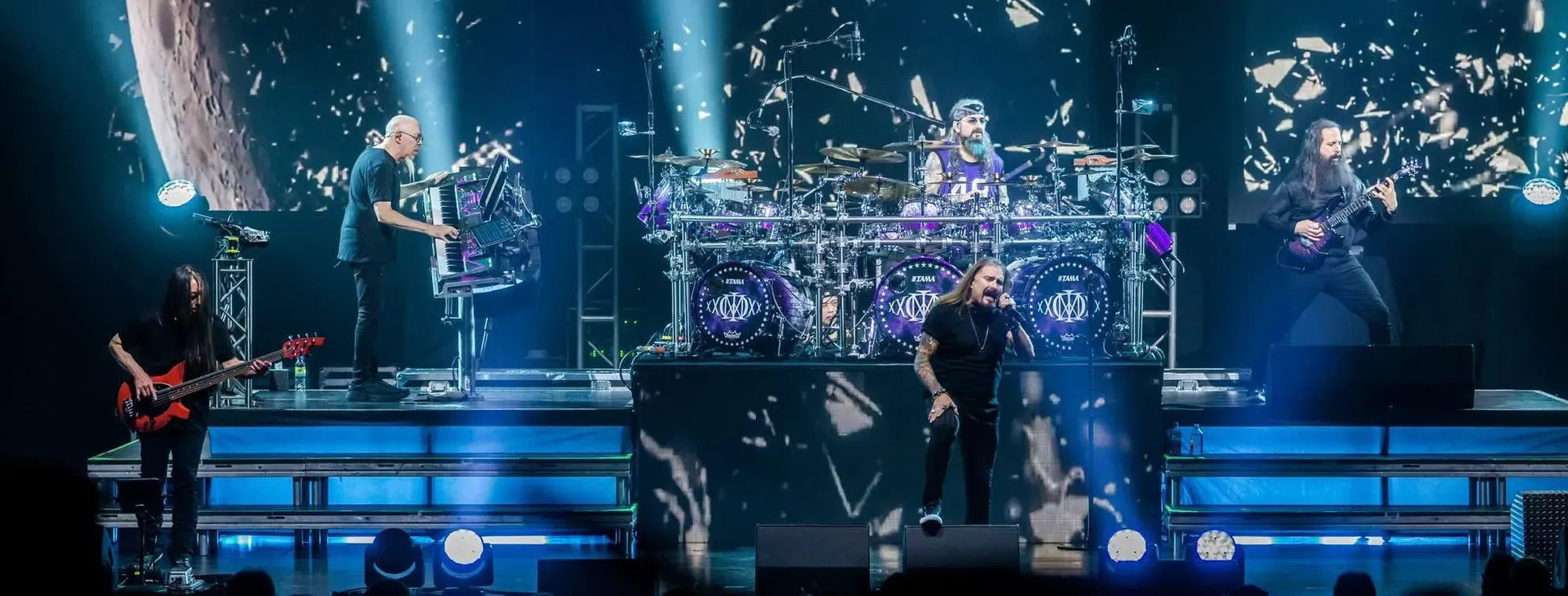
It is going really well with the help of a huge crew. This show has production never achieved before by Dream Theater because of the sheer number of contributors to it and because of the meticulous synchronization of the entire band, crew and video over a 3-hour period. It is awesome to work with a group of people who are always bringing their A-Game, but who also have a sense of humour, acceptance and are fun to hang out with on show day, or on days off.
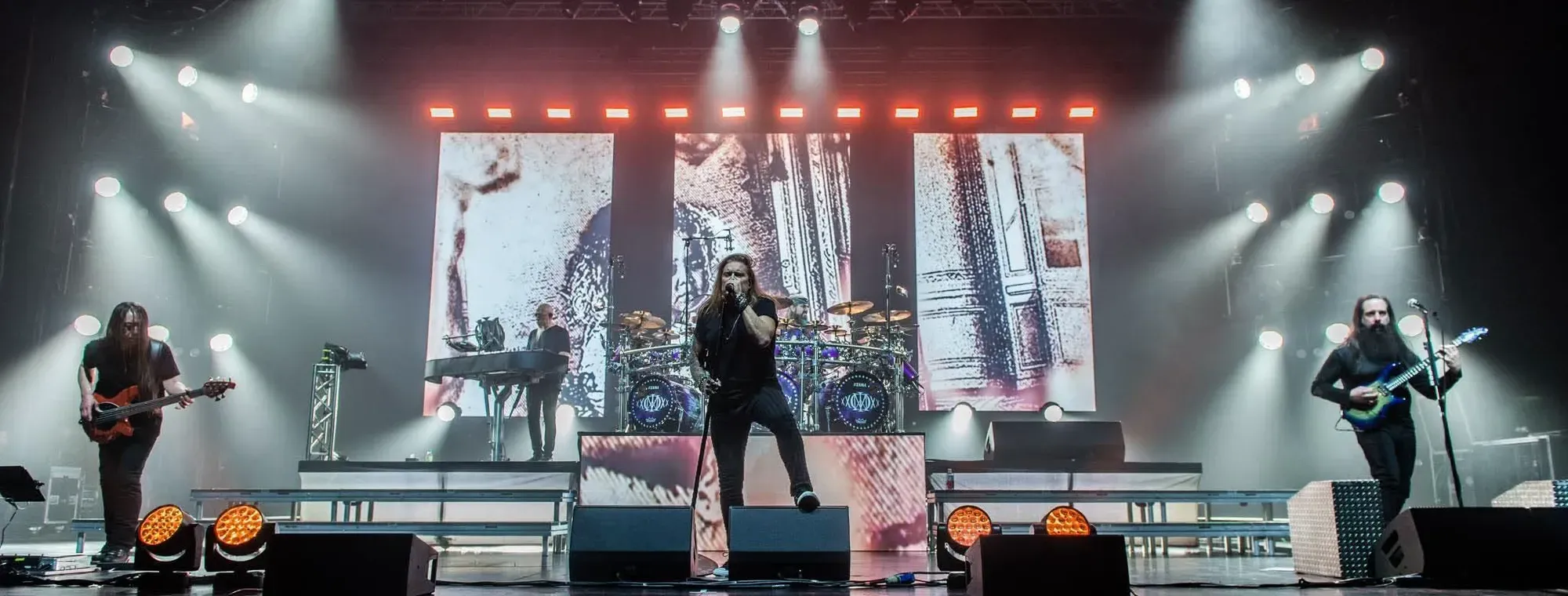
Fans are interested for 3 hours. The set list is well paced. The video and light show are also getting a lot of attention. James is taking the bull by the horns and entertaining the crowd and keeping everyone involved with what’s going on for the whole 3 hours.
Drumming-wise, my years of several hours of practice per day are making the 3 hours not a problem for me. Physically overall however, the pace of 4 shows every 5 days (for the most part) is a challenge.
Mentally, I’m constantly thinking about my body mechanics and where I am in the song. My timing has to be perfect for 3 hours of playing with videos, instrument delay settings and cues. I don’t have any room for error and that can weigh on me because I cannot lose focus for even a part of one second. A different subject that makes me really happy is the amount of females and children coming to DT shows. Their numbers are increasing, especially in the V.I.P. meet and greet. Numerous interviewers noticed and have asked me why I think this is so; it isn’t just me seeing what’s going on. I think it is because of the audition documentary, the Grammy exposure and very simply, how the music and lyrics are translating. This is important for the Progressive genre and all the false stereotypes associated with it.
The show reviews are just unbelievably positive, to cap it all off.
None of us can know and understand what it takes to go out on the road and perform such complex and demanding music night after night. What’s required to prepare and then withstand that sort of rigour and playing?
In order for me to prepare properly to hit the drums harder than it looks for our 3-hour Dream Theater show, I have to dedicate way more time to resting and caring for my body. That means social sacrifices in not meeting up with associates, friends or family, I cannot explore the World’s cities and I need to sleep more than usual, stretch more, get physical therapy every 5 days or so and warm up – all to avoid, or tend to injuries and to prolong my career. We fly business class and that is huge, huge help. Flying and playing is the worst kind of touring. I also have to watch my diet, especially late night. Nights before show days remind me of school nights growing up. From 3 to all 5 of us stay up together and talk when we’re on a bus, then we have to get to sleep.
Time gets eaten up though. Before you know it, it is bedtime and then wake up time.
I need to make time to communicate with my family as if I am home. We all do. That means I get put on their devices and they carry me around the house talking to me. Time zone differences make things a challenge, but it is kind of funny to me that “I” reside in a handheld device. One child says to another, “Here, you take Daddy now.” They pass me around and sometimes leave me on a table facing the ceiling.
How has your body treated you over the many years of touring & playing? I imagine you’re the sort of person who is very aware of your physical and mental state.
In 2014, I had to begin the tour after finding out something that three different doctors blew it on for the previous two plus years of trouble. Something was wrong with both my right wrist and my clavicle area. Although I now know what’s going on, not knowing exactly what was going on then weighed on me big time causing huge stress and physical discomfort off the drums. I had to factor in managing these injuries into my daily routine. I cannot shake hands without pain because all the stuff around my right ulna bone is sensitive when it gets touched. I cannot sign autographs sometimes without discomfort and subsequent pain. Those motions hurt me, but hitting or lifting things does not. It bums me out because I appear to not want to shake hands or sign in general and that is untrue. I’m afraid of messing up my drumming and that’s what people are paying to see, not to touch me etc. Being restricted is a bummer, but I give to them by putting on the best show I can.
Mental fatigue kicks in at some point and I can lose my way physically, emotionally and spiritually quicker than I’d like. On a show day, I am busy for 5 to 7 hours before we play. I am also haunted by people repeatedly asking me for concert tickets and my time. I’d love nothing more than to play a show, stay in the city and have a wicked party with all kinds of people, with new people I never met even, but we cannot. Plus, no tickets are free. We pay for them. We’ve done our job when we leave that stage exhausted.
It is uncomfortable being asked to put my entire band (and by default, our families) in a position to buy/purchase/pay for tickets for someone they don’t even know.
You’re at the point where you’re no longer the ‘new kid’ – does it now feel like home to be in DT?
It will be 4 years, 2 albums and 2 Grammy nominations with Dream Theater in October 2014 since I got “the call.” It feels great!
I am now comfortable with most everything, including what I constructed as a physical drum kit while studying the band’s back catalogue in 2010. I am really lucky that my 1st creation is almost the same today. I only moved 1 cymbal, replaced the 26” and 18” kick drums with Pearl’s TRUTrac trigger kicks and tune the drums higher than I used to.
I am also lucky that my sense of riff constructing on the drums, or off them on a keyboard or string instrument, matches, or is growing into what those guys do naturally with key signatures. I’ve been very slow to offer non-drum ideas though.
My two studio rooms are almost hooked up and ready to function so I can now compose and practice much better. I feel like I can’t wait to get the riffs flowing.
I am also very comfortable on and off the stage with everybody. We hang out. We talk and we live well together. We like the same foods. We value the same things in life, too.
Oppositely, I am not comfortable in hearing untrue, assumed, embellished, negative, or twisted around things said or written online about any part of the drummer audition process, my band mates, or about any private band business whatsoever, for that matter. The media loves dirt and loves to put people on the spot, too.
Not “anybody” could exist in that band when, to do so, a great deal of immediate improvisational and time signature recognition ability is needed in the style of Progressive Rock when the heat and pressure is on. Some players have earned those skills. In general, it is disrespectful to DT and both MP and me for anyone to say that “anybody of X, Y or Z could do ‘that’ gig.”
DT held a professional try out. A baseball player doesn’t strike out on four at-bats, then ask to stop the game so that he can learn how to hit those pitches at home before batting again.
I worked – and continue to work – hard, and am totally comfortable in the game at all times with DT, especially in moving forward.
The album has been extremely successful and so has your transition into the band – how much pressure was there on you at the beginning to prove your position and help the band keep going for the fans?
There was a lot of pressure on me to work hard. Just because a drummer ‘could’ play a DT track, or ‘could’ hit the correct drums for a song for the most part, doesn’t mean you can make it believable, (especially to the band members that composed the music). If being worthy of playing with DT was as easy as playing along with the records, there would have been a large database of drummers thinking they were capable of serving as a replacement for Portnoy. Clearly there were not. He has a monster memory and can nail songs from decades ago, not as play-a-longs, but for real. My respect and work ethic are the most valuable things I can offer in order to keep things moving forward.
I can keep the band going for fans as I am not bored playing the songs at album tempo the way the composers composed them. I have a lot of things in common with them all off stage and like to hang out with them, so we are happy on stage. I am like these guys in that our goals both individually as players and as a band are similar. We all are into evolving on our instruments as the very backbone of what we’re going to compose next.
I am happy with that existence and I just love to push the envelope of playing heavy – and sometimes progressively – complex stuff with the band.
What was the feeling for you, going into the studio to record your first album “A Dramatic Turn of Events” (ADTOE) with DT and their first album without MP?
Upon entering the studio for “A Dramatic Turn of Events,” I felt I was at the very beginning of getting to know what it was all about. Beyond a feeling of submission about things I could not change, I had 3 big concerns: my newly hurt right wrist from constructing the kit, a weird looking and totally unique drum kit that might not be understood, and a sense of being a bit unsure how much I should sound like what Portnoy would play here and there. After all, I do have to replicate his style quite often as my job and I happen to really like his playing. Also, I had never composed music for DT. I did not compose any of ADTOE. By submitting to these truths, I was better able to go with the flow in a supportive way.
While constructing the drum kit, which was different than what I’d been playing, I hurt my wrist carrying a very heavy cymbal bag. I could not practise and learn the songs they sent me for 8 days out of the two weeks remaining before I entered the studio. While I couldn’t play, I had a chance to contemplate parts and listen more. What was the coolest thing, was that an out of place bone slipped back into place and I was able to just play as normal without feeling many restrictions from the injury. I also had a sense of the entire batch of songs in my mind.
I also really loved my tweaked/newish set up and I was happy that recording drums was my new job. I also wanted to be there for the DT guys for welcoming me into their family and families. The support I received from them all was incredible. Rudess and Myung picked up on my quirky humour, buzzing energy and rhythmic craziness, and accepted me as I am. Knowing LaBrie for more than a decade, I can say that I really like him personally, have so much respect for his incredible singing talent and for his rhythmic sense and athlete’s mentality. Petrucci was so knowledgeable, professional, funny, nice and helpful during my studio time and was nothing short of amazing. Being supported and supporting was my feeling going in and those feelings have only grown stronger since recording ADTOE.
Can you talk about the process leading up to the studio – the song writing and rehearsals for “Dream Theater” – it must be an enormous undertaking to practise, rehearse and be prepared to go into the studio with a band like DT and those compositions?
I first had a chance to just jam at sound checks for 2011 and 2012. At home, I practised mechanics and I gathered up my new drum beats, riffs and partial songs that I composed and recorded on keys, bass, guitar and drums.
Similar to preparing for my DT audition and then before ADTOE, I worked on all 24 of my limb combinations with a set of stickings ranging from 20 notes down to 2 notes to sharpen my pattern recognition skills to be able to play as much stuff as possible as quickly as possible. This is the thing that made the audition tests easy for me. I also made sure to work on my velocities and playing stronger than normal.
We didn’t play much alone or together before getting to the studio. There were soundcheck jams, but no rehearsing per se. We largely wrote together, so I had to improvise a lot. Many of my improvisations are on the final tracks.
All drummers are fascinated by the kit set-up you developed for DT – you put together a setup that incorporates into one, all the alternatives MP had to go to for different compositions. Can you explain all the consideration you put into finalising the monster Dream Theater kit?
After a few months of scanning the entire DT backlog of songs, the drum kit I put together for playing with Dream Theater was a combination of years of developing my own playing with what Portnoy used for sounds over the years. For example, no matter what I was at the time as a drummer, I still had to play and sound like the DT songs sounded. The greatest payoff for all my hard work was the ability to play lefty, or righty, or a mix of the two. This means that I could reach things and hit them with feel.
My kit has been set up in an Apex shaped, ambidextrous kind of way since the mid-nineties. The reason I have the toms and cymbals that I have is simply for tonal and pitch range capabilities. i.e. when the instruments play high notes, I hit smaller drums and cymbals. When there’s a big “boom” or “thud” needed musically, I cannot hit a 6” tom. I have to hit the lowest floor tom or the gong bass drum to match it. Check out the new record to hear my stacked Oriental Trash cymbals follow the keyboard note changes, or my toms follow the transition riffs between parts.
For anyone interested, playing the kit requires different drumming skills than the norm. One must be able to play fully lefty and righty to do it. Playing my kit is NOT LIKE PLAYING A KIT WITH A BUNCH OF PEDALS THAT HIT THINGS. I cannot stress this enough: limb combinations along with sound associations differentiate lefty versus righty playing with the world of just using different limb combinations. It isn’t about stepping on pedals. It is about the physical moves that are linked to sound associations. i.e. make the hi hat go “pssst” in unison with a kick drum hit playing the opposite way and duly have your butt kicked.
Most importantly, this kit is a reflection of what Aquinas refers to as “human potentiality.” That is different than just human potential. This kit is my calling, but I didn’t know it until I earned different skill levels and my eyes were opened.
Lots of different players in this world have different kits than me and certainly outplay me (as they should if they’ve put the work in.) I have the most respect for them and people like them. My life would not be as enjoyable if guys like Donati, Chambers, El Negro (and a LOT of others) didn’t exist because I have people to share my life’s path with; people that understand each other. I can’t stand not mentioning 400 other drummers that I love. Anyway, enjoying and applauding what each other does is absolutely the best way to live, especially when you mean it. There are all kinds of drummers doing their thing and I’m happy to do mine.
When you’re on tour, what is sound check like for you? How long does it take to firstly construct the kit and then tune and prepare before a concert?
I think it takes Eric (my tech) less than an hour to fully set it up. While on tour, sound check is very quick. I now do not hit with the same velocity as the show because not warming up is not healthy for me given how hard I am hitting during the show. My drum tech tunes, line checks and hits the drums before I arrive. I barely have to move anything ever, by the way. I just show up and play through a song and part of another and we get out of there. When any of us sticks around, it is either because we need to tweak our gear, work on something, or that we simply have the time to jam if we are not starving and needing to eat. We’re usually very hungry, though.
I want to ask you about your DVD release ‘The Grid’ – it’s extremely well put together, as we expected, but for those who maybe haven’t seen it yet, can you talk about what you set out to achieve and demonstrate and how any individual can relate to the system you’ve developed for their development?
The Grid is a shape and philosophy based management system. By outlining everything that has ever been played, ever could be played for all of eternity on every instrument and in every way, it gives a viewer a sense of peace in knowing who they are by what they do and what they are as a human being, and who they can become by what is possible and not yet playable by them, or even on their radar.
I set out to achieve a definition of “improvising” as well as a method for doing it. I also set out to achieve a time and soul saving method for musicians who either want to achieve something on their instrument, or who were stripped of their courage and dreams by another person who told them that they did not “have it” in some way. Albeit, a person may not be naturally ‘pre-wired’ with extensive hand/eye coordination, or to be the best ever at what they do, but as long as a person’s body and brain are functioning ‘normally’ per se, they do have the opportunity to play most things given time, gear and passion. I think that is what hope is all about.
The Grid is therefore something one pictures in their mind while developing themselves or when coming up with ideas while improvising. Improvising is not a random thing without rhyme or reason. At some point and at some level, there are neurons fired and decisions, or connections made without us being able to detect them. Nothing is random; not a thing in this universe is. That word is used when somebody can’t explain, or figure out what motion or thing causes the next one. It is a cop out word, and always will be.
Why not figure out just how it all works and forget the “why” sometimes? With improvisation, I did and I tested it while teaching at Berklee College. The Grid philosophy worked so well, that I could use a portion of the system dealing with using an appropriate drum and drum striking technique to take a Rock drummer who could barely even play Rock beats well and within one single 30~minute lesson, get them to improvise in a very, very basic way with Afro Cuban, Jazz, Brazilian, Rock and Funk drumming. I did it every time with every student, while never, ever failing them. None of the unskilled players would win a drum contest, but none of them improvised at all without the Grid.
The Grid thinking offers hope so many people can enjoy music and enjoy personal growth. As Aristotle said about successful teaching and learning, “it is in the method.”
Now that your life is so much about DT the band, do you miss teaching? Do you miss the days of Berklee?
I will always be a teacher because having to explain something I do means having to understand how I work, how the thing I’m trying to figure out works and what I could possibly do to help another drummer (and learn too) while I am in a position of influence.
I miss my colleagues and students, but I do not miss teaching for a living as a college employee at this time in lieu of being the guy on stage and on film. It isn’t that I wouldn’t enjoy that under the right circumstances again.
I need my time for the foreseeable future to exist in the professional environments that the performance-oriented students really want to learn about and be a part of from paying for an education in a music school – like a lawyer who has his practice and then teaches what he knows at a college about how to have a better chance at working as a Lawyer once out of school. That is good critical thinking that follows natural laws of source and derivative things. The environment is the source. Teaching performance-oriented things is not a main “gig,” it is a derivative job by nature and I’ll do it here and there on my own and on the side for now.
You’re extremely highly rated by your students and peers as a teacher – when did you realise you had such a gift for teaching and education? When did this develop and how?
I realized that I had a knack for teaching when I was able to visualize how to get another person from point A to point Q on the drums the first time I was asked to teach someone in 1984. Somehow, I can see a flowchart in a critical thought kind of way. I see people’s (mine too) patterns, tendencies, attributes and lack of them in a Grid kind of way. The other thing I noticed is that students knew that I put them first and did everything to find truthful answers for them based on research and natural laws regardless of my own opinions. This formed strong bonds and trust and I took note of it and was told so directly by students. I had to have their hearts though and I found ways to get to what really made them happy.
Teaching developed by my writing down ideas to teach, responses to questions, needs and wants and generally organizing as much drum info as I could with diagrams. Eventually, I found the Holy Grail of learning and teaching by reading cognitive science books on how people learn, store and use information and how we work mechanically. I learned to respect the scientific method. That term is worth looking up the definition of. This was in the mid 90’s, which is when I wrote my Rhythm Knowledge books.
In the late 90’s, I observed the power of living by natural law and not by human nature as the most peaceful way to live. Putting human nature in Its place by shelving selfishness and weaknesses and using body parts according to their mechanics and main purpose is an easy way to get through all kinds of obstacles. Seeing this work as a teacher in the 80’s, 90’s and then in the 00’s while at Berklee was an evolution. The only way things can evolve is via some kind of will. No randomness, whatsoever. I still just want to know the whole truth and I don’t cave into the perversions of words because I look them up. If I don’t know about a drum thing, I research it. Why not?
Politicians and manipulator types know that most people do not look up terms, or research the history and full meanings, or applications of them. They turn partial meanings into slogans and people vote for slogans rather than for the person with defined programs and a proven track record of success in running anything. I learned to not fall prey to that, be it in politics or with my own growth in trying to play, or teach better. In the U.S.A., I refused to vote for the adverb “change” for president for example. Vote for “change” they said. Well, students and I always want to change for the better, but how and in what way?
In the beginning and the end, I always ask students and myself what is the desired thing to learn and what kind of music we love the most. I evaluate their Grid and find their key to their happiness and most valuable attributes.
What was life like for Mike Mangini growing up? Did your parents have an interest in music?
Life for me growing up was about a belief system, family, grades, sports and music. Family gatherings with a backyard full of people were monthly, if not weekly events, not annual ones. There was food, drinks, sports and games. I have a lot of relatives and saw them often.
My mother played piano casually and my father did not play any instrument. He did dance and they still dance together. They mainly are listeners. They actually listen to well-played music now that I think of it, and love the great singers of the world. They know what is cheesy, or not.
Since my older brother and sister were always playing records in the dining room area for my entire childhood, I was always listening and tapping along from age 2. At age 2½, I set up food cans like the pictures of drum kits I saw on the LP records and hit them with pencils. At age 3, my Dad bought me a toy drum kit and at age 4, my maternal grandfather bought me a real, but miniaturized drum kit. A couple of years after that, my Dad bought me a real drum kit – a Rogers 1969 model.
The entire family would gather around to watch me play drums at home (or to watch anybody do what they did) and make me play at weddings by age 5. I had taken a few lessons from my cousin Johnny. We had between three and five hundred people in attendance. I hated performing that young (by the way) because I knew that I wasn’t “good enough yet.” I cried all the time trying to get out of playing. I climbed a tree and kicked a person trying to get me down in order to get out of playing at age 7.
My brother played the saxophone in a cover band and had me sit in when I was 9. He also bought me records to learn drums to and took me to see a guy named Buddy Rich at age 9, I believe.
Money was not something we had to throw around, because of our appetites I think I valued my gear when I was able to add to it over the years. I valued those LP records he bought me. I learned them from front to back.
I took lessons from the same public school drum teacher from age 10 until age 18. He used to explain why he was giving me what he was giving me to learn, usually included music I wanted to learn and almost always explained to me how my body worked and the effect of that on technique. He affected how I teach and prepare for auditions to this day.
Now with a family of your own these days, how difficult is ‘the balance for a professional touring and recording musician at your level?
Firstly, any human being’s skills will decay without use on any level. One has to use it or lose it. Mine goes fast because I’ve pushed it pretty far and need physical attributes to pull off what I do.
Balancing my particular professional and home life is a matter of scheduling and communication at this point. I would have no way to deal with balancing my career and home life without my wife being a full-time mother and taking care of the family’s needs.
There is simply too much to do each day to maintain or increase chops, learn songs, do repetitions, fix and maintain the house, the family and the self. Like most people I know, I also have an unholy amount of emails to deal with. Like many others, I have to shut my brain down at night, which is really hard to do. It is a difficult balance because of my path to improve my chops and learn new things properly and solidly.
When you do get time at home is it purely family life or is it constantly necessary to also be limber and aware of the consistency of your abilities – even while life is not about the band?
I can’t have purely family life without practising my drums, or I won’t be able to support them, or be fully myself – whatever that is. When my legs lose their speed and strength, or I lose some coordination wiring from letting it go, I am not a happy person. So I must not take too long off the kit. The kids know I work really hard, but that I put down the sticks and pick up a street hockey stick with them. I am careful to do my practising while they are not home, most of the time. When they get home, I am with them, unless I have chores to do.
Can you tell us what the rest of 2014 and into 2015 holds for Mike Mangini? The immediate future is the rest of the tour, but what else do you have planned in your life looking down the track?
Growth is the name of the game of me. Life for me will contain musical compositions recorded on drums, bass, keys and guitar. I’ll be able to make song part suggestions for Dream Theater, write full songs out of ideas not used by us, provide sound bites and partial song ideas for other situations, post free videos online, make videos for sale, or just have the ultimate practising and learning facility of my dreams. I could teach online too.
I will continue to pursue my control of multiple complex patterns that are very long in length on the drums. I will get my wrist repaired. I will try to get my golf under 10 if I can make time to play. I will enjoy my family the most, though.
Therefore, life is full of opportunities for me, but I have to prioritize and schedule them, or I’ll become overwhelmed and too moody if I don’t progress in many ways. I have faults to fix, people to see, fun to have and things to eat.
AWARDS:
*Grammy Nominations: Best Hard Rock/ Metal Performance for “The Enemy Inside” Dream Theater’s self-titled 12th studio album was released on September 23, 2013 and sold around 34,000 copies in the first week and landed at No. 7 on the Billboard 200 chart, one position higher than A Dramatic Turn of Events. Best Hard Rock/Metal Performance for “On The Backs Of Angels” from A Dramatic Turn Of Events; Released in September 2011, the album peaked at No. 8 on the Billboard 200-Rock Instrumental – Steve Vai For the Love of God (1997 Live Recording ), Windows to the Soul (1999)
*Awards won as a Percussionist: All East-USA Orchestra 1st Chair ( 1980), All Mass. State (1977-1981), All East Mass. District (1977-1981), Waltham High School John Phillip Sousa Award (1981), Waltham Central Junior High Band Director’s Award (1977)
*Awards won as a Jazz Drummer: All Mass. State (1981), All East Mass District (1980, 1981), Seven NAJE Jazz Festival “Outstanding Musicianship” Awards (1980-1981), Waltham High School Louis Armstrong Award (1981)
*Official W.F.D. World’s Fastest Drummer in five categories (2002 – Current.)
*Reader’s Polls: Modern Drummer, DRUM! for Up & Coming, Best Clinician. Best Progressive & Best Book All Top 5 finishes from (1997-2005)
*Drum Solo & Rhythm Section contest: Boston’s Best Drummer (1989)