

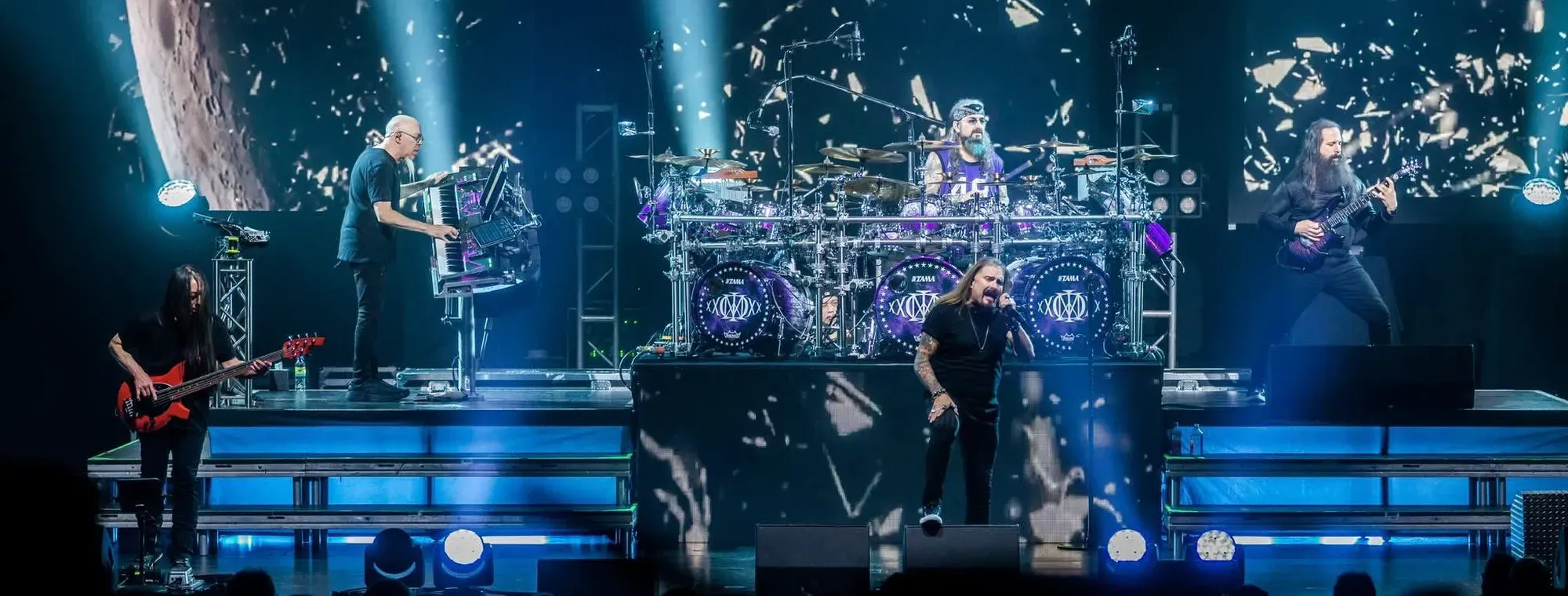
Originally published in Guitar Player magazine · February 2012
Drama King
InterviewJohn Petrucci20 min read
John Petrucci, Dream Theater, And The Eternal Quest For Sonic Gratification
by Jude Gold
When you pop Dream Theater’s new disc, A Dramatic Turn of Events [Roadrunner], into your computer, the genre classification iTunes assigns it is “metal.” But calling this dynamic ensemble a metal band is a bit like saying Moby Dick is a story about a fish.
Powered by volcanic guitar tones, assaultive riffs, stratospheric solos, and operatic vocals, Dream Theater’s music indeed delivers the classic staples of metal. But considering the band’s ambitious concept albums, epic song arrangements, strong classical leanings, time-morphing meter changes, and sophisticated harmonized lines, Dream Theater has more in common with Zappa than it does Zeppelin. Not only that, but as the band stays closely connected to its devoted fan base via online forums, meet-and-greets, and other media, its global audience is more like a community of Phishheads than a Metallica militia.
And yet, to grasp Dream Theater’s apparent musical contradictions and its lack of rock star aloofness, all you have to do is sit down with the band’s open and humble mastermind, John Petrucci.
As far as guitar wizards go, Petrucci is more than generous when it comes to revealing his spells. He is extremely accessible—even while in the middle of a world tour promoting A Dramatic Turn of Events (which debuted in the Top 10 in America, as well as in more than a dozen other markets across the planet). Dream Theater album and DVD sales long surpassed the ten million mark worldwide, but Petrucci seems as driven and hungry and approachable as an artist promoting a critical first release. Such energy is all the more amazing, considering that Petrucci and his longtime band mates—keyboardist
Jordan Rudess, vocalist James LaBrie, and bassist John Myung—are still coping with the departure of founding drummer and creative partner Mike Portnoy in 2010. More than 26 years after being formed at Berklee College of Music, it’s a new era for Dream Theater.
Mike Portnoy has left the band, you have a new drummer, and you’re now the band’s sole producer. How did this all go down?
I don’t like to speak for Mike. The reasons for his leaving are things that only he can address. But from my perspective, he got to a point where he wanted and needed to change musically and professionally. It was difficult and heartbreaking, to say the least, but that was over a year ago. Since then, we not only have a new drummer, Mike Mangini, but also a new studio album and a new world tour. To be where we are right now is pretty incredible. At the time when Mike was leaving, picturing us being here was difficult.
The split must have been pretty stressful.
Absolutely. We were not only bandmates for 26 years, we were also business partners, so there were a lot of details to work out that took a lot of time and attention. It’s not something that’s easy to go through or overcome—especially when you’ve been together that long. And Mike definitely worked hard. He was the big face of the band out in the public, and that level of presence and involvement is something all of us have needed to increase since he left. We needed to take over some of the things he did, but doing so was just a matter of having discussions, making decisions, being organized, and restructuring.
How was the experience of being the sole producer of a Dream Theater album for the first time?
It was incredible. Producing is something I love to do. Mike and I began producing Dream Theater albums ourselves in 1999, with Metropolis Part 2: Scenes From a Memory. Now, without Mike, there was really nobody I was required to bounce things off of. I was able to bring my thoughts, inspiration, and direction to life exactly as I envisioned them. But it wasn’t like, “Mike’s gone, and now the shackles are off.” I’ve always had creative freedom. The way I’ve written and arranged music for this band has been the same since the beginning. I’m a strong musical force in Dream Theater. In those regards, my role hasn’t changed much.
In one of your biggest production decisions, you brought in a true heavyweight to mix the album.
Yes. I’ve wanted to use Andy Wallace for years and years. There was a period when I would hear something on the radio, or pick up an album, and think, “This sounds amazing,” and it would always be Andy. Whether it’s albums by Nirvana, Chevelle, Slipknot, Linkin Park, Jeff Buckley, or countless other bands, I have always loved his work. When we reached out to him, and he said he was interested, it was a dream come true.
What was interesting about the way he mixed your record?
Andy’s mixes are very alive. It’s striking how much time he spends on details. There are so many mix moves going on, yet, as you’re listening to the music, you don’t even know they’re happening, because he’s making the music dynamic and allowing it to breathe the way it was meant to when you wrote it. The biggest thing I learned from him is to constantly strive for a balance that’s musical, so the songs never sound static.
How does that level of detail pertain to guitar parts?
He really rides guitars in the mix, pushing them to make dramatic parts even bigger, or pulling them back to feature other instruments. It’s not like he goes in there and carves out major EQ curves or anything. That’s because when I’m tracking with Paul Northfield—who engineers our sessions—the guitar sound we’re getting is already the ultimate sound. It’s exactly what will end up in the mix.
What guitar and amp did you use to get your tones?
On the whole album, I used my signature guitar—the Music Man JPXI. This guitar came out in 2010, and the XI signifies me being with Music Man for 11 years. I also used a 7-string JPXI. The amp I used on basically the entire record was the Mesa/Boogie Mark V. It’s a three-channel amp, so I’m able to get everything I need out of it. All the clean stuff on the record is Channel 1. All the heavy guitars—which constitute about 90 percent of the guitar sounds on the album—were tracked using Channel 3 in Mark IV mode. Everything was played through a Mesa/Boogie 4x12 Rectifier cabinet loaded with Celestion Vintage 30s. That’s it—really simple.
The new record sounds exceptionally clear and dimensional.
Good! A lot of that is certainly Andy Wallace’s genius mixing, but a big part of it also has to do with the arrangements. We purposefully avoided over-orchestrating, so you can really hear what everybody is doing. We’ve learned that all those parts you add don’t make the sound bigger—they can actually make the sound smaller.
What amp settings did you use for solos?
One cool thing about the Mark V is that you can put Channel 3 in IIC + mode. The IIC+ is an amazing, classic Boogie amp, of which I have several. It has this liquid-y, creamy sound that’s great for my style of playing. I even brought some IIC+’s into the studio, but when I compared them to the Mark V in IIC+ mode, the Mark V kicked their butts. So I ended up using the Mark V in that mode for all of the solos. There are no overdrive pedals on the album. It was recorded using just the guitar and a Mogami instrument cable straight into the amp.
I think one mistake guitarists make in the studio is using too much gain, so on A Dramatic Turn of Events, neither the lead sound nor the rhythm sound arc overly saturated. For the solos, the gain was probably set at one or two o’clock. The thing about using less saturation, though, is you have to work harder. You’ve got to be way on top of your technique. All your picking nuances have to be precise. When you’re doing any sort of legato runs or tapping parts, there’s no extra-squishy gain or pedals or wah-wah or anything to hide behind. You’ve got to have your technique spot on. That’s what all the practicing is for.
What’s a good example of your less-saturated solo tone?
Check out “Lost Not Forgotten.” Andy Wallace mixed that solo perfectly, letting the guitar really soar above everything else. Another reason that solo sounds so clear is that there’s no rhythm guitar to distract you. The guitar solo is the total focus of that moment.
Do you have specific microphones you like to use to record guitars in the studio?
Going into the sessions, I said to Paul, “Obviously there are tried-and-true tracking methods such as running a Shure SM57 through an API or Neve preamp, but what’s the latest and greatest? What are people talking about?” So he brought in a whole bunch of gear, and we ended up going with a Shure KSM 353 ribbon mic blended at equal volume with a Shure SM57, and both mics running through a Shadow Hills Equinox microphone preamp. From there, it was straight into an SSL mixing board, and then into Pro Tools. That’s the guitar sound.
How did you approach your rhythm sounds?
For rhythm parts, I would track one performance, double it, and then pan the takes left and right. That’s how you get that big stereo guitar sound with no phasing problems. People try to get a good doubled sound by just recording one performance and putting a doubler effect on it, but I feel that’s not as effective as actually playing and recording the same part twice. Even though you’re playing the same notes and rhythms both times, the slight differences between the takes make for the wide spread, and that’s what creates that huge stereo image.
Speaking of multi-layered parts, how did you track the intro to “ On the Backs of Angels’?
I had been wondering how the album should open. What would be the first thing people hear when they’re introduced to A Dramatic Turn of Events? So I had this idea of doing something à la Pink Floyd’s “Welcome to the Machine”—something with a dark vibe that would set up the album right. I ultimately decided to double-track the clean electric part, but one track is dry, and the other has a Boss Phaser on it. The idea of having an effect on only one side of the stereo spectrum came from playing through a Roland JC-120. When you slip on that amp’s chorus effect, it’s actually only applied to one of the two speakers—which creates that classic JC-120 stereo sound. Similarly, I double-tracked two Taylor acoustic parts in different ways—one strung standard, and one strung in Nashville tuning to give the song that 12-string vibe. In each case, I panned one track hard right, and the other track hard left.
You’re known for having some pretty elaborate stereo stage rigs. Do you ever head down to the local blues jam and just plug straight into a one-channel combo?
I’m sure that would be fun, but, no, I’ve never done that. Jamming was a big part of how I developed my playing when I was younger. Maybe I was just lucky, but in the neighborhood where I grew up on Long Island, there were tons of bands jamming in every different style. We may have all sucked, but, at the time, we thought it was the greatest thing in the world. At one house we’d be playing blues, Hendrix, Stevie Ray Vaughan, and Grateful Dead. Then, we’d go down the street and play Scorpions and Black Sabbath and stuff like that. Jams are great. When you get into those circumstances, you find out a lot about your strengths and weaknesses as a player.
Do you have a little living-room rig you like practicing through?
I have rigs all over my house. There’s a Boss eBand in the office, a Roland Micro Cube in another room, and a Boogie Mark IV combo by my piano. Next to that is a Boogie Subway Rocket that is perfect for jams. I’ve got Boogies downstairs in the basement, as well—including a full Rectifier rig for my wife, Rena, who is also a guitarist. There’s another eBand up in the bedroom. I could go on and on [laughs]. In the studio, there’s a Fractal Axe-FX. I used that a lot for our demo sessions. Fractal had come in earlier and modeled the sound of my miked-up Mark V—which was very helpful, because the Axe-FX is a very simple way to demo songs without cranking up an amp. Everybody else was going direct during the writing process, as well. I was also programming drums in Logic using Superior Drummer. Then, we would send finished versions to Mike Mangini to absorb and learn so he could come to the studio fully ready to track drums.
Do you use the Axe-FX live?
Yes. I usually run two Mark Vs in stereo, and the only processor in the rack is an Axe-FX II in the effects loop. It handles four different delays, a chorus, and a harmonizer. I also have a satellite pedal board in front of the amp for different stompboxes we like to throw in there.
What stompboxes are you using?
There are MXR EVH Flanger and Phaser pedals—though I used the Boss Phaser on the new record. I also have a slot for an overdrive, and that pedal constantly changes. Right now, there’s an Analog Man King of Tone in there. Sometimes we use an Analog Man-modded Ibanez TS-808 Tube Screamer, or a Robert Keeley modded TS-808 or TS-9. We use whatever we’re in the mood for—provided it sounds great, and is transparent enough that it doesn’t negatively impact the great Boogie sound. I also use an Ernie Ball volume pedal quite a bit, and the Dunlop Cry Baby rack wah is a staple of my rig. It gives you a ton of EQ possibilities, so you can get any type of wah sound you want.
Do you move around the stage a lot, or do you stay in your zone?
I move around a bit, but I’m on a cable, so I can only go so far. I prefer the sound of a cable over being wireless. Also, our songs have a lot of changes, so I need to be fairly close to my pedalboard.
A lot of guitarists at your level have their techs switch effects for them during shows.
My tech, Maddi Schieferstein, is amazing, and he is certainly capable of doing that. Or, we could automate effects changes through MIDI. But we don’t do any of that because I like switching my own effects. I like to drive the vehicle.
Who is one of your favorite non-guitarists that you listen to for musical inspiration?
I love Peter Gabriel. I’ve always been a major fan of his songwriting, his impact on music, his arranging and recording approaches, and, of course, his voice.
In the past, you have likened certain aspects of playing guitar to doing push-ups. Where do the calisthenics leave off, and when does the music begin?
Whether somebody is born with a talent for songwriting, or is gifted on a certain instrument, pure inspiration is certainly a huge part of being a musician. But, beyond that, I’ve always felt that craft is an even bigger part of the picture. You can be gifted with natural ability, but you need to develop that ability in a very methodical and consistent way. It is similar to athletics, because even the greatest, most gifted athletes have to develop their talents. Whether you’re a drummer or guitar player, there’s no getting around the physical aspects of playing any genre of challenging music. That physical maintenance of keeping your fingers and hands in top form is a huge part of being able to play complex guitar music, as well as making the stuff you hear in your head come out of your fingers.
What do you think of those You Tube spoofs—like the one someone did about your instructional video, Rock Discipline?
[Laughs.] I think they’re hilarious. Whoever does them is hysterical. There’s another one I love that’s a spoof of Joe Satriani, Steve Vai, and I doing a soundcheck on the G3 tour. At one point I say to Joe, “ I shall rip out your heart and feed it to the dragons.” I fall off my chair laughing every time I hear it.
Who are your buddies among your guitar-playing peers? Who do you email with, trade notes with, and talk shop with?
Joe Bonamassa, Steve Lukather, Rusty Cooley, and Steve Morse. But I probably interact with Steve Vai and Joe Satriani me most. They might send me their latest pedals to check out, or we might talk about anything from delay times to business matters. They’re both great for bouncing opinions and ideas off of.
What kind of business issues does a modern-day prog-guitar hero deal with regularly?
Everything, really. Many musicians don’t become hip to the business side of things early enough, so I always recommend getting experience with that world as soon as possible. If you’re going to be a pro, you’re going to be dealing with record labels, publishing, merchandising, management, and all kinds of contracts. Situations you get into early on may affect you in major ways further down the road, so you always need to know what’s going on.
What is your advice for up-and-coming artists who are designing their first signature guitar, or getting deals for other gear endorsements?
The number one thing is that if you’re going to have your name on it—or be associated with it—it needs to be something you stand behind and use because it’s the very best musical vehicle for what you want to do. If you’re getting lots of offers, look at things carefully. I’ve been fortunate in that I’ve always played through things that I love, and professional relationships have stemmed from that. Everything that I use—Music Man guitars, DiMarzio pickups, Taylor guitars, Ernie Ball strings, Mesa/Boogie amps, Dunlop accessories, etc.—is perfectly suited for me. For example, I can’t remember ever not using DiMarzio pickups. Now, I am fortunate enough to have signature DiMarzio humbuckers of my own—the Crunch Lab bridge pickup and the Liquifire neck pickup. All my Music Man guitars come with those pickups.
What are some of the things an artist should expect from their first endorsement deal?
It varies depending on the size of the company. You might get anything from discounted or free gear to royalty compensation. But whether it’s an endorsement deal or a record deal or a management agreement, make sure the contract is not for too long, and not all encompassing. By the way, I should mention that most of my endorsement relationships have never involved any contracts. For instance, with Ernie Ball/Music Man, it was a handshake with Sterling Ball. Twelve years later, we’re going stronger than ever.
You’ve been a pro guitarist for decades. If you could go back in time, knowing what you know now, what things might you have done differently?
There are a couple of haircuts and outfits I wouldn’t have worn—that’s for sure [laughs]. I guess the biggest thing, though, is that when you’re young, and you have a very specific and driven focus to make music a part of your life, it’s important to take advantage of all the time you have to pursue that goal. You won’t always have that time. I practiced up to six hours or more per day, and I went to Berklee College of Music straight out of high school. I took every step I could.
One opportunity young players have now is the ability to record so easily. Now you can document what you write, and develop the craft of composition at a much younger age. I’m not saying that if I could go back, I would have written more, because all I did back then was write and play guitar. But if I were getting started right now, it would be smart to develop my recording and composing chops in tandem with my guitar skills.
Also, there are certainly business things I would have done differently. As a young guitar player, I had no real concept for contracts and legal agreements. When you’re hungry and start getting offers, you might sign things that you don’t really have a handle on, or know all the repercussions of. You don’t want to be an idiot who is great at guitar, but who knows nothing about publishing, songwriting, management, or any of the other things that go along with making music a career.
Now that you’ve been touring for 25 years, what do you still love about it, and what are some of the drawbacks?
The only real downside of being a touring musician is being away from your family. That’s a major sacrifice. I have a wife and three kids. When I go on tour for weeks and weeks at a time, it’s difficult for them, and it’s difficult for me.
The pluses are too many to count. Perhaps what I look forward to the most each night is the sonic gratification. The rig sounds so good! We use in-ear monitors, so when I go out onstage with my Music Man plugged into those Boogies with this great stereo effects system going, it’s just so sonically satisfying. It’s like a drug. When I’m not playing, and I don’t have that experience, I go crazy. I go insane on days off. I like to play.
Box
A Lick from “Outcry”
Transcribed by Jordan Baker
Few Dream Theater guitar passages more spectacularly exhibit Petrucci’s passion for scales than the neck-spanning 7-string break on “Outcry” from A Dramatic Turn of Events.
“This example employs the harmonic major scale that I was turned on to recently by John Flynn,” says Petrucci. “It’s simply a major scale with a ♭6. John pointed out I had unknowingly used the scale before on my solo album [Suspended Animation] at the end of ‘Damage Control.’”
In the key of B—the key of this excerpt from “Outcry”—the harmonic major scale is spelled B, C#, D#, E, F#, G, A#, with G functioning as the ♭6. If you don’t have a 7-string, simply start at bar 2 to grok the rising scale sequence, as it repeats an octave higher with each new barline (through bar 4). In the climactic final bar, pick sweeps and tapped notes help you reach the finish line. – JG
Box
Dear John...
Questions from Students at Musicians Institute, Los Angeles
Why are you so forthcoming? Why do you teach so much and share everything? – Nygil Hoch
I started teaching pretty early on to make a little extra money, and I guess I got into that sharing headspace at a fairly young age. Maybe that set the tone, and it carried over into my professional career. I just love to share things, and tell people what I’m doing. The more guitar stuff that people know, the better.
Why do you sometimes tune down a whole-step from standard? – Adam Virden
The obvious reason for doing that—such as on “Lost Not Forgotten” from the new record-is that when your guitar is tuned down, and you’re playing through a distorted amp. it sounds that much heavier. This is of course. why you have guys playing 8-string, 7-string, and baritone. I love the sound Chevelle gets playing a bari tuned down to B♭. The less obvious reason, though, is that detuning your guitar gives you new tonal centers. A lot of guitar players write riffs around E and A and other keys that are natural for guitar. But when you tune down. you can shift things to a new key, and, for example, make D the tonal center, which creates a wholly different musical mood.
Which techniques do you practice each day when you first pick up the guitar? – Tyler Clark
I think the most valuable exercise on guitar is playing scales, and it’s probably one of the first things I do. There are tons of tricky little finger gymnastics and drills that you could do, but just playing scales on the guitar in different octaves—and in different forms—is probably the number one best thing for developing synchronization between your hands. Plus, running scales greatly improves your knowledge of the fretboard.
You’re such an accomplished player already. What motivates you now? Are there still parts of your playing you are striving to improve? – Philippe Trottier
I am always trying to improve. I never rest on my abilities. We’re in the middle of a world tour right now. and getting out there and trying to perform and play my best every night is always my number one goal. I always want to step up my level of performance, and offer some thing better to the audience each night. If there’s a difficult passage, or a hard solo, or a sequence of notes from the record that’s tricky to play, I want to be consistent with that live, too. So in order to do that. I have to look at my technique in detail. A lot of it stems from my picking hand. I am constantly honing in on little things and perfecting them—whether it’s my thumb moving when I don’t want it to or picking with the wrong part of my arm when I get nervous.
What are you feeling when you play difficult parts, like those on “The Dance of Eternity” (Scenes From a Memory)? Are you concentrating on technique, or are you just enjoying the music and having fun playing? – Lenny Pietrolata
I definitely try to enjoy it. When I’m playing live, my mentality is that I’m performing, and that it is no longer about me, it’s about the audience. It’s about people’s experience watching Dream Theater. So the most important thing is that I enjoy it—that I enjoy the sound, enjoy what’s coming out of the speakers, enjoy how the guitar and my hands feel, and enjoy people’s reactions and the energy they give back to us. Musically, whether the lines are complex or simple, the melody is what joins everything. People often ask me. “How do you remember all this stuff? Your songs are so complex.” I focus on the melody. The melody notes are what lead me through. Always.
Back in the ‘80s, you were really into Al Di Meola and other players of that era. Who do you take inspiration from now? – Cody Biller
Shawn Lane is a big influence I got into later, and I also love Tommy Emmanuel. Shawn, unfortunately, is no longer with us, but both those guys are monsters, and they are so inspiring when you hear them play. One place where I get turned on to many other guitar players is my own website, johnpetrucci.com. People are always posting cool things there in the forum. For example, it’s the first place I heard about Guthrie Govan, Rusty Cooley, and Andy McKee. There’s a group of guys within that forum community who are monster players, too, such as Andy James, Andy Wood, Tom Quayle, Martin Miller, and Rick Graham.
When are you going to do a follow up to your Rock Discipline videos? They’re some of the best instructional videos out there. We need the next batch. – MI Instructor Ken Steiger
People ask me that question a lot. It’s probably the second-most-asked question behind, “When are you going to do another solo album?” Rock Discipline was obviously a while back, but, given the amount of time, energy and dedication that Dream Theater takes, doing a follow-up instructional video is simply a matter of finding the time to organize and do it. It’s something that I’ll definitely do—I just don’t know when.