

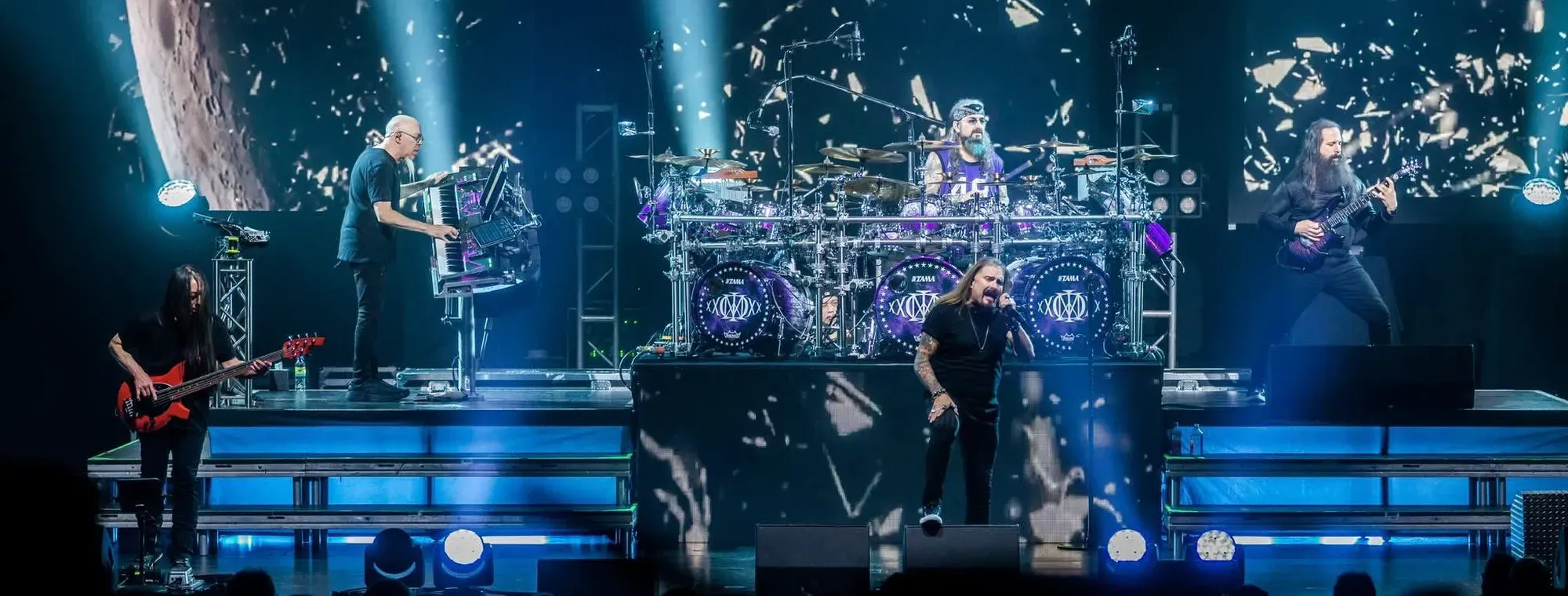
Originally published in Bass Player magazine · February 2012
Deus Ex Machina – Dream Theater’s John Myung Takes Another Dramatic Turn
By Freddy Villano
InterviewJohn Myung6 min read
It’s two hours before Dream Theater is set to hit the stage in New York City, and John Myung is nowhere to be found. It’s not because he is avoiding the PR duties often associated with musicians of his stature. It’s because he’s woodshedding like a madman, running up and down his 6-string neck just like he does before every Dream Theater show, a ritual and warm-up routine that helps the soft-spoken bassist prepare for the band’s high-energy, technically challenging performances.
Last year, Dream Theater made headlines when longtime drummer and founding member Mike Portnoy left the band. This year, though, the music is doing the talking. A Dramatic Turn of Events [Roadrunner, 2011], recorded with new drummer Mike Mangini, features a collection of songs that run the gamut from melodic to mathematical, and Myung’s playing is simply jaw-dropping. With his stellar bass breaks in ‘On the Backs of Angels’ and ‘Outcry,’ melodic flourishes on ‘This Is the Life,’ and now-signature use of Moog Taurus pedals, Myung is once again putting his Berklee-honed chops to good use.
As if Dream Theater weren’t enough to keep him busy, Myung also recently recorded Shall We Descend, the latest from his side project the Jelly Jam, featuring King’s X guitarist Ty Tabor and Dixie Dregs drummer Rod Morgenstein. If there’s one thing that has come to define John Myung over the years, it’s a dedication to craft – and his continuing evolution as a player remains a testament to that fact.
Have you changed your approach to better fit Mike Mangini’s drumming?
No, not really. I’ve just gotten adjusted to his energy. The most important thing about Mike is that everything he does is musical, and he gels really well with the band – that’s the key component.
How do you put together your bass parts in the studio?
It’s sort of like when you’re building a big puzzle – you know the piece is in there somewhere, but you need to dig through all the different pieces until you find something that might fit. There’s always a moment of wondering, “Well, where to go from here? What’s going to happen now?” Sometimes, it’s just a normal sequence of events that builds structure, and other times, it’s something that charges the song, like a vibe or feeling – and that conversion of emotion into the song is what makes it what it is. It’s great when it works out and takes the song to a new level.
In ‘This Is the Life,’ you do a tasty fill at 1:30 in direct response to James LaBrie’s vocal melody. Was that improvised or orchestrated?
I heard that motif as I was recording. When we’re tracking, I bounce ideas off Paul [Northfield, DT’s engineer]. There are moments during the overdubbing – or during the actual tracking – that the parts actually develop. That was a moment that developed as I was tracking, not as we were writing.
Your tone on A Dramatic Turn of Events has a very grinding yet natural sound.
A lot of that has to do with the valve preamp I was using. James Demeter was inventorying his place, and he came across enough parts to build a valve pre that he once made a long time ago. It’s the VTMP-2B, the same one Quincy Jones used to record Michael Jackson’s Thriller album. It’s like the ultimate DI – I love the way it resonated and warmed up the tones, so I tapped into that. It made a big difference.
You also had some input into the development of the Music Man Bongo 6-string that you’re now playing. What impact did that have?
We went through a few variations. One big improvement was adopting a larger 6-string body style with a 5-string-size neck. The bigger body lends itself to better sound; a thick, heavy body just has a special tone. So I ended up with the best of both worlds. I think the Demeter DI, plus having an awesome bass that was really dialed in, made a big difference.
I hear distortion, too.
I had four tracks in total. One was a Mesa/Boogie Triple Rectifier going through a 4x12 cab for guitar-like overtones. Then I had two other Demeter 2x12 bass cabinets with 8” crossover speaker configurations that were capturing different mic flavors, including a Mojave MA-201fet bass drum mic. There was plenty to work with. But you can always hear the true sound of the bass and the way it was resonating.
What’s the trick to remembering a ten-minute song with multiple time changes?
If I play something enough, I eventually get ownership of the song through physical memory. I tend not to count things much – that’s distracting for me. For example, there could be something that’s felt in triplets, but I’m not really enunciating the triplets; I may just be playing even fours that don’t follow though all the way, rather than counting it as groups of three. Or, if there’s a 7/8 rhythm and an 8/8 rhythm for a total of 15 beats, sometimes it doesn’t matter to me if I count the 7/8 first or the 8/8 first.
Who inspired your use of Moog Taurus pedals?
Whenever I would see Rush or Yes live and the bass pedals would kick in, I always loved their power, the impact, and the energy. There’s nothing like being able to have that sort of harmony going on in the low-end range. I used them in the chorus of ‘Breaking Illusions,’ the ending of ‘Outcry,’ and in the intra and chorus of ‘On the Backs of Angels.’ It adds an awesome dimension.
What inspired you to begin playing 6-string bass in the early ‘90s?
I recorded the Images and Words album [1992] with a Spector 4-string, and after the album was done and we were about to go on tour, several companies approached me about using their instruments. I started checking out 6-string stuff and taking to it. It made sense for me to venture into that world; it gave me more options. The two extra strings lend themselves to a more creative, chordal type of playing.
Did you go straight from 4 to 6?
I just dove in and started creating exercises to get my hands used to the 6-string. It was definitely strange at first, but once I got warmed up, it wasn’t so foreign anymore. We went straight into writing Awake [1994], and a couple of songs stem from that instrument – the harmonics in ‘Lifting Shadows Off a Dream’ were inspired by the 6-string. That album represents the transition from 4-string to 6.
What’s your practice regimen like these days?
I’m working with small trill movements using three right-hand fingers and all four fingers on the left. I have a set pattern in one position, and then I just move it up a half-step each time I do the routine. It usually takes an hour and a half to go fully up the neck. That’s pretty much what I’ve been doing for the last couple of years. A consistent, gentle trill movement over a period of time seems to really lock my hands into place and gets me into a frame of mind where I can direct my hands a little more rather than having to ask them. They listen better.
What advice do you have for developing one’s musicality on bass?
Identify where you want to go musically, and embrace cool musical values from the past. Understanding the feeling and musicality of Bach’s cello pieces, for example, can be great building blocks for future compositions. The Bach cello stuff is unexplored territory; he was one of the only guys who really understood the range of the bass. All his cello pieces are right in the 5-string bass range. I have a whole collection of Bach stuff and interpretations; it takes six to eight months to get one of the heavier ones together, and that’s going at it every day. For me, as a player, there’s no lack of things to do. There’s only a lack of time and energy.