

Originally published in New Voice fanzine 13-14 · October 2009
Sound Chaser: iPhone, Bebot & Beyond
InterviewJordan Rudess16 min read
Manchester, UK
9 October 2009
After a flying visit to Leeds to see Porcupine Tree the night before, we sat down in the lobby of Dream Theater’s hotel in Manchester to talk all things technology with the Wizard himself!
RP: Now that you’ve been in Europe for a couple of weeks, how have things compared with the Progressive Nation tour in the US so far?
JR: Well, it’s certainly a lot more exciting because the audience is really happening here. I mean the US was great and everything was fine, except for the fact that the people sometimes seemed a little sleepy. For whatever reasons, the economy, maybe that particular Progressive Nation lineup (although I thought it was cool) – maybe it just didn’t resonate with as many people. When we got to Europe it was like “A-ha! Okay! This is what it’s all about!” We played a couple of shows and felt good about ourselves again.
RP: So far you’ve played three different types of show supporting Black Clouds & Silver Linings: headlining shows, festivals and the two Progressive Nation legs. What do you consider to be the advantages and challenges of each type of touring you’ve done?
JR: Okay... Well, one of the nice things about Progressive Nation is that there’s a little bit more time during the day to do different things, such as walk around and meet with friends as we don’t usually play until later. There’s also a lot of flexibility in our schedules which is really nice. The festivals are always kind of wacky because there is a different situation every day – you could be camped out in some weird little trailer and it could be pretty horrible or it could be okay. I think the festival thing is cool if you like hanging with the other rockers, but that’s not really my thing as much as it is for some other people (as you know). So it can be challenging but fun! When you go to the bigger festivals, such as Download, it’s exciting and it’s a big deal. There’s a big buzz even though it’s crazy and you have to deal with the scale of it. Then when we’re doing our headlining shows, that’s more in the middle of those two extremes. When we came and did the headlining shows in between the festivals last time around in Europe, the only thing that was weird was that we were in the middle of the festival run and we weren’t totally in the spirit or groove of doing our own shows. The idea was to fill in some space between the festivals with some headline shows, although it is better when we are on a consistent run.
RP: Are there any highlights for the band or for you personally during this tour so far? Is there anything in that stands out in particular?
JR: Erm... I really look forward to dinner! [laughter] More seriously though, from this particular run, I really enjoy the European shows because unlike others, I like to get out a lot and go from place to place, checking out the vibe and the people. Basically I can wake up and walk around.
Like today, I had to do some stuff for the video that we’re doing. I was walking around with the video team and we ended up in Chinatown. That’s the great thing about travelling as you never know who you are going to meet or what you’ll end up doing and that’s the cool part.
RP: While we’re on the topic of videos, what inspired you to start doing your YouTube videos?
JR: Originally, I was talking to my manager Frank about the idea of capturing video when we went to Moscow and Tel Aviv. He suggested that I get into that mode – usually I am the one who comes up with things like this. So when we started touring he suggested it would be really great to capture some video of those places. I had never been to these places before, so I thought that it was a really cool idea. So we arranged to get this camera and film the whole thing. I shot a bunch of video from Moscow and some more from Israel. Nobody has ever seen that video and there are reasons for that (partly hard drive, partly record company planning), but it will come out one of these days and should be fun for everybody to watch! So I got inspired by that. Then the new version of the iPhone came out and, being as into technology as I am, I had to have it the day it came out. The new iPhone has the ability to not only take video, but also post directly to YouTube, which makes my life incredibly easy. Often at the venue there’s a wireless router so I can hook up my iPhone and I’ll have a video up online of us taking a bow on stage before Mike is even in the shower! It’s pretty crazy how this has all opened up and how easy it all is. So that is how it started and now I walk around with my iPhone in my hand all the time!
KP: So how do you decide what to film and choose what to share on the internet?
JR: Well, some things are easier to capture than others like at the end of the night when I’m done playing where I can take my camera and film the crowd. I think it’s cool to document the crowds because the vibes are different in each country. I grab my camera at the end and people really look forward to it. Sometimes though certain people in the group aren’t that thrilled to have a video camera in their face all the time and this sometimes makes it hard. As a band member, I don’t want to be always bothering them with that. My hope is to do it sensitively although I’m not personally someone who is that relaxed with a video camera in my face either! Whilst I would be okay with it, it always makes me feel a little self-conscious. That being said, I try to capture the things that I can, so if a funny thing is happening, I will be there with my camera filming it.
KP: Are there things that you have shot that you didn’t put on YouTube?
JR: Yeah some things that are not appropriate [laughs] but I guess those are the things that you wanna see!
KP: Do you see any of the comments that people are making in response to the videos on YouTube?
JR: Yeah, some of them. It has really caught on and there are a lot of people making comments now. I just posted one of me in Chinatown moments ago and people are watching that as we speak. Originally I had it set up so that when people commented it would go direct to my email but I was missing a lot of other emails from people that I really needed to hear from, like you! [laughter] They’d tell me that I never responded to their email and I’d explain that it was probably lost in the 500 different YouTube comments. So yeah, I’ve seen some of them, but I’ve had to relax a little bit on that.
KP: Still on the iPhone, you’ve now got its sibling, the iPod touch, as part of your rig. How did you find out about Bebot? When did you think that you could use this in the studio and then decide to bring it out on tour?
JR: Since the iTunes app store opened, I have become incredibly Interested in the things that are happening. The very first things that people were doing were really interesting. So at the beginning of this journey I discovered this program called Bebot, as it was one of the music applications being offered. These musical applications are pretty cheap in general. Being as interested as I am in this, a dollar or two here or there is not a big deal, as it is something that I’m involved in and really want to know about. So when I saw Bebot, I thought it was really cool because it reminded me a little bit of the Continuum. It’s similar because you have a touchscreen, and on the touchscreen there’s a grid and you can choose whatever scale you want and then you slide your finger from point to point to create the sound. It can also go from left to right to create a pitch, and if you move your finger in a vertical direction, front and back, you can change up the volume.
It is amazing that there is such an expressive instrument on the iPhone. I called Russell Black, the programmer of Bebot, who has become a friend of mine, as I had some ideas to make it an even more serious instrument. My contribution to him was the ability to do pitch correction on the slide. A violinist would start on one note and move their finger to the desired destination note – very often you stop your finger and thank God for vibrato, because you don’t know if you’re going to be exactly on the note or not. Yet when you start doing vibrato you can hide the fact that maybe you were not exactly on the spot that you were aiming for! So unless you are Itzhak Perlman or Yehudi Menuhin, the chances are you’re not going to be always doing it right. When I began to play Bebot originally I loved it, but when I started to slide, it was such a small screen that I couldn’t always get my finger quite on that line. So I didn’t feel like I was really playing it in a musical way. I spoke to Russell about it and now we have what we call the grounding of pitch – autotuning. When I was in the studio, I was in a big whirl, because that’s when all these modifications happened and it has such a wild sound. I was showing Mike and he said “Oh man! We gotta use that!” Mike is really supportive of my technology and all the crazy things that I do with it. We were doing ‘A Rite of Passage’ and I was doing my lead and we were in the studio feeling upbeat and a little wacky, and I got out Bebot and did this ‘Whack’ solo. Mike has some video somewhere of me laying that down.
RP: You’ve also designed an app as well – do you want to tell us a bit about that?
JR: Sure. The one that I have designed is called JRHexatone and it is very different from Bebot. I’m not using it live as it is a sound sequencing environment and it is pretty cool. It’s based on a hexagon and you basically input different rhythms and notes on the hexagon. It is really designed for people with an electronic music mindset (IBM, glitch, drum and bass) and you can do anything on it. If you are interested in electronic music then it is totally cool. You can programme a pattern and then start to randomize it and change it about a little bit, and even that part of it is programmable.
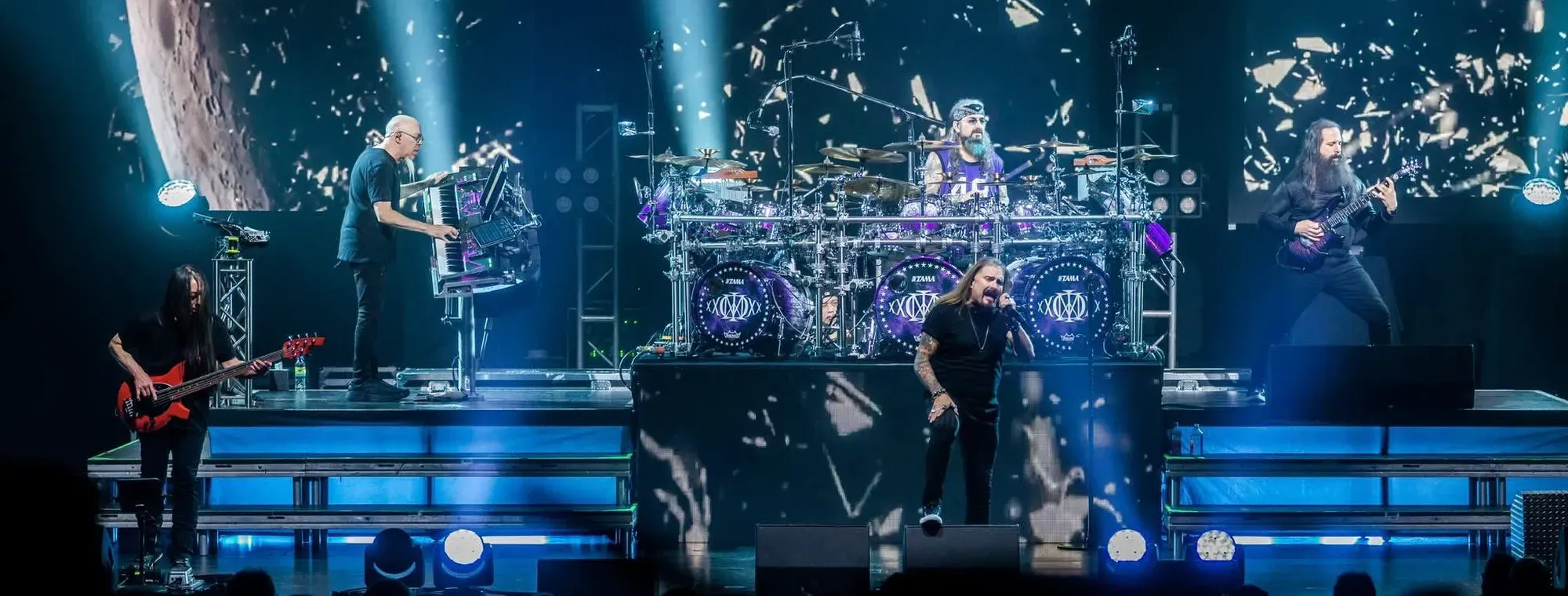
RP: In your live rig you’ve got a screen with a cartoon wizard character on it. How did that come about, and in the duet section, are you triggering the character’s parts?
JR: Dream Theater have had a couple of cartoons done over previous years designed by a Finnish guy called Mika Tyyska who does our animation. He originally designed the keyboard wizard character. We came up with this idea of having a character for each of us and Mika, being the talented guy that he is, put each of us in a cartoon form. With my cartoon character, we have been able to expand on it and use it in a lot of different ways. A couple of years ago I spoke to Robert Medina, an Australian guy who does our 3D stuff on screen. He brings all our album covers to life and does a lot of really great stuff. I mentioned to him that I thought it would be really cool if we could have the keyboard wizard character in 3D animation playing with me in real time. I thought Robert would think that I was being crazy but instead he said he could do that. We started to talk about the specifics, what it would look like, how it would react and what things it needed to react to, such as the pitch and mod wheels or the turning of the stand. So he was punching numbers and putting bits and pieces together and the next thing you know, he had sent prototypes to my PC. It is a really cool feature that is unique, unusual and special.
RP: Any other plans for the virtual wizard?
JR: Well, maybe we’ll take some contributions from fans to do that because we’ll have to pay Robert extra!
RP: Thinking about the whole tech side of things, your rig is pretty different now to how it was when you were first in DT.
JR: Yeah...
RP: Does having different stuff available to you have an impact on the evolution of your mindset over time? Are there things you’d have done differently back then if you had the gear you have now?
JR: Well, the live rig has always been a bit of a challenging and interesting thing to put together. What I use in the studio is very different to what I use live. I’ll use all kinds of stuff – new and old synthesisers as well as my own gear. I’ll borrow things that I want to check out or try if I think it would be cool – the control room ends up being very full along with my computer stuff. When it comes to playing live then a lot of decisions have to be made, and I have to figure out how I’m going to make all the sounds and recreate everything I did. I always do this to myself, creating these big challenges and then having to then figure out how I am going to make all the sounds on whatever I choose to play live. In the early days, I was playing a Kurzweil keyboard but they were looking like they were maybe in trouble, things were going down and the technology was changing. Even though I love my Kurzweil keyboards to this day, I felt like I had to start using something else where the technology was more modern and sophisticated, and where I had access to more support if something went down or we needed help whilst on the road. So I made the change from Kurzweil to Korg, which is who I am with today.
Other changes have come about too. On the last tour, I thought it would be really cool to have an instrument like a mellotron. I had a new instrument called a Memotron which looks like the top of a mellotron. It’s white and has the same kind of dials and it is very proggy. I had it attached to my main stand as well as this little rack thing that had a lot of blinking lights. This time around I could have used the same things but I decided that I didn’t want to push around a big stand with all this crap on it. I just wanted a lighter stand. So I got rid of them and put all the sounds inside the Korg Oasys as well – I just had to do some more programming so that the changes could happen.
Then, remember the big synthesiser with all the plugs and dials?
KP: The one you used for Dark Side of the Moon?
JR: Yeah. Well that one was pretty cool and I still have it... It was so big though and I felt bad that I had to ask my crew to carry that around, because once in the case, it weighed a few hundred pounds. So it was really heavy. Being the nice guy that I am, if I was having to arrive early or stay late at a gig and see what they were having to do to get my gear on the stage, my heart would sink. But it looked cool! So for this tour, I decided to get rid of that as I can make those sounds with other things. Instead, I got a video screen to do the animation thing. The old school Emerson thing is awesome for Keith Emerson, but as I am a technical kinda guy, I always want to be on the cutting edge. I thought it would be great to have a visual screen backing me that’s always changing and doing interesting things. So now, I use the keyboard wizard 3D thing and I also have a program called MIDI Live that I run with cool visuals. I met some very cool guys in Vienna that provided some cool visuals that happen when I play through the MIDI. These are nice replacements for that big black monster!
RP: What excites you most about new technology for your instrument?
JR: The sound! [laughter]
RP: Is there anything out there that you’d like to experiment with that you haven’t tried yet?
JR: Yes, I’m sure there are some cool things out there as technology is changing every day. There’s a new instrument that it seems everybody in the world is telling me about, including you guys! It’s called the Aigen Harp. Now I don’t know if I’ll want to add it to my rig, but I like things where people are thinking out of the box and finding creative and expressive new ways to make sound. Some of them are good, some are not so good. I think the Continuum is an important musical instrument as it is the kind of thing that will last for a long time. One of the reasons why is because it is very simple in a way and not snazzy with tonnes of features... It’s a very sensitive control strip and you can determine what you want it to send and that makes for a really great instrument. Maybe this Aigen harp thing is also really great... They’re actually coming out at Wembley to show me that instrument!
RP: Are there any musicians out there that are really influencing you at the moment?
JR: Well, I’m very influenced by what the electronic community are doing, people like Richard Devine or Tim Exile, who are people that our rock audience have never heard of! These guys are at the cutting edge of technology. They’re into things like sound installations where you can walk into a room and there’ll be a sensor in the wall that starts a sound, and if you move this way or that, there are other sensors that start another sound or create really interesting graphic connections to music like a 3D model on a screen, which you can move and sounds change along with it. These are things that really fascinate me, so if I can bring a little bit of that into Dream Theater then I feel that is a side of my contribution to keeping the band fresh, and if not for anybody else, then for me. The chance to use these other tools is always cool.
KP: So what’s next for you and what’s next for DT, in terms of tour plans and beyond?
JR: Okay, hmm, it’s an interesting time to ask me that question because at the moment, there’s only so much that I really know. The future is not that clear. I know that we’re definitely going to Australia and New Zealand for the first time in December, which is cool. I’m going to take November off to be with my family. After New Zealand and Australia, I’m not sure! I know that in the not-too-distant future I’ve got to start working on my next solo album. I really want it to be an album that mixes my electronic interests with my progressive rock side. I’m looking forward to putting all these things together and showing people another kind of progressive fusion! I’ll work on the solo album sometime in the New Year and then eventually we’ll get back in the studio and do some more touring!
KP: Rock Band Network – what do you know about it?
JR: Video games? Yeah, it’s when you prepare the song for people to play and a lot of bands are doing it themselves.
KP: Yeah, I think it has to come from the band...
JR: Well, we’re very aware of that. Actually, Chris Romero, who’s our main keyboard transcriber, has spoken to me about that and I’ve also spoken to our management about it, so everyone’s really aware of it. We’re just waiting for things to work out on a business level but we would all love to see it happen.
KP: The rumour was from Ryan Maziarz. (Tabs)...
JR: Yeah, he’s the other transcriber!
KP: There’s talk that you might do the entire catalogue. Do you know if that’s true?
JR: Well, nothing’s happened yet. It would be cool and if they could get the go-ahead then I’m sure they’ll be happy as it’s a lot of work! [laughter]
KP: So it is something that everybody is looking at and if it can happen it will?
JR: Yeah, for sure! Absolutely. I think it would be a really cool thing.
KP: Great! Thank you!