

Originally published in New Voice fanzine 03 · October 2005
Into The Wizard’s Lair
By Richard & Kerry Parker, and Tom Manning
InterviewJordan Rudess14 min read
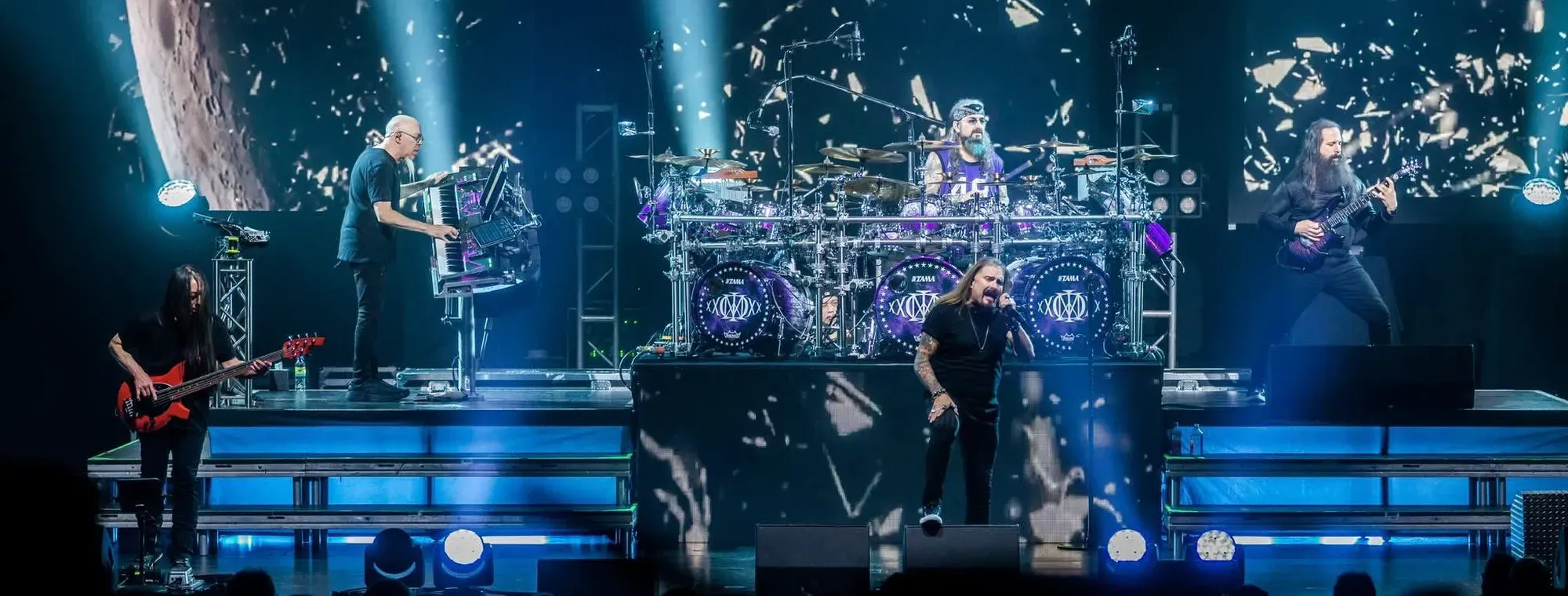
On Monday 24th October, we sat down with Jordan Rudess backstage at the Hammersmith Apollo before the first of Dream Theater’s two nights at that famous venue. Pressed for time with Dream Theater due on stage in less than an hour and a half, Jordan was gracious enough to answer all our questions fully, giving insights into his contribution to Octavarium, his recent changes in live setup and the Dark Side Of The Moon cover performance (due for its second and final performance the following night – its first having been in the Netherlands a few days earlier).
RP: Octavarium is woven together around a musical concept on several levels, could you explain that bit to the readers, was it a pre-planned concept or did it evolve as part of the creative process of the album?
JR: Yeah, it definitely came out of the process; we didn’t go into this album knowing that we were going to be creating what it is. We went in and started writing the music and towards the beginning Mike actually introduced this idea of having the album built around the idea of the octave. That’s when we started to think that, okay, well now we have some songs let’s make sure that each song is represented by a tonal centre so that the album starts in the key of F and basically goes back to F – all the songs, if you look at the piano, are the white keys, and the little interludes that are there are the black notes. So it was kind of shaped as we were going about it, up until the last minute actually when I was looking at the album artwork and fixing the key signatures and stuff like that.
RP: So that element of the creative process fed back into your contribution, influenced you as it was going along?
JR: Yeah, the more we worked the more content we’d gather and more things got thrown into it. Dream Theater has always been a band that not only makes music, but there’s a lot of things behind the scenes, a lot of conceptual things, lots of interesting thoughts and connections between the albums. Even though all this stuff is going on, I’m just trying to write some good music. I find out later from Mike “oh there’s birds here, and this is the spider and that...” and I’m like... [laughs]
RP: So does it also help in an inspirational sense in experimenting with new equipment and different sounds?
JR: Well, you know I’ve learnt how to play a couple of new instruments around the making of this album which was really fun for me. I was interested in learning the lap steel guitar. I’ve always been a big Yes fan, Steve Howe, those beautiful melodies on the lap steel, I’d love to play that, and I’d played some of that on the keyboard but for sounds like that you’d use a pedal and keys and it would kind of simulate the lap steel sound, I’d play melodies and chords with the left hand and I thought it’d be good to play the real thing so while we were out on tour with him a couple of years ago over the summer I studied what he was doing really carefully and kind of figured out what it was and asked him a lot of questions. So right before we started to record I bought one, I bought this old Fender lap steel in NYC and brought it in and showed the guys, I couldn’t really play it very well but I kind of had a feeling about it and Mike was especially enthusiastic about it, he likes new things, so with his support and with my enthusiasm and energy we put that in as part of the Dream Theater experience and now of course I’m using it on some other things as well, the older catalogue on stage. The other thing is my new Continuum, everyone is asking “What’s that thing you’re playing with the red surface or whatever...” This is like a fretless keyboard that’s the kind of instrument that I’ve been dreaming about for a long time, you can slide smoothly, or just play the notes. I discovered this instrument after putting the idea out that I wanted to play something like that. I started to actually design something with some Korean engineers, something similar to that, and then I found out one day that there was this guy who was making something and had been working on it for 20 years. You know what, we stopped talking to the guy in Korea, spoke to the guy who was working on this; he turned out to be this interesting guy called Lippold Haken. He’s one of these inventors, you know, creative people with an engineering background. The instrument is awesome.
RP: Tell us a little about the orchestration for Octavarium and your role in that.
JR: A guy named Jamshied Sharifi orchestrated it. He’s an old friend of mine who has a lot of experience with orchestras. He had to take basically my parts that I would flesh out on the synthesizer and write them out for the traditional instruments.
RP: So you started out with ideas on the synth similar to the Six Degrees type of thing and then he expanded from that?
JR: Yeah, I would call up an orchestral sound on the keyboard and just play it and he would be able to separate it out into violins, violas and this and that. Then he rook it a step further and he actually did some arranging, added parts here and there. He did a great job.
KP: So at what point did you say it’s got to be real orchestra?
JR: Well it was something that we had talked about as a group for a while. When we started this album, Mike and John were both really interested in pushing it through. From my perspective, I also wanted to see the band one day work with an orchestra, but I originally did think “You know what, maybe we shouldn’t really spend the money on it – I can really do that”. Torn is not really the right word, but I guess I was presenting the idea that we didn’t necessarily need (an orchestra) to make that sound, but it would be cool. So it actually worked out great, it’s a great sound and we ended using an old friend of mine and I was very happy using someone that I knew and had worked with in the past, so it was cool.
RP: At present, what do you feel about Octavarium as a whole? Do you have a favourite track or personal contribution?
JR: I think as far as the songs go, excluding the big epic track, my favourite track is These Walls. I like it because it’s Dream Theater in the sense that it’s kind of progressive, it has some different meters in it, it really flows, it’s really smooth and that appeals to me: being able to be progressive and kinda weird but at the same time have it flow.
RP: During the recording process, was there anything you listened to in an inspirational sense?
JR: Yeah, I was listening to some Radiohead, Coldplay, Muse and then in other parts of the process I was listening to Genesis, Pink Floyd. you know, kind of going back to certain roots and in some cases things that weren’t necessarily my roots but kind of an exploration; learning, (for example) analyzing Coldplay and what makes their style tick and what makes Muse’s style tick harmonically, where the chords go, how does it work.
RP: One obvious change for Octavarium in a live sense has been your setup this time round, your rig. Back in Austria in June, Bert (Baldwin – DT’s video and lighting director and formerly Jordan’s tech and assistant) mentioned to us that pretty much the only surviving element of your previous rig was the power supply...
JR: That’s probably true...
RP: Was it due to the experience of putting Octavarium together or did you feel that it was time for a change?
JR: Well, I’d been using a bunch of Kurzweil equipment and Kurzweil was a great company but they’ve been suffering a lot lately and not doing a whole lot of business. You know with a group like ours, playing all over the world, I can’t be in Poland or somewhere playing keyboard – what happens if it breaks down, I need some support with distributors in a lot of places. So a couple of things really: they weren’t really capable of providing support, plus the fact that I really wanted something a bit more high tech, newer, something that could accomplish my goals more simply. I really wanted to get back to the old days where the main keyboard parts that I played weren’t all spread out across lots of different rack units. Even though I used one keyboard in the past I also connected it to a lot of other things – so a MIDI cable would come out and when I played you’d hear that keyboard, but you’d also hear stuff from the racks. Sometimes I’d have some mystery come up and I would think “well which sound is that?”, or “what’s doing that?” or “what is that note that’s stuck?” It would be very challenging. There were other challenges too with the old stuff – before each show I’d have to struggle to squeeze in all the songs that we would play, because it was a programming nightmare. So I decided to make a big change and use this Korg gear. I’m using a Korg Oasys as the main thing – now I can play for six hours and it’s no problem at all. I can load all that I need to load in with the way it’s all structured, which is unbelievable. It makes my life a lot easier and my tech’s life much easier. I used to sit backstage programming until the last minute going “Okay, I think I squeezed the set in” or we’d have to load in the intermission. It was hard.
RP: In one respect you’ve gone very retro on this tour with the addition of that rather large 70s analog synthesizer unit. What is it, where did you find it, and how are you using it?
JR: Well I found it because this fellow who owns this company called Synthesizers.com contacted me. He makes his version of the old modular Moog synthesizer and he builds them so that they are true to the old Moog synthesizer, but with updated parts so that they’re very stable.
RP: So they’re more reliable?
JR: Yeah for sure – he wrote to me and in his letter he said basically “Jordan, I think that you’re one of the top keyboard players today, but your system isn’t complete until you have a giant modular synthesizer” and I was like “Well I have a lot of synthesizers”...
RP: But you didn’t have a big wooden box!
JR: [laughs} He said “I want to build you something cool and very special” so I was like “Okay, build away!” Then of course we got the idea to do the whole Floyd thing so I was thinking “perfect!” As a matter of fact, tonight (Mon, Oct 24th) I’m probably not even going to use that thing because we just dialed in the Floyd settings (for the following night) and I don’t want to re-patch it, it’s a nightmare! [laughs all round] That’s what I was doing before I came here: setting up patch cables. Next time someone writes me a letter like that I’m going to... [laughs]
RP: So was Dark Side of the Moon an album which had influenced you over a long time? Is Pink Floyd a core influence for you?
JR: Oh sure.
KP: We were saying earlier that Master of Puppets and The Number of the Beast aren’t so much your cup of tea.
RP: So you’re now doing an album where you’re not playing guitar parts.
JR: Yeah that’s good!
RP: About Dark Side of the Moon – Dream Theater’s version is a faithful reproduction of the original. How did you go about achieving the sounds for it?
JR: Well there was a lot of thought that went into the sounds. I mean, they’re simple keyboard parts, I’m not playing anything technically hard, but the challenge for me was that he’s playing a lot of organ and he plays a lot of piano and of course on the album he tracks them, but live I want to be able to play all of that so I’ve got organ on my left hand and piano on my right. Then there are a lot of background vocals and we have Theresa who’s here to sing some vocal parts, but also on the album there’s three women singing a lot of “Oohs” and “Aaahs” so I’m also doing that on the keyboard – there’s a lot of that stuff.
KP: And then there’s the beginning of ‘Money’ and the clock...
JR: Yeah, there are a lot of musical elements but also lots of sound effects. Some of them are being triggered by the front of house but all the spoken words are being triggered by me on my keyboard. Some of the voices we got from the Making of Dark Side of the Moon, some of them we didn’t get that way. I had a friend of mine called Jim Fife, who’s an actor, come in and do some of the voices that I needed, the ones I was missing, so we had a little session at home.
RP: In terms of your background as a classically trained pianist who went to Julliard, we sometimes wonder how you got from there to the very technically advanced background that you have now in terms of your equipment. Do you see the technology as being a necessary evil in expressing yourself or are you a diehard gear-head?
JR: I have a funny relationship with the technology actually, because, well, originally I was at Julliard studying lots of classical music and then what happened was that some friends brought over one of these older, smaller Moog synthesizers to my house. It had these panels with knobs and stuff, and I played it a little bit and thought “Wow, this is really awesome.” The idea of playing a keyboard and making all of these different sounds was very exciting. I wasn’t so much excited by the fact that it was technical, I was excited by the sounds.
KP: By the different means of expression...
JR: Yeah, the sound and the feeling of turning a knob and having it do that was very organic for me. It wasn’t like when you think of a computer, it was like everything you touched shaped the sound. I think ‘organic’ is the main word for describing how it felt. I ended up having a very close relationship with the Mini-Moog synthesizer – one where I didn’t have any idea technically what the technical writing above the knobs meant – I didn’t care technically. What I did care about was that when I turned that one it would go “Oaahwaaau” or I’d turn this one and it’d go “Owawawa.” So I knew every knob just by feel, every combination, every wheel and what it’d do to the sound. It wasn’t until later in my life with these musical instruments that I learned “Oh, a cutoff frequency means the filter, the filter means the harmonics, and LFO means low frequency oscillator” and it started to come together. My love for the sounds and the instrument that made them led me along the path to where I worked with Korg and Kurzweil. I actually used to go around teaching people how to use the stuff in the old days. It was this very gradual thing though. I was never really a very technical person – I was led into the instruments by a passion for the sounds and having friends that would say “Hey, you know that’s this” and kind of connecting the dots for me. Most people who work with synthesizers nowadays go to a music school and study synthesis or will study recording technique. My background was very much in the trenches if you will, just doing it.
RP: So overall, you keep yourself very busy, you’ve got the conservatory, you’ve got the online magazine Accent and you contribute quite a lot on your website. How do you find time to do all the things that you do?
JR: I don’t know, it’s really hard and challenging! I’m just very passionate about doing the things that I do. I’m really into my online conservatory and the magazine, and I have a real interest in the technology that’s being used for passing on knowledge. Also, the bunch of guys that I work with are really great – sometimes you just fall into a circle that shapes where you go. Like the people I do the magazine with – they’re young computer guys, they’re musical, they’re very supportive of me, they’re into this, it makes it possible to do it, you know. I work with another bunch of guys who do the transcriptions – they’re amazing, those guys are awesome. This is my world, so I try to keep everything floating.
KP: What have you done in the last year that you really enjoyed/what really stands out for you?
JR: Well certainly my solo albums are always fun, a bit of creative release, although this last one was done so quickly. It was a great experience for me because I locked myself in the studio – it was like a musical tornado or something. I put all the tracks down and next thing you know I’d done my parts and had produced the rest of it – it was a lot of fun. When this tour is over, I’ll do something, but maybe not that insane.
RP: Something with a little bit more of an even pace.
JR: Yeah, if I can do a solo project and have it be a little slower, that’d be really good.
RP: So finally, what makes Jordan Rudess happy in life?
JR: I was very happy the last couple of days because I was in my hotel room and was playing with this choir program where you can type in words and when you play the keyboard the choir will sing the words that you typed in. Things like that make me pretty happy! Seeing my kids and my wife makes me happy. It’s finding that balance between working with all my toys – I’ve got a lot of great toys obviously, musical equipment, and I love that – if I can find time to do that and I can find time to be with my family then Jordan is happy. If one gets a little too off-balance with the other, then you know, I’m just looking to restore them.