

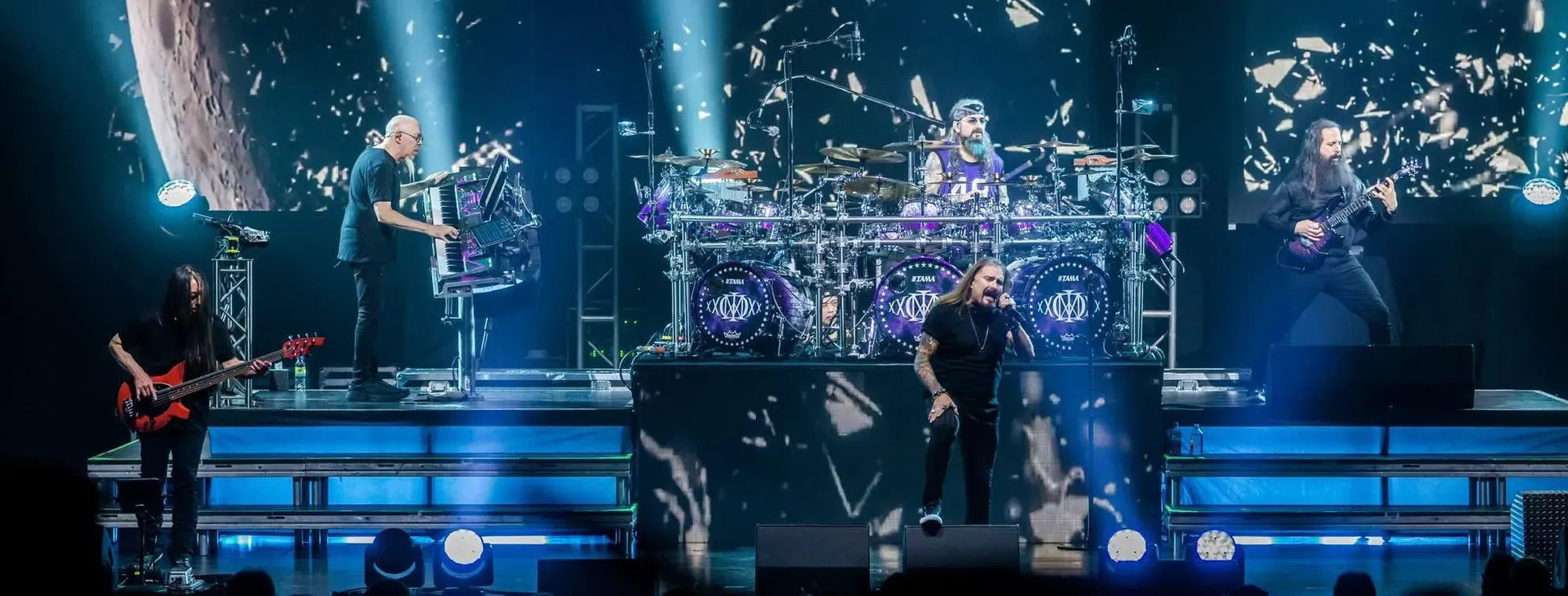
Originally published in Ultimate Guitar.com · January 2025
John Petrucci interview
InterviewJohn Petrucci7 min read
Ultimate Guitar: On the album Parasomnia, which songs proved to be most challenging guitar-wise?
John Petrucci: They all have their moments. When I record a new album, I’m always trying to see if I could put something in there, do some new technique or something that maybe I haven’t done before, and just challenge myself. That keeps me on top of my game. Every song has a moment in there. And then the interesting thing about that is that especially when you have to play those songs live, they become a little bit intimidating. Like, “Okay, now I have to try to learn how to do this consistently night after night.” And what I find as a guitar player is that, eventually, you’re able to do those things that you challenge yourself on. And they become, now, a new part of your arsenal. In ‘Night Terror,’ there’s just like a crazy, fast kind of picking thing that I put in there as a unison section with Jordan. And it takes a lot of focus and dexterity to do, and now I could do it every night without an issue. So, each song has its own little challenges in there that are little mountains for me to climb. But I like it. I like having that challenge.
UG: Which Dream Theater songs were the most challenging for you to record and also to play live?
JP: Some of the instrumentals are pretty challenging. We’ve been playing ‘Stream of Consciousness’ live, and that’s an instrumental that definitely takes a lot... It’s a very ‘shred-driven’ song. So, that’s one that, again, has now turned into a highlight for me, a high point during the show, where it was something that was a little bit like, maybe anxiety-causing at first. Like, “‘Okay, I gotta relearn how to do all this stuff,” and be in like, ‘Olympic athlete mode.’ And then you find yourself playing it every night and having fun and looking forward to it. So, that’s one of them. There’s a song we’re adding into the set, ‘The Dark Eternal Night,’ which is a pretty crazy song. We’ve been working on it for this tour. And it’s presented some need for a rehearsal and some challenges. But again, it gets to the point where you’re just playing it live, and it becomes like, second nature.”
UG: Have you ever considered using “conventional” guitars like Les Pauls and Strats and Teles?
JP: For me, I’ve been in such a unique position where I’ve been able to design the perfect guitars with the best guitar manufacturer on the planet, which is Ernie Ball Music Man. For over 25 years, we’ve been working on signature models from the original JP6 to the JP15 and the Majesty. And they’re the ultimate guitars for me, that reflect everything about my personality as a player, my requirements as a player, the way they sound, the way they look. I have no desire at all to pick up anything else. And even before that, honestly, I never was a guy who was into traditional guitar shapes, or a collector, or a vintage guy. I started my professional sort of guitar endorsement career pretty young. So, for most of my career, I’ve had the privilege of being able to play instruments that I helped design. I know a lot of guys are really into that stuff. I never got into it. In fact, I don’t even own a Strat or Les Paul.
UG: Yes, because I was going to ask if you have any older guitars like that in your collection.
JP: Probably one of the first guitars that I ever played back when I was young, like an Aria Pro II that I had when I was a kid. I’m not a collector. I don’t have vintage instruments.
UG: Who are some modern-day guitarists you enjoy?
JP: There’s a lot of guys. I have a guitar camp that’s called John Petrucci Guitar Universe, and we’ve done four of them so far, and the fifth one is actually happening in Las Vegas in August of this year. And if any guitar players out there have not been to one of these camps, I suggest that they sign up and come, because it’s such an incredible experience. It’s such a big guitar community camaraderie event. And the campers make friends for life, and they experience up close and personal their favorite players. Some of the guys that I have had are my favorite players, that’s why I bring them out. The last camp, I had Joscho Stephan, the gypsy jazz guitar player from Germany, and he was just mind blowing. From the beginning, I’ve had Tosin Abasi, who I love, really great friend. And Guthrie Govan. All these players that are just phenomenal. And what’s cool too is my wife, Rena Petrucci, has been doing these camps as a guest instructor, as well. And she’s amazing. And it’s great having her on this so, yeah, it’s great. A lot of the players that have been guest instructors in my camps are some of my favorites out there for sure.
UG: You just mentioned your wife, Rena, who is a very talented guitarist. Did you ever consider doing a project with her, perhaps of instrumental guitar music?
JP: We’ve talked about it. In fact, we played together a few times on stage. One was at my camp. There was a European guitar award that I had received in the Netherlands, and she came. We jammed ‘Jessica’ by The Allman Brothers, and we’ve done ‘Frankenstein’ on stage together and stuff, but we’ve never recorded an album together. I think that would be something fun to do. It’s a matter of finding the time.
UG: What are your thoughts about the state of modern metal guitar?
JP: Well, I think it’s amazing. I think about even just the genre that we’re known for, prog metal, and how, when we first started, the prog metal sort of moniker didn’t exist. Now, that family tree has just expanded to where there’s so many offshoots and bands doing some sort of version of metal with a more progressive influence. And so, yeah, incredible musicians all over the place, including my nephew, Jake Bowen, who is in Periphery, and the stuff that they’ve been able to do. Metal is in a great place. And even, sometimes, for people in the US, it’s hard to wrap their head around, “Oh, it seems like something that was from the ‘80s.” But all you have to do is step outside of the US, and go to South America, Europe, Asia. I mean, metal is alive and well. Some of the biggest rock and metal festivals that happen in the world are out there that are just a testament to the huge metal community. And, of course, the guitar being really, to me – and maybe I’m biased – the biggest voice as far as defining the genre of metal. Because you can’t have metal music without metal guitar.
As Petrucci told Ultimate Guitar in a recent interview, the Majesty can find its place in anyone’s hands, no matter the genre. When asked whether he thinks it’s a good choice for guitarists who’d usually not consider such instruments, like blues or classic rock players, he replied:
“Yeah, 100%. In fact, that’s something that we learned about the Majesty, even though it came from my design perspective, along with the engineers at Ernie Ball, and I play a certain kind of music, which we call ‘prog metal’ or whatever.”
“What we’ve learned is that players from country to rock to blues enjoy the Majesty just as well,” John continued. “You don’t have to play prog metal or prog or metal to enjoy a Majesty. It’s just a beautiful-sounding guitar that’s so versatile and that feels incredible to play. So, it’s kind of crossed all the lines of musical genres, or as far as players who enjoy playing them.”
After a lengthy relationship with Ibanez, another brand associated with virtuosic playing, Petrucci switched to Ernie Ball, and the company started making his signature models in the early 2000s. After a lengthy successful run of Music Man JP models, John and the company blessed the world of guitar with the Majesty line, featuring not only high-end qualities and ergonomic specs but also some pretty innovative features that make these guitars fairly versatile tools.
When we recently caught up with John Petrucci for an interview, the guitarist reflected on the tumultuous period right after Portnoy left, but also added that they managed to get back on track with Mangini’s help.
“That was a big change for us,” John recalled. “It was very upsetting for us. This is somebody who we’re all best friends and built this band together, and it was a shock that he had decided to move on. So, it was something where we all had to kind of learn what our strengths were, and to carry the band on without him. Especially myself, being that we used to co-produce, and I moved to being sole producer. But we pulled ourselves up by the bootstraps, as they say. And with Mangini in, managed to come out with a whole bunch of great music, several new Dream Theater albums, three Grammy nominations and a Grammy win, and all these successful tours and stuff. So, at first it was very disruptive and traumatic for all of us, but we were able to continue on in a very positive way. And then, life kind of comes full circle, and here we are, 13 years or so after that event, and Mike’s back in. So, you never know what life has to offer.”