

Originally published in Total Production International magazine · April 2020
Event Focus: Dream Theater
Interview9 min read
Entec supplies a comprehensive audio package for the American prog-metal figureheads’ recent tour of Europe.
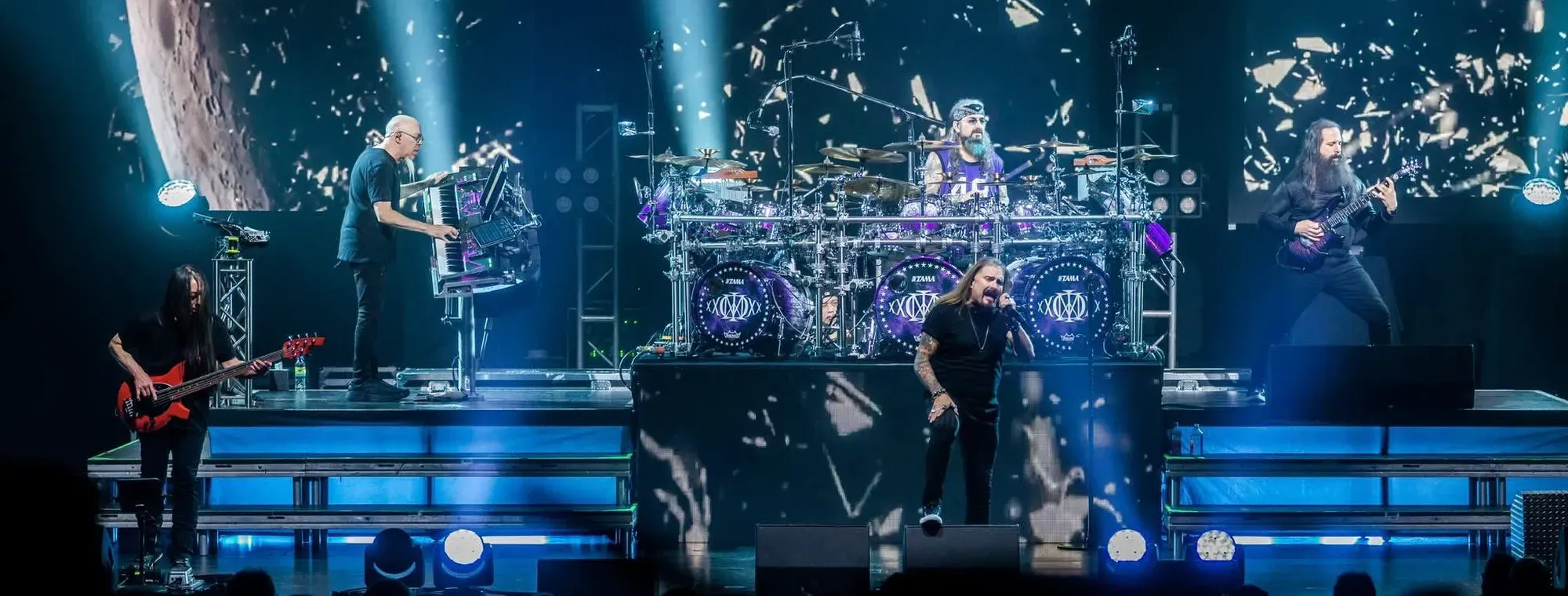
Founded in 1985, Dream Theater – featuring original guitarist, John Petrucci and bassist, John Myung, with lead vocalist, James LaBrie, keyboard player, Jordan Rudess and drummer, Mike Mangini – constantly reinvent with every album release, and this ethos is mirrored by their approach to touring.
For their 2020 tour of Europe, the band called upon Entec to provide a complete audio package, comprising its recently acquired d&b audiotechnik KSL line array and EXE rigging hoists, DiGiCo consoles, monitoring and wireless equipment.
Launched last March, the Distance Over Time Tour included a European festival run in between two US legs, before recommencing in January-February with 29 dates that concluded with two shows at Hammersmith Apollo and another at Glasgow’s SEC Armadillo.
Throughout the tour, the GRAMMY-nominated five-piece paraded their genre-defining combination of powerful dexterity and fantastical concepts, earning media plaudits all the way.
Working with Entec was a new experience for long-time Production/Stage Manager, TJ Rodriguez, who was delighted with the outcome. He explained: “We were ready to make a change of vendor and Entec came to us through our stage technician, Ed Hammond, whose experience with the company was key to them coming onboard.”
Dream Theater’s relationship with Entec began during the transition between Jonny Clark’s final months as Head of Sound, and the appointment of Dan Scantlebury as his successor. “It was a very smooth handover from our perspective – we were very well looked after by both of them,” said Rodriguez. “We are a very relationship-based organisation and it’s clear that we and Entec share a lot of the same values. From day one, communication has been detailed, regular and extremely helpful, with the aim of giving us the easiest ride possible.”
Win/Win
The overwhelmingly positive reactions earned by the band were in no small part due to the crack audio team – FOH Engineer, Michael ‘Ace’ Baker, Monitor Engineer, James ‘Jimmy T’ Meslin, and Entec System Technician, Bart de Wit – and the d&b audiotechnik KSL system, which was configured by Ed Hammond, effectively playing the middleman.
“It’s a really warm-sounding, powerful system that fills the room with great-quality audio – the clarity is incredible,” claimed Rodriguez, a former audio pro with years of touring with Bruce Springsteen behind him. “We’ve used pretty much everything out there, but having KSL on this tour has definitely taken things up a level. With Ace driving it at FOH, it’s been win-win all the way.”
Now a veteran of three Dream Theater world tours, Hammond explained how KSL was selected: “Ace had noted that every time the band played with a d&b rig, the difference was remarkable, but the added bonus of the low-end rejection onstage was what got it over the line – especially as Jordan Rudess is very susceptible to extraneous noise onstage and particularly low-end. It’s surprising how little bottom end you hear behind the hangs. When Entec told us of its intention to invest in KSL, everyone was keen to pursue this route.”
Ace made his debut with Dream Theater during rehearsals for the world tour last February. He talked about how d&b audiotechnik KSL helped achieve the best from this impressive band. “Our guitar and bass amps are kept offstage and everything else goes direct, so it’s already pretty quiet up on stage,” he said. “What you then want to avoid is a tonne of low-end leakage coming out the back of the boxes and into the microphones, adding mud to the sound. KSL gives me every possible advantage of working with the purest sources at the desk.”
He continued: “With KSL, I have the best ammunition to deal with any acoustical situation we might face. Even in a funky, old theatre or a big, boomy ex-factory, I was never left wanting something more from the PA. A significant part of the winning formula was Bart de Wit, who was on top of everything.”
Rigging
While d&b KSL8 speakers were joined by a pair of KSL12s in each of the left/right hangs, a row of six Y10P front fills was in service at every gig, along with 12 SL-SUB enclosures. The cabinets were assembled in carts of four. Generally, the crew used front hangs of 12 or 16 with the exception of Glasgow where, to aid vertical coverage, carts were split to allow a 14-box hang. In venues where additional out fill was necessary, the crew added ground stacked V8s at the sides to boost dispersion.
“Traditionally, you’d link speakers in pairs and run them back to the amplifiers but, with KSL, every box is on its own circuit to enable individual fine control through ArrayProcessing,” observed Hammond. “That has come about since d&b introduced the D80 amplifier – a technology that has improved operation in leaps and bounds.”
On this tour, the system was rigged in tension mode using the first batch of Entec’s EXE Rise 1,000kg D8+ low voltage hoists, recently purchased from Area Four Industries Direct UK. Offering maximum reliability and durability, the D6+ hoist solves issues that have arisen in parts of Europe concerning other low-voltage models, and Entec’s intention is to defer to its new investment for all future projects.
DiGiCo’s Footprint Solution
Another crucial influence behind this audio success story was the specification of two DiGiCo consoles: an SD10 at FOH and an SD12 on monitors. These choices provided the ultimate solution when the tour brief included a wish to minimise the control package footprint.
“On our previous tour, we ran two brands of desk and that required an analogue split and everything that went with it. Audio took up a much larger space and that impacted on weight and trucking which, ultimately, means extra cost,” Hammond commented.
“Jimmy and I had the opportunity to take a step back, look at things afresh and find a way to trim down without compromising sound quality. With the ability to share one stage rack [SD-Rack] between the two desks, DiGiCo solved the issue.” He continued: “This band used to generate 96 inputs and, of course, the SD-Rack handles 56. During pre-production, we reviewed our input list from the last tour and tightened it up so that it would be accommodated within the single rack. We’ve ended up with the tidiest rig we have ever taken on the road.”
DiGiCo SD10 is Ace’s favoured console – one that he has used frequently with Joe Satriani, Sammy Hagar and Jason Bonham’s Led Zeppelin Experience. Although Entec supplied a Waves SoundGrid processing package with the SD10, Ace made light use of its powers. “I specified Waves because there are some vocal effects that I need to duplicate with flange and distortion, and I also use the SSL pre-amp on the two snare drums, but otherwise I run things pretty straight,” he explained.
“I’m an old-school guy who has been extremely lucky to have worked for some very good-sounding bands. This music is extraordinary but, from a mix perspective, it’s a pretty straightforward rock band,” he noted.
“If you pick up some high-quality mics and have your system tuned correctly, you really don’t want to mess with the formula,” he continued. “John Petrucci has spent a long time developing his guitar sound, so when he’s set up and ready to go, my only job is to get that into the mix without adding any colour.”
Just before Ace joined the team, James LaBrie upgraded to Shure Axient Digital for his lead vocals, using it with an SE Electronics V7 dynamic capsule. When it came to reviewing the rest of the existing mics, Ace introduced a Beyer M88 for the bass guitar amp but found little reason to make further changes to the Shure-dominated line-up supplied by Entec for Europe.
Monitors
Through working with Dream Theater as a studio engineer during the recording of their last two albums, and also touring as their ProTools Playback Technician, James ‘Jimmy T’ Meslin acquired the wealth of knowledge required to create the best possible monitor mixes on stage.
Making his Monitor Engineer debut on the Distance Over Time Tour, Meslin was exposed to DiGiCo for the first time. “Even though I had never used a DiGiCo before, the SD12 was a no-brainer for me. I find their platform really simple to follow. It took a maximum of two hours at the desk before I actually started working with it.”
Jimmy T admitted that he previously had “a little favouritism” towards Avid due to his previous use of their products in the studio, but when he weighed up the criteria, “everything pointed to DiGiCo”. He added: “It was so refreshing to set up at the side of any stage, allow plenty of room for artist access and not eat up space that the guitar tech needs.”
Five of the mixes generated by Jimmy T were sent to Shure PSM1000 wireless in-ear systems – a model that has successfully served the band for five years. For drummer, Mangini and keyboard star, Rudess, Jimmy T sent a group of sub-mixes to the 16-channel Aviom 360 personal mixers they used to tailor their own feeds. As well as using IEMs, Petrucci enjoys the extra support of a pair of monitor wedges and strongly favours Meyer Sound’s MJF-210 for its size and shape.
“It has to feel comfortable when he rests his foot on it, which happens regularly at each show,” Jimmy T said. “A different shaped wedge affects the way he holds his guitar and, ultimately, his performance. This mix has more low end, so John can gain a greater physical sensation of sound through his body.” Jimmy T also records each show on to a laptop to provide a reference for the band. Also included in Entec’s audio package was its custom INDU 120v isolation transformer, which Hammond designed for the company ahead of Marilyn Manson’s Heaven Upside Down European tour in 2017.
Shooting The Show
Both nights at Hammersmith Apollo were captured by Canadian filmmakers Pierre and François Lamoureux of Fogo Labs, who hired recording engineer, Will Shapland to multitrack the live audio in his SSL-equipped studio truck.
“Entec played an important role in helping us achieve the end goal with this,” informed Jimmy T, who will soon mix the video soundtrack in preparation for a forthcoming release. “François was passionate about getting an analogue feed to the truck, but with our compact configuration, we no longer use a split, so we were faced with the challenge of compromise,” he outlined.
“In the end, we asked Entec to supply all the elements that bridged our world and the truck. They included all the fibre and an additional SD-Rack, which we put into the Opto-Loop, maxing out the output card. I gave a copy of my patch directly to François and he was able to chase analogue tails right out of the card and into the truck, and also took a MADI feed as a redundant back-up. It was a great endorsement of DiGiCo’s strengths.”
According to Ace, the Distance Over Time Tour has been one of the most rewarding he has worked on over his long career. “Entec’s supportive staff were always at our disposal,” he said. “Anything we needed was right there and we were immediately confident that they’d have our backs throughout the tour. I hope we enjoy a long and fruitful relationship with the company into the future.”
In closing, Entec’s Head of Sound, Dan Scantlebury, reflected on the tour. “This was an excellent opportunity to have our KSL system out with such a high-profile act, and with sound engineers who really know their craft,” commented Scantlebury, who joined Entec at the end of 2019.
“It was good to note how well KSL performed in a wide range of venues. Working with Dream Theater’s team was a very rewarding experience – one that we hope will come around again soon.”