

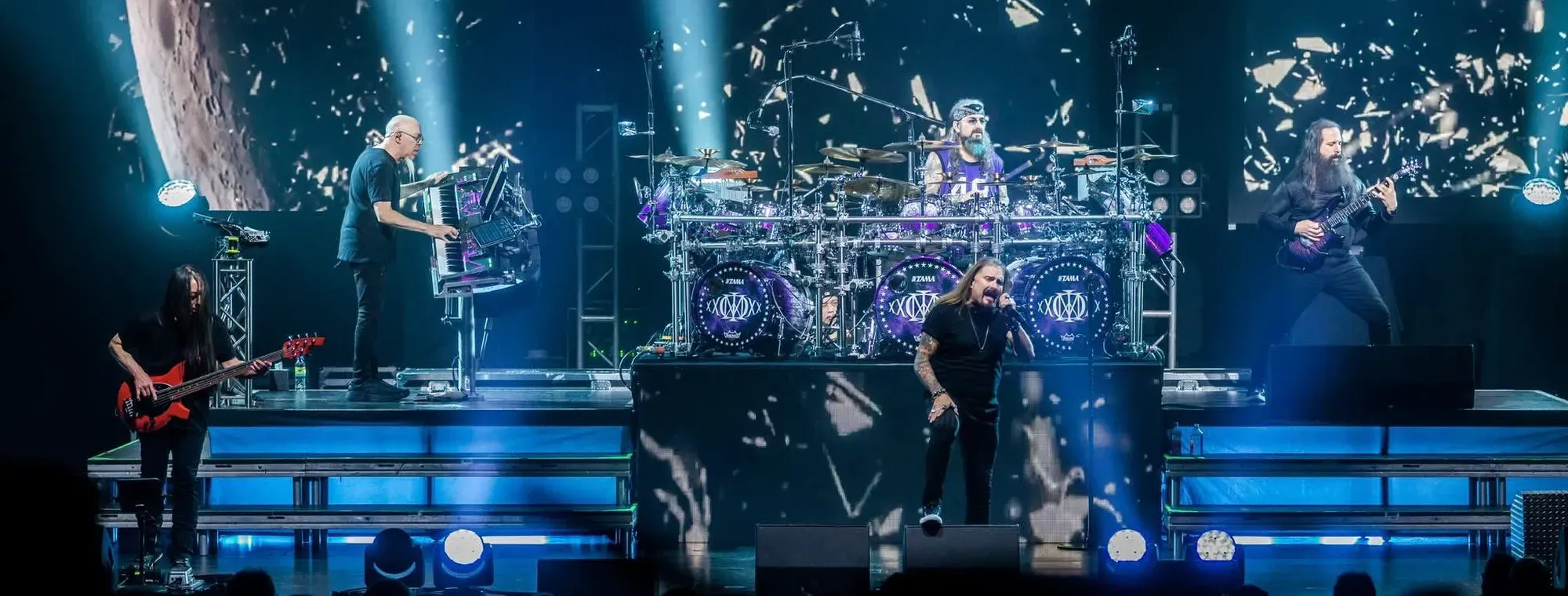
Originally published in Two Doods Review · October 2019
James LaBrie interview
InterviewJames LaBrie13 min read
Jave Patterson: James LaBrie how are you?
James LaBrie: I’m doing great! How are you Jave?
JP: Good, good. So you’re in San Jose?
JL: Yeah, we have a show here tonight and then we’re gonna head to Reno.
JP: I have to say I’m a little nervous about this interview just because I’ve been such a huge fan of, not only Dream Theater, but you as a vocalist, going all the way back to Images And Words. I was a kid growing up just starting in a radio and trying to make my way as a professional musician. We actually opened up for you down in San Antonio, Texas way, way, way back in the day on the Images And Words tour. So I’m excited to have you on the line.
JL: So what was the band? Who were you?
JP: The band I was playing in at the time was called Paradox. We were kind of a prog rocky Christian rock band. We played a place called the Showcase Theater the first time you guys played in San Antonio. My guitar instructor was a guy that you might be familiar with named Ron Jarzombek. His brother Bobby Jarzombek I think was on a roll call for when you guys had drummer auditions a ways back or so...
JL: Well I’ve met so many people Jave, so you have to forgive me on that one.
JP: No worries. So speaking of drumming, you started as a drummer when you were a kid. What other instruments do you play, James?
JL: That’s pretty much it. I grabbed a guitar two years ago, so I’m slowly learning the dexterity that’s involved in guitar playing, and I’ve gotta tell you, that’s intimidating. But drums, I’ve played from the age of five until I was 17. And you know what? Thank God that because the rhythmic sensibility, especially being able to just infuse myself, especially in a band like Dream Theater naturally, it came from that fundamental background. So I always thank my lucky stars I did that. It just seems all natural. I’m not one of these guys, I don’t want to count all the crazy time signatures when I’m singing in between. It needs to be natural – it needs to feel real.
JP: Tell me about working with Sebastian Bach early on in the band Winter Rose. Were you guys in the same band together?
JL: No, no, no. What happened was, Sebastian was working with Rich Chycki – he was the guitar player. It wasn’t called Winter Rose then; it was just called, I don’t know, whatever the hell they called it. And he was singing some songs that they had put together, and then Sebastian was, obviously found by Skid Row. So he moved down to New York, and the rest is history. So what happened was, I was just doing this odd little side project and the bass player went to buy a TV off of Rich, and then Rich said, “I gotta play ya something we just recorded,” and we’re just, like, “Who is this guy?” And then all of a sudden, Rich and I started working together and we formed Winter Rose. We were being looked at by Atlantic and EMI and stuff like that in 1991, and then all of a sudden we were out touring with Lee Aaron, and she threw my tape down to New York and this band Dream Theater... But Sebastian, we know each other very well, I’ve gotten together with him, I’ve gone to his house at a party – I didn’t feel very good the next day. [laughs] But we have that mutual respect – two Canadians that have done well – and so we just have that kind of connection. Obviously when you’re a fellow singer there’s that whole community like any other of the respective instruments, right?
JP: Yeah. Now it had to be tough goings when you submit your audition for Dream Theater. You knew you were in the hunt with a lot of other great vocalists. I would imagine John Arch, a fellow Canadian was maybe one of them (from Fates Warning).
JL: Yeah, I know that he had already sung with them. He’d already gone down...
JP: Tell me about that experience and when you finally got the call and the guys in Dream Theater said, “Hey, I think you’re our man.” When did you first see yourself as a frontman?
JL: Well, I saw myself as a frontman when I was 12! [laughs] I always knew that the drums were secondary, because I started singing at around the same age – at five – and actually the first couple of bands that I formed I was the lead vocalist and drummer – I was doing the whole Don Henley, Phil Collins thing. [laughs] But to be honest with you Jave, when I went down to do the audition, I was completely oblivious to any of the other singers that they had had, which is probably a good thing. I know they told me – they go “We’ve been auditioning singers for, like, two years, the last two and a half years. We’ve even worked with some for six months, eight months who’ve recorded a ton of demos.” And then my CD happened to cross their laps and they’d listen to it in Mike Portnoy’s van one night; they actually got a live recording of me at Rock & Roll Heaven in Toronto, which used to be an awesome bar to play. And it was sponsored by Q107, which was a big radio station up in Toronto, and we recorded live. So they actually got a live recording of me and they’re like, “There’s no way, man.” I was like, “No, there is!” So when they brought me down, we basically went to the rehearsal hall, we jammed for about... I’m gonna say an hour or so. And we went through a lot of the songs from the first album, and even jammed on ‘Lovin’, Touchin’, Squeezin’’ by Journey and stuff like that. They just kind of looked at me at the end and went – and I didn’t know their lingo – and at the time, John Petrucci looks over at me and goes, “Dude, you’re sick!” I said, “Actually, you know what? I feel great.” He goes, “No, no, no! I mean that in a great way!” And I’m like “Oh, OK – now I get it.” And then the very next day, we went to John Myung’s condo place with a roommate, and we recorded three songs or four songs actually in his bedroom on, like an eight-track recorder. I was there for like five days doing stuff, and then I flew back home. They asked me before I left – they just said, “Dude, you got to be in the band. Are you into it?” And I said, “Absolutely. But I’m gonna tell you one thing: I’m staying in Canada. I don’t want to move down here. I love it down here, but...” And I’m in Toronto, so back in the day that was a 50-minute flight, so it was no big deal. But that’s basically how it came together and then obviously over time they told me all the other singers that they had had there and it was pretty funny.
JP: Just focusing on you as a vocalist. You’ve released five solo albums. What can you do James, on your solo albums that you don’t feel would necessarily fit in Dream Theater, or that you can’t do in Dream Theater?
JL: On the peripheral edge, there are progressive moments throughout some of the solo material, but for the most part, Matt Guillory and I, we’ve been a team – we’ve been doing this since 1998 if you can believe it. Matt is a phenomenally talented keyboard/piano player, writer... When we’ve been putting the songs together, our focus is really first and foremost on the songs having just a bit more of a hard rock, very palatable, kind of... it’s something that you can sink your teeth into as far as hooks. A lot of the hooks are coming from the guitar and especially the melody. I’m assuming you’ve listened to them?
JP: Oh yeah!
JL: So you see that the focus that we put on the vocals as far as the melodies and the hooks and the chorus, and obviously the lyrics. So Matt and I split the lyrics. He does half; I do half on every album. We just want to create our own sound by incorporating some very heavy and aggressive moments, and there’s even minimal – we use it sparingly, but I think it still has a purpose – grunt vocals. Peter Wildoer, the drummer, does that. He does a phenomenal job, but it’s used more as a tool, and it’s not necessarily, “Oh, listen to this voice.” That’s what I think maintains that equilibrium throughout. By doing these things that I’ve mentioned, it kind of creates that separation between Dream Theater and this, because it wouldn’t make any sense for me to do it if it was just gonna... I must add though that each and every player – Peter Wildoer, Marco Sfogli, Ray Riendeau and Matt are phenomenal musicians, so they can basically play anything. They would not be tried to do any Dream Theater material, as well. So that gives us an open canvas to go wherever we want, if we want to get crazy musically. I think that we’ve maintained that that balance. We just want to be more straightforward, but put some interesting moments into it that are a little more in the musicianship realm, so to speak.
JP: It’s almost 30 years since Images And Words was released. And the success of ‘Pull Me Under’ during the time when MTV actually played rock videos – did that ever freak you out when you saw yourself on TV? Because there was a while where they were playing that video a lot!
JL: It was almost like it was on every ten minutes! [laughs] “The song’s done? Play it again!” It was pretty surreal, especially at that point. We came out with an album that was so left-wing if you think about it – it’s like, “Wait a minute, what are the guys doing? They’re releasing a progressive, heavy, metal-type album?” Everyone was like, “What are you going to do with this? What’s going to happen?” Fortunately for us – cause I have to be honest Jave – if ‘Pull Me Under’ hadn’t exploded like it did and made the album extremely successful, I don’t know if you and I would be talking today. I seriously don’t, because the reality is, before ‘Pull Me Under’ hit, I think they released 10,000 albums for the States, and then trickles in Canada and the international and all that stuff. If there was nothing to really grasp on to, where do you go with that? Fortunately for us, ‘Pull Me Under’ became something that was not only North America, where it was kicking, but all of a sudden, it made its way internationally. Europe was on it immediately, and then all of Asia, and then it just mushroomed from there. It allowed us to be able to go in with the follow-up Awake and feel confident and so on and so forth – all the sequential albums beyond that.
JP: I burned out on VHS tape the Images And Words – Live In Japan; that was so much fun seeing you guys out on the road having fun during that time. Let me ask you: how did the loss of original keyboardist, Kevin Moore, affect the overall sound and songwriting in Dream Theater? Was the album Awake hard to put together?
JL: You know, he was involved, but we could tell, and we were still kind of guessing with, “What’s going on with Kev?” when we were writing that album, because he was there, but then again, he wasn’t. We just knew something was up – there was a change. But he was very integral to Dream Theater. Everything leading up to Awake – and I’m not gonna take anything away from him, because he’s incredibly talented, very intelligent, and his lyrics were amazing, his whole musical sense was just beautiful. And so when he did tell us – the night before, I was to go in and start recording my vocals for Awake – is when he had a meeting with the band, and he said, “Guys, I’m gonna record the album and then I’m leaving. I can’t do this anymore, I’m sorry.” And was I just looking at him, going, “Dude, you think you could have waited maybe a couple weeks? I’m gonna take this into the studio tomorrow – are you freaking kidding me?” We were really upset, we didn’t want him to leave, obviously. But at that point, he had been thinking long and hard on it, he wanted to just do his own thing; he wanted to be in charge. I touched base with him maybe a couple of years ago just via texting and stuff like that. I still love the man, we’re friends and stuff, but where we are today, I think it’s a beautiful thing. I don’t think you can go much higher than someone like Jordan Rudess. And I’m not gonna omit Derek Sherinian, either. He’s a very talented individual, and for the time he was with us, I think it made sense. But Jordan was just somebody that we have been aware of for years. He and Rod Morgenstein came and opened up for us on a tour, and we watched these guys perform every night, opening up, and we’re like, “Ummmm... hello? Who the hell is this guy?” And he did Liquid Tension with the guys. I guess there’s a reason for everything, right? Why things happen... And Jordan, his timing couldn’t have been more perfect, coming in for Scenes From A Memory, which now we’re out in celebration of the 20th anniversary.
JP: On that same point, how is Mike Mangini doing? He’s been with you guys for a while, but what does he add to the songwriting and to the musical dynamic of Dream Theater?
JL: Yeah, it’s been almost 10 years, it’s incredible. He is first of all, incredible drummer – that goes without saying. And I think over the years, he’s at a point – especially with the last album (Distance Over Time) – he was fully integrated, fully involved with everything, the whole process, the writing... He’s an incredibly talented musician. He’s played stuff for us that he’s written and that he wants to eventually release. It’s great stuff! I mean it’s really cool stuff that he’s done! So his whole dynamic with the band... I would have to say, honestly, it’s probably been in the last few years that we have seen the full Mangini on board. I think everything up to that point was him just gracefully coming into the fold. He’s still playing phenomenal each and every night and on the albums, but I think it’s been since maybe the self-titled or The Astonishing that you kind of felt that whole click. Definitely I think he shined like a diamond on the last album, and I think that’s because he was fully involved. He’s a great guy – he’s crazy, like most drummers. [laughs] He’s a really funny guy; just a crazy sense of humor. But that’s good – we need the balance.
JP: I was gonna say you guys are such impeccable players. It almost seems like nobody skips a beat, nobody misses a note live. Who is the practical joker in the band, if you had to single one out?
JL: It could be Mike. I mean, I’m more or less just like throwing humor around all the time. As far as a practical joker, yeah I think Mike would be more inclined to do the whole slapstick thing. But you know what? We’re all human, we take care of ourselves, we’re eating healthy, we work out. I gotta really be disciplined when I’m out here, because I’m doing three hour shows every night. We just finished six shows in seven days, and had yesterday off, so we’re back at it again today. But we signed up for it, right? It’s what we do and love to do. I think we’re extremely fortunate – we never take any of this for granted. You can see everybody backstage revvin’ up for the show and they’re warming up. I think where we are at this point is in a really healthy place, and we’re just taking it for all it’s worth.
JP: Lemme ask you: I’ve noticed on Setlist.fm that ‘Pull Me Under’ does not look like it’s been played in the last many shows. What song do you hate to play live the most? Would that be one of them, because you have to play it at every show forever? Like, “Oh my God! If Led Zeppelin has to play ‘Rock ‘n’ Roll’ again, give me a break!”
JL: [laughs] Yeah, you know that kind of touches on it a little bit. We just kept thinking, “Are we gonna keep incorporating this into every leg, every tour?” I think even the fans would appreciate it if we didn’t play it. I would say that that’s probably the one that we know we’re kind of committed to because it was our big hit. I can only imagine what some of these bands, like the Eagles, Aerosmith, and... oh my God... Billy Joel... [laughs]
JP: What song do you love playing each night?
JL: On this tour? Well I love doing the whole Scenes, because it’s so dynamic and vocally it’s just a beautiful piece to sing. But I’d say out of the first set, I love doing ‘Fall Into The Light’ which is from the new album, and I love doing ‘Barstool Warriors’. I love doing ‘In The Presence Of Enemies’ that we kind of pulled back – part one. I’m just loving singing everything, Jave! Like ‘Pale Blue Dot’ is such a great song, and we finished the first set with that; it’s a mammoth tune to hit everybody. And then we do the intermission... So it’s kind of hard to bring it down to one song. Right now, if I had to, I’d say probably ‘Fall Into The Light’.