
Originally published in Soundcheck.de · April 2019
Dream Theater: typically atypical
by Ulf Kaiser, Peter Sausenthaler, Dominik Sauter · April 04, 2019.
InterviewJohn PetrucciMike Mangini21 min read
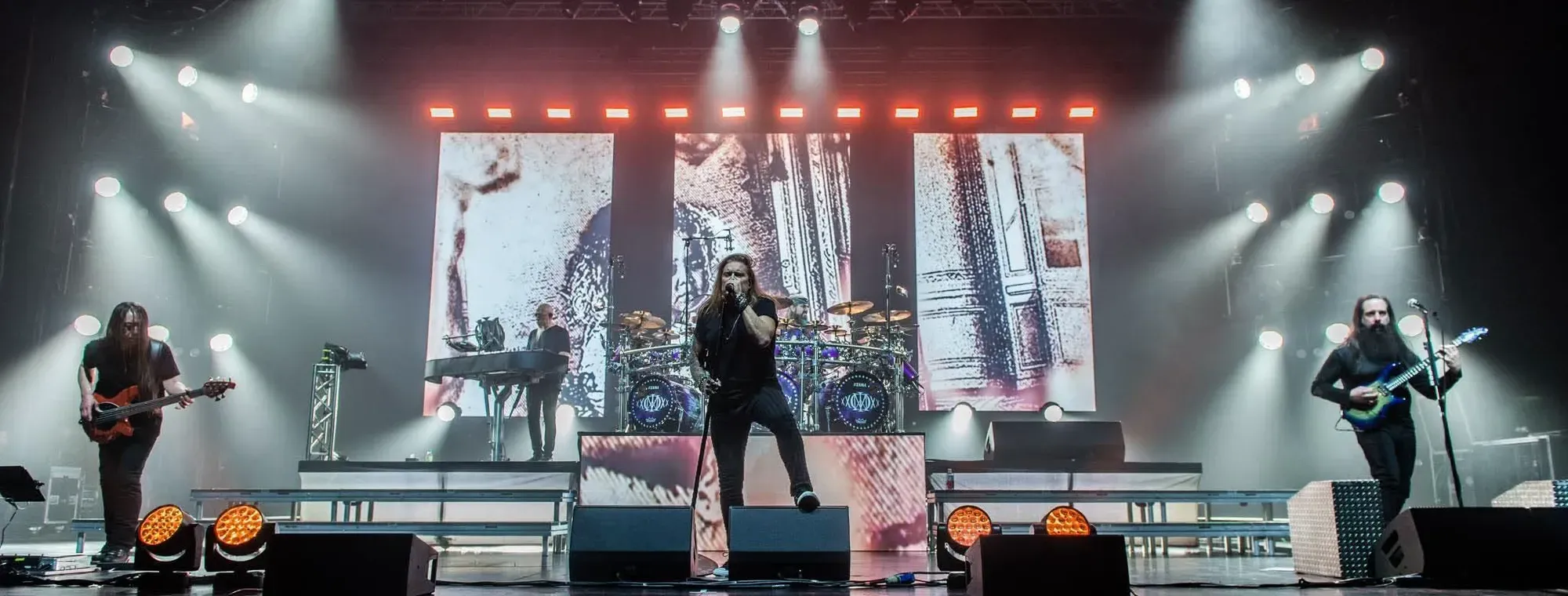
With Distance Over Time, the prog heroes Dream Theater present their 14th studio album. Compared to its predecessors, the record is much more accessible and less cerebral. In the SOUNDCHECK interview, guitarist John Petrucci and drummer Mike Mangini explain the new approaches the band has taken with the recordings.
Distance Over Time is a very typical and at the same time atypical dream theater album. Typical because it bears the unmistakably progressive handwriting of the band, and atypical because there is also a lot of earthy rock to hear between all the prog parts, such as the song “Viper King”. How did that happen?
Mike Mangini: That is probably due to my influence (laughs). “Viper King” for example: I was very much inspired by Van Halen and that’s something the band has never done in over 200 songs over the years. But it is also true that such songs are not clones. We don’t change our style when we play shuffle or boogie. Of course we put the “progressive part” into such songs, you can tell at the breaks. In other words: a band that normally plays boogie, shuffle style or the like would never incorporate these complex parts, as is usual with Dream Theater. This is exactly the kind of influence I have had on Distance Over Time.
John, tell us about the location of the new album.
John Petrucci: With the Yonderbarn Studio in Monticello, New York, we found the perfect place. As a band we wanted to spend time in a different place, hang out together and of course compose. In contrast to previous rehearsal sessions, we deliberately wanted to get away from home and looked for a place where we could play loudly around the clock. The previous owner had turned a barn into a studio. There is a small house on the property where we could live, all in the middle of nature in the mountains. That’s exactly what we wanted - far away from the city, without any interference. We brought our live equipment there. So we composed the entire album in about three weeks. It was originally planned that we would move to another studio afterwards, but that suddenly seemed nonsensical to us, because the room with its high ceilings and wooden walls sounded wonderful and we felt very comfortable.
There was no recording equipment on site, but the necessary peripherals in the form of first-class, documented cabling. So we still had to have a mixer, get monitors and a Pro Tools recording system in there. Apart from the microphones and Neve preamps, we worked here completely in the computer for the first time. James Meslin was responsible for the recordings. His rough mixes already sound great. He is very talented and has worked as an assistant on previous albums and also performed live at the concerts for “The Astonishing”. The final mix was done by Ben Grosse, who has his studio in Los Angeles. I left the job entirely to him and then just approved of his results. The result convinces me. Ben wasn’t part of the production so he had a different perspective because he didn’t know the music yet while we were very close for months. So maybe it’s not a good idea when I’m there!
Did you actually go to the Yonderbarn Studio with no ideas?
Petrucci: No, we had a few sketches because during the soundchecks on our tours we keep stumbling across new ideas that we basically take up. Viper King, the bonus track, started out like this. When I play the guitar, I always record new ideas as voice memos on my smartphone.
The complete songwriting for the new album only took 18 days, hard to believe ...
Mangini: That surprised us even. We couldn’t believe that everything was ready in 18 days. Each and every one of us was always fixated on one and the same thing and with the same high level of commitment. This unit that we had formed made sure that everything went so quickly. That was a great experience and gave us as a band an absolutely happy and satisfied feeling. It was also a learning process for us.
How would you describe the result of your new album yourself?
Petrucci: I would say that this album sounds more alive than much of what we’ve done before. The orchestration is definitely easier. For the last album, The Astonishing, we recorded tons of tracks, to a real orchestra. Here you hear Dream Theater, nothing more, plus a reduced selection of sounds. Jordan (Rudess, keyboards, editor’s note) often played a classic rock organ sound. And as far as the guitars are concerned, there is often no additional rhythm guitar at all for the solos, as on stage. We don’t have any guitar support there either. Playing together brought us closer together. We were all in a creative mood, which was reinforced by the undisturbed location. There was no recording studio in the classic sense that you had to start at a certain time. The house was 30 meters away, we woke up at some point and then walked over when we felt like it - relaxed and informal. I think you can hear that on the album too.
What about the lyrics?
Petrucci: It was their turn after the finished compositions. When we decided to record in Yonderbarn too, we first recorded the individual instruments and then devoted ourselves to the lyrics. I didn’t text alone this time either. Two texts each come from James and John, and Mike here also contributed a text for the first time with “Room 137” that revolves around the mystery of this number.
How was the composition phase different from your other studio albums?
Petrucci: I think we were more open-minded. We wanted to work together consciously instead of working out something ourselves and then presenting it to the others. Without sounding clichéd, we wanted to go back a bit to our roots. We stood together as a band in the room, turned up the amplifiers and jammed. Based on that, we were able to pick up speed and let a song grow in each direction. At the same time, we didn’t want to make things too complicated. Since I also worked as a producer again, I had to make sure that we didn’t get off track within this vision and get lost in details.
How do you work out your parts for a dream theater song? What is the process behind this?
Mangini: It’s a very intuitive thing. I work with my eyes a lot. Take a keyboard as an example. It has 88 keys, and now check out my drum set. I always try to have as high a tonal range as possible. So I can generate a wide range of tones from extremely high tones on the rocket toms to extremely low tones on the gong tom, to stick with the acoustic instruments. So I listen to the parts of my bandmates, connect my hearing to my eyes and use my drum set like a keyboard. That’s how I do it, and that’s how I’ve always done it. On the new album more than ever! So I use my drums like a keyboard that I hit on! (laughs) Because with Distance Over Time, I also experimented a lot with different microphone positions in order to get the maximum sound out of my set.
Mike, the current one is the fourth long player you’ve drummed for the band. Looking back: which album was the most challenging for you?
Mangini: From the time I joined Dream Theater, I was an equal and full member of the band. Distance Over Time is the first album where I got involved in songwriting. In this respect, I did not act out completely before. That difference makes the current album the album that has challenged me the most.
To be a drummer at Dream Theater would mean for most drummers that they have climbed the “drum Olympus”. Where do you think your creative and technically extremely demanding game will take you?
Mangini: Exciting question. That led me to write music that is far less complex than Dream Theater. For the current album I contributed a lot and realized that I had a lot of ideas, but they didn’t fit the band. So I went back to a virtue of the Dream Theater guys, who all started a solo side project at some point. In the end, the whole thing got me to write songs with a continuous four-quarter time (laughs). On the other hand, I try to play increasingly complex patterns that flow unchecked into the sound of Dream Theater. For example with “Outcry”, a song that is far more technical than it appears when it is first heard. I had to play to a completely different timecode than the clock dictated. That was quite a challenge for me. Just like “Pale Blue Dot” on our new album. It’s such a crazy number too.
The high proportion of melodies on the new album is very noticeable. Where are you from?
Petrucci: We wanted to compose an organic sounding album. On the one hand it was supposed to be harder stylistically, which resulted automatically from playing together, but on the other hand we also wanted to deliver strong melodic aspects - not only in the choruses. We often know if our ideas are choruses or stanzas and work them out accordingly. The harmonies are partly already in the idea, partly the melody is also directly available. Then again there are riff-based songs, such as “Paralyzed”, where the melodies only emerge when the text is being composed.
Wasn’t it necessary to work longer on certain sounds?
Petrucci: It was different. At first we didn’t even have the plan for admission. We built our backline to be able to play. The sounds were less relevant there. Instead, we were able to note during the composition that we wanted certain timbres here and there without actually implementing them. Instead of devoting ourselves to finding the sound like in the real studio, we simply recorded the completed songs in a simple version as live demos.
Let’s go back to 2014. There was the “Along For The Ride - An Evening With Dream Theater Show”. You played to a video installation, with each individual note fitting exactly on a specific frame of the video sequence. How do you work towards such a complex concept?
Mangini: (laughs) Oh yes, that was more difficult than anyone can imagine. I don’t want to sound presumptuous, but someone who has never done something like this cannot imagine what an enormous amount of work that means.
The pressure on you is enormous. The click to which we played ran continuously in a 36th timecode. I prepared myself by holding a grappa in each hand so I wouldn’t have a nervous breakdown (laughs). In preparation: I rehearsed for three months just to play for click. And those are just the basics for it. There was no interaction with the band yet. In the three months it was really just about playing with the timecode and the individual phrases and video sequences. Only then were we ready to even think about rehearsing together. Something like that is almost impossible, but we did it anyway.
Mike, how did it come about that your drum set grew to this level over the years?
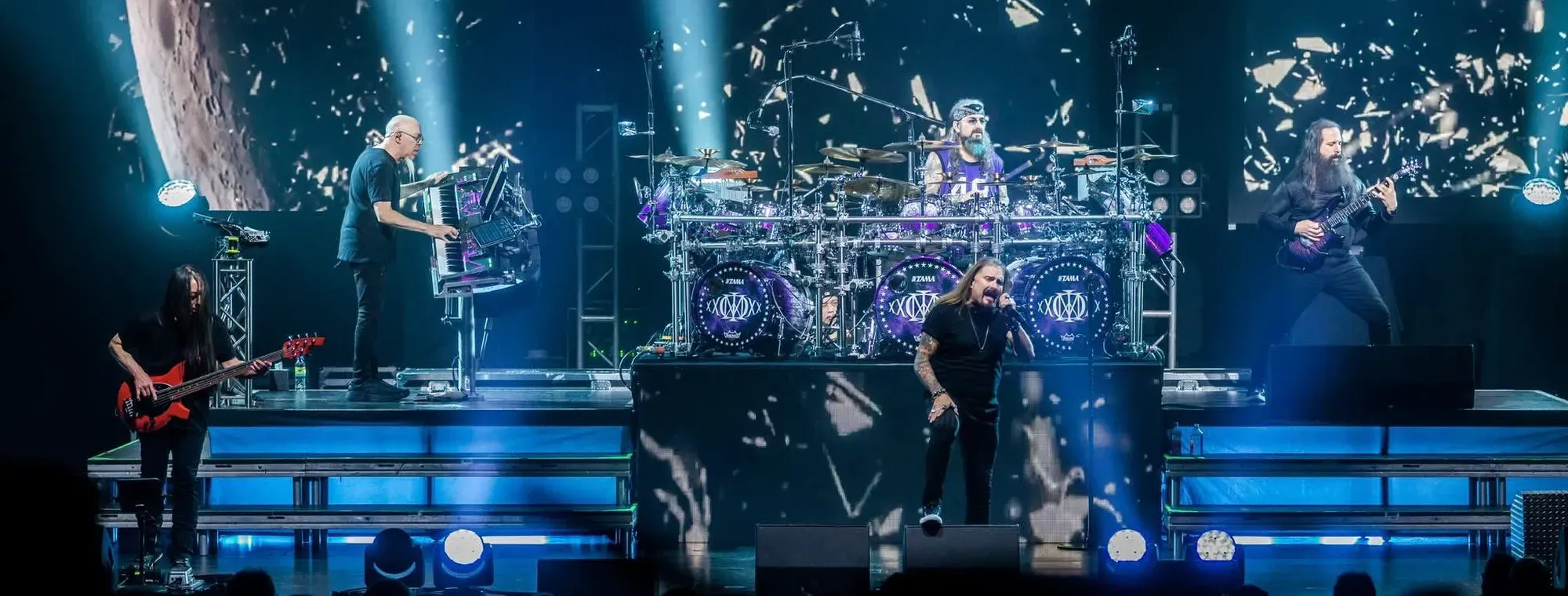
Mangini: I like it when a drum set is structured according to octaves. If, for example, a violin goes into the high pitches and then goes back to the lower pitches, it is of little help if I play a drum for the low tone that sounds like you’re kicking a little wire-haired dachshund (laughs ). The other way around, I don’t need a Timpani sound when something delicate is required and I just need a short, high “ping”. The same goes for percussion instruments, although I don’t have many of them on set. What I am missing, I imitate with stacked cymbals, if necessary. Those are the reasons my set is so big.
Do you also use this monster set-up in the studio?
Mangini: For Dream Theater largely yes. Of course I don’t use six bass drums in the studio, that would actually be an exaggeration. I play a bass drum with a special double bass pedal that my Drum-Tec built for me from two Demon Drive pedals. Otherwise my studio set is similar to the tour set. It can of course also be smaller. For the G3 project that I started with John Petrucci, I had a normal four-piece standard set - both live and in the studio.
And John, do you still play guitar regularly?
Petrucci: Sure, I try to be fit on the instrument and to stay that way. In the studio you always have loads of takes and the opportunity to punch in. You are sometimes acting above your technical and playful possibilities. So I have to go back to the recording and really learn the parts in order to play them live. That makes me a better guitarist. At the same time I try to keep the instrument, the riffs and solos always exciting and interesting. That’s my claim, I’m working on it.
What equipment did you use to record the album?
Petrucci: I use my Mesa / Boogie signature amplifier, the JP-2C. Its distinctive sound, which I love so much, can be heard directly on the intro riff of “Fall into the Light”, for example. I play live in stereo with two amplifiers. It sounded so good that we thought about recording it straight away. In the end I played the left and right sides one after the other. So the heavy parts are doubled. Solos and cleans are also separate tracks, as are the few acoustic parts on the album. For these parts I used a new Taylor model with V-Class bracing. You can see the guitar in our video for “Untethered Angel”. I had around twenty guitars in the studio. So we could change the mood quickly at any time. My Music Man Majesty models were used almost entirely, with two exceptions: “Paralyzed” is recorded in B with my JP baritone model, as is the ballad “Out of Reach”. As for the effects, I used - in addition to countless other effects and pedals - to a large extent my Dreamscape pedal from TC Electronic for chorus and my signature wah from Jim Dunlop.
Last question: Will there actually be a DVD for The Astonishing?
Petrucci: You know what: We actually wanted to do that because it was our biggest live production. We recorded the sound performance of all concerts, but unfortunately none of the tour’s concerts were professionally filmed. I think we just missed the timing. (laughs)
Dream Theater: typisch untypisch
von Ulf Kaiser, Peter Sausenthaler, Dominik Sauter
04. April 2019.
Mit Distance Over Time legen die Prog-Helden Dream Theater ihr 14. Studio-Album vor. Im Vergleich zu den Vorgängern ist die Platte wesentlich zugänglicher und weniger verkopft. Im SOUNDCHECK-Interview erklären Gitarrist John Petrucci und Drummer Mike Mangini, welche neuen Ansätze die Band bei den Aufnahmen verfolgt hat.
Distance Over Time ist ein sehr typisches und gleichzeitig untypisches Dream-Theater-Album. Typisch, weil es die unverkennbar progressive Handschrift der Band trägt, und untypisch, da es zwischen all den Prog-Parts auch viel Erdig-Rockiges, wie zum Beispiel den Song „Viper King“, zu hören gibt. Wie kam es dazu?
Mike Mangini: Das liegt wohl an meinem Einfluss (lacht). „Viper King“ zum Beispiel: Da habe ich mich stark von Van Halen inspirieren lassen und das ist etwas, was die Band in all den Jahren, in über 200 Songs, nie gemacht hat. Es ist aber auch so, dass solche Songs keine Klone sind. Wir ändern unseren Stil nicht, wenn wir Shuffle oder Boogie spielen. Wir packen natürlich den „Progressive-Anteil“ in solche Lieder mit hinein, das merkt man an den Breaks. Anders gesagt: Eine Band, die normalerweise Boogie, Shuffle-Style oder Ähnliches spielt, würde nie diese komplexen Parts einbauen, wie es bei Dream Theater üblich ist. Genau das ist mein Einfluss, den ich auf „Distance Over Time” ausgeübt habe.
John, erzähl uns etwas über den Aufnahmeort des neuen Albums.
John Petrucci: Mit dem Yonderbarn Studio in Monticello, New York, haben wir den perfekten Platz gefunden. Wir wollten als Band Zeit an einem anderen Ort verbringen, gemeinsam abhängen und natürlich komponieren. Im Unterschied zu früheren Rehearsal-Sessions wollten wir dabei bewusst weg von zuhause und suchten einen Ort, an dem wir rund um die Uhr laut spielen konnten. Der Vorbesitzer hatte eine Scheune in ein Studio verwandelt. Auf dem Grundstück gibt es ein kleines Haus, in dem wir wohnen konnten, alles mitten in der Natur in den Bergen. Das hatten wir uns genau so gewünscht – weit weg von der Stadt, ganz ohne Störungen. Wir brachten unser Live-Equipment dorthin. So haben wir das gesamte Album in circa drei Wochen komponiert. Ursprünglich war geplant, dass wir anschließend in ein anderes Studio umziehen, das erschien uns aber plötzlich unsinnig, weil der Raum mit seinen hohen Decken und Holzwänden ganz wunderbar klang und wir uns sehr wohl fühlten.
Vor Ort gab es kein Aufnahmeequipment, wohl aber die notwendige Peripherie in Form erstklassiger, dokumentierter Verkabelung. Wir mussten also noch ein Mischpult, Monitore und ein Pro-Tools-Aufnahmesystem dort hinschaffen. Abseits der Mikrofone und Neve-Preamps haben wir hier erstmals komplett im Rechner gearbeitet. James Meslin war für die Aufnahmen zuständig. Seine Rough-Mixes klingen bereits großartig. Er ist sehr talentiert und hat bereits als Assistent auf früheren Alben mitgewirkt und war auch live bei den Konzerten zu „The Astonishing” dabei. Die abschließende Mischung hat Ben Grosse übernommen, der sein Studio in Los Angeles hat. Ich habe ihm den Job komplett überlassen und seine Ergebnisse anschließend einfach nur abgesegnet. Das Ergebnis überzeugt mich. Ben war nicht Teil der Produktion, so hatte er eine andere Perspektive, weil er die Musik noch nicht kannte, während wir monatelang sehr nah dran waren. Vielleicht ist es also gar keine gute Idee, wenn ich vor Ort bin!
Seid ihr tatsächlich ohne Ideen in das Yonderbarn Studio gefahren?
Petrucci: Nein, wir hatten einige Skizzen, denn wir stolpern bei den Soundchecks unserer Tourneen immer wieder über neue Einfälle, die wir grundsätzlich aufnehmen. Viper King, der Bonustrack, nahm so etwa seinen Anfang. Dazu zeichne ich neue Ideen, wenn ich Gitarre spiele, immer auch als Voice-Memo auf meinem Smartphone auf.
Das komplette Songwriting für das neue Album hat nur 18 Tage in Anspruch genommen, kaum zu glauben...
Mangini: Das hat uns selbst überrascht. Wir konnten auch nicht fassen, dass in 18 Tagen alles fertig war. Jeder Einzelne von uns war immer auf ein und dieselbe Sache fixiert und das mit gleich hohem Einsatz. Diese Einheit, die wir dabei gebildet hatten, sorgte dafür, dass alles so schnell ging. Das war eine tolle Erfahrung und gab uns als Band ein absolut glückliches und zufriedenes Feeling. Obendrein war es auch ein Lernprozess für uns.
Wie würdet ihr das Ergebnis, euer neues Album, denn selbst beschreiben?
Petrucci: Ich würde sagen, dass sich dieses Album lebendiger anhört, als vieles von dem, was wir bisher gemacht haben. Die Orchestrierung ist definitiv einfacher ausgefallen. Für das letzte Album, The Astonishing, haben wir jede Menge Spuren aufgenommen, bis hin zu einem echten Orchester. Hier hörst du Dream Theater, mehr nicht, dazu mit reduzierter Klangauswahl. So hat Jordan (Rudess, Keyboards, Anmerkung der Redaktion) oft einen klassischen Rockorgel-Sound gespielt. Und was die Gitarren angeht, gibt es bei den Soli oft auch gar keine zusätzliche Rhythmusgitarre, so wie auf der Bühne. Dort haben wir ja auch keine Gitarren-Unterstützung. Das gemeinsame Spiel hat uns einander nähergebracht. Wir waren allesamt in kreativer Laune, was durch die unabgelenkte Örtlichkeit verstärkt wurde. Es gab kein Tonstudio im klassischen Sinne, bei dem man zu einer bestimmten Zeit beginnen muss. Das Haus war 30 Meter entfernt, wir sind irgendwann aufgewacht und dann rübergegangen, wenn uns danach war – locker und zwanglos. Ich denke, dass man das auf dem Album auch hört.
Wie sieht es mit den Songtexten aus?
Petrucci: Die kamen nach den fertigen Kompositionen an die Reihe. Als wir beschlossen, auch in Yonderbarn aufzunehmen, haben wir zunächst die einzelnen Instrumente aufgenommen und uns dann den Texten gewidmet. Ich habe diesmal auch nicht allein getextet. Je zwei Texte stammen von James und John, und auch Mike hier hat mit „Room 137“ ebenfalls erstmals einen Text beigesteuert, der sich um das Mysterium dieser Zahl dreht.
Inwieweit war die Kompositionsphase anders als bei euren anderen Studioalben?
Petrucci: Ich denke, wir waren ergebnisoffener. Dazu wollten wir bewusst zusammenarbeiten, statt selbst etwas zu erarbeiten und es dann den anderen vorzustellen. Ohne klischeehaft zu klingen, wollten wir ein Stück zurück zu unseren Wurzeln zurückkehren. Wir standen als Band gemeinsam im Raum, haben die Verstärker aufgedreht und gejammt. Darauf basierend konnten wir Fahrt aufnehmen und einen Song in jede Richtung wachsen lassen. Gleichzeitig wollten wir die Dinge auch nicht zu kompliziert gestalten. Da ich auch wieder als Produzent gearbeitet habe, hatte ich darauf zu achten, dass wir innerhalb dieser Vision nicht von der Spur abkommen und uns in Details verlieren.
Wie arbeitet ihr eure Parts für einen Dream-Theater-Song heraus? Welcher Prozess steckt dahinter?
Mangini: Das ist eine überaus intuitive Sache. Ich arbeite viel mit den Augen. Nimm als Beispiel ein Keyboard. Das hat 88 Tasten, und nun schau dir mein Drum-Set an. Ich versuche immer, einen möglichst hohen tonalen Umfang bereitzuhalten. So kann ich von extrem hohen Tönen auf den Rocket-Toms bis hin zu äußerst tiefen Tönen auf der Gong-Tom, um bei den akustischen Instrumenten zu bleiben, eine große Bandbreite an Tönen generieren. Ich höre mir also die Parts meiner Bandkollegen an, stelle die Verbindung meines Gehörs zu meinen Augen her und nutze mein Drum-Set wie ein Keyboard. So gehe ich vor, und das habe ich schon immer so gehandhabt. Auf dem neuen Album mehr als je zuvor! Ich verwende mein Schlagzeug also wie ein Keyboard, auf das ich draufhaue! (lacht) Denn bei Distance Over Time habe ich auch viel mit unterschiedlichen Mikrofonpositionierungen experimentiert, um das Maximum an Sound aus meinem Set herauszuholen.
Mike, das aktuelle ist der vierte Longplayer, den du für die Band eingetrommelt hast. Rückblickend: Welches Album hat dich am meisten gefordert?
Mangini: Von dem Zeitpunkt an als ich bei Dream Theater eingestiegen bin, war ich ein gleichberechtigtes und vollwertiges Bandmitglied. Distance Over Time ist aber das erste Album, bei dem ich mich ins Songwriting einbrachte. Insofern habe ich mich zuvor nicht komplett ausgelebt. Dieser Unterschied macht das aktuelle Album zu dem Album, das mich am meisten gefordert hat.
Drummer bei Dream Theater zu sein, würde für die meisten Schlagzeuger bedeuten, dass sie den „Drum-Olymp“ erklommen haben. Wohin, denkst du, führt dich dein kreatives und technisch extrem anspruchsvolles Spiel?
Mangini: Spannende Frage. Mich hat das dahin geführt, Musik zu schreiben, die weitaus weniger komplex ist als die von Dream Theater. Für das aktuelle Album habe ich Einiges beigesteuert und dabei erkannt, dass mir viele Ideen kommen, die aber nicht zu der Band passen. Also habe ich mich auf eine Tugend der Dream-Theater-Jungs besonnen, die alle irgendwann einmal ein Solo-Side-Project starteten. Im Endeffekt hat mich das Ganze dazu gebracht, Songs mit einem durchgehenden Vier-Viertel-Takt zu schreiben (lacht). Auf der anderen Seite versuche ich, immer komplexere Patterns zu spielen, die ungebremst in den Sound von Dream Theater einfließen. Zum Beispiel bei „Outcry“, einem Song, der weitaus technischer ist, als es beim ersten Hören den Anschein macht. Ich musste zu einem komplett anderen Timecode spielen, als der Takt es vorgab. Das hat mich schon ziemlich herausgefordert. Ebenso wie „Pale Blue Dot“ auf unserem neuen Album. Das ist auch so eine verrückte Nummer.
Der hohe Anteil an Melodien auf dem neuen Album ist sehr auffällig. Woher stammen sie?
Petrucci: Wir wollten ein organisch klingendes Album komponieren. Einerseits sollte es stilistisch härter ausfallen, was sich automatisch durch das gemeinsame Spiel ergab, andererseits wollten wir aber auch kräftige melodische Aspekte liefern – nicht nur in den Refrains. Wir wissen oftmals, ob es sich bei unseren Ideen um Refrains oder Strophen handelt, und arbeiten das entsprechend aus. Die Harmonien stecken teils bereits in der Idee, teils ist die Melodie auch direkt vorhanden. Dann wieder gibt es riffbasierte Songs, etwa „Paralyzed“, bei denen die Melodien erst bei der Komposition des Textes entstehen.
War es denn nicht nötig, länger an bestimmten Sounds zu arbeiten?
Petrucci: Es war anders. Wir hatten zunächst ja gar nicht den Plan zur Aufnahme. Wir haben unsere Backline aufgebaut, um spielen zu können. Da waren die Klänge weniger relevant. Stattdessen konnten wir während der Komposition anmerken, dass wir uns hier und dort bestimmte Klangfarben wünschen, ohne es direkt umzusetzen. Statt uns der Klangfindung wie im echten Studio zu widmen, haben wir die jeweils abgeschlossen Songs schlicht in einer einfachen Version als Livedemos aufgenommen.
Lasst uns zurück ins Jahr 2014 gehen. Da gab es die „Along For The Ride – An Evening With Dream Theater Show“. Ihr habt zu einer Videoinstallation gespielt, wobei jede einzelne Note exakt auf ein bestimmtes Frame der Videosequenz passte. Wie arbeitet man sich an ein derart komplexes Konzept heran?
Mangini: (lacht) Oh ja, das war schwieriger, als sich das irgendwer vorstellen kann. Ich möchte nicht anmaßend klingen, aber jemand, der so etwas noch nie gemacht hat, kann sich nicht im Ansatz vorstellen, was das für einen enormen Arbeitsaufwand bedeutet.
Der Druck, der dabei auf einem lastet, ist enorm. Der Click, zu dem wir gespielt haben, lief permanent in einem 36stel Timecode durch. Ich habe mich darauf vorbereitet, indem ich in jeder Hand einen Grappa hielt, um keinen Nervenzusammenbruch zu erleiden (lacht). Zur Vorbereitung: Drei Monate habe ich allein für das Spielen zum Click geprobt. Und das sind ja nur die Basics dafür. Da fand noch kein Zusammenspiel mit der Band statt. Es ging in den drei Monaten wirklich nur um das Spielen zum Timecode und zu den einzelnen Phrasen sowie Videosequenzen. Erst dann waren wir so weit, überhaupt ans gemeinsame Proben zu denken. So etwas ist nahezu unmöglich, aber wir haben es trotzdem gemacht.
Mike, wie kam es, dass dein Drumset über die Jahre hinweg ein solches Ausmaß annahm?
Mangini: Ich mag es, wenn ein Drum-Set nach Oktaven aufgebaut ist. Wenn beispielsweise eine Geige in die hohen Tonlagen geht, um dann wieder in die tiefen Tonbereiche zu kommen, ist es wenig hilfreich, wenn ich dabei für den tiefen Ton eine Trommel spiele, die klingt, als würde man einen kleinen Rauhaar-Dackel treten (lacht). Anders herum brauche ich keinen Timpani-Sound, wenn etwas Filigranes gefordert ist und ich einfach nur ein kurzes, hohes „Ping“ benötige. Dasselbe gilt für Perkussion-Instrumente, wenngleich ich davon nicht viele am Set habe. Was mir da fehlt, imitiere ich mit gestackten Cymbals, sofern das vonnöten ist. Das sind die Gründe, warum mein Set so groß ist.
Nutzt du dieses Monster-Set-Up auch im Studio?
Mangini: Für Dream Theater weitgehend ja. Natürlich verwende ich im Studio keine sechs Bass-Drums, das wäre tatsächlich übertrieben. Ich spiele eine Bass-Drum mit einem Special-Doublebass-Pedal, das mir mein Drum-Tec aus zwei Demon-Drive-Pedalen gebaut hat. Ansonsten ist mein Studio-Set dem Tour-Set ähnlich. Es geht natürlich auch kleiner. Für das G3-Projekt, das ich zusammen mit John Petrucci initiiert habe, hatte ich ein normales Four-Piece-Standard-Set – sowohl live als auch im Studio.
Und John, spielst du denn noch regelmäßig Gitarre?
Petrucci: Klar, ich versuche fit am Instrument zu sein, und es auch zu bleiben. Im Studio hast du immer jede Menge Takes und die Möglichkeit zum Punch-in. Da agiert man teils oberhalb seiner technischen, seiner spielerischen Möglichkeiten. Also muss ich zu den Aufnahmen zurückkehren und die Parts richtig lernen, um sie live spielen zu können. Das macht aus mir einen besseren Gitarristen. Gleichzeitig versuche ich, das Instrument, die Riffs und Soli immer spannend und interessant zu halten. Das ist mein Anspruch, daran arbeite ich.
Mit welchem Equipment hast du das Album eingespielt?
Petrucci: Ich nutze meinen Mesa/Boogie-Signatureverstärker, den JP-2C. Dessen markanten Sound, den ich so liebe, hört man beispielsweise direkt beim Introriff von „Fall into the Light“. Live spiele ich stereo mit zwei Verstärkern. Es klang so gut, dass wir kurz überlegten, es direkt so aufzunehmen. Letztlich habe ich aber die linke und rechte Seite nacheinander eingespielt. Die Heavy-Parts sind also gedoppelt. Soli und Cleans sind ebenfalls gesonderte Spuren, ebenso wie die wenigen akustischen Parts auf dem Album. Für diese Teile habe ich ein neues Taylor-Modell mit V-Class-Bracing genutzt. Man sieht die Gitarre in unserem Video zu „Untethered Angel“. Ich hatte an die zwanzig Gitarren vor Ort im Studio. So konnten wir jederzeit schnell die Stimmung wechseln. Zum Einsatz kamen fast durchweg meine Music-Man-Majesty-Modelle, mit zwei Ausnahmen: „Paralyzed“ ist in B mit meinem JP-Baritone-Modell eingespielt ebenso wie die Ballade „Out of Reach“. Was die Effekte betrifft, habe ich – neben unzähligen anderen Effekten und Pedalen – zu einem großen Teil mein Dreamscape-Pedal von TC Electronic für Chorus und mein Signature-Wah von Jim Dunlop eingesetzt.
Letzte Frage: Wird es eigentlich eine DVD zu The Astonishing geben?
Petrucci: Weißt du was: Wir wollten das eigentlich tun, denn es war unsere größte Liveproduktion. Wir haben die Sound-Performance sämtlicher Konzerte aufgezeichnet, aber leider kein Konzert der Tour professionell gefilmt. Ich denke, wir haben den Zeitpunkt schlicht verpasst. (lacht)