

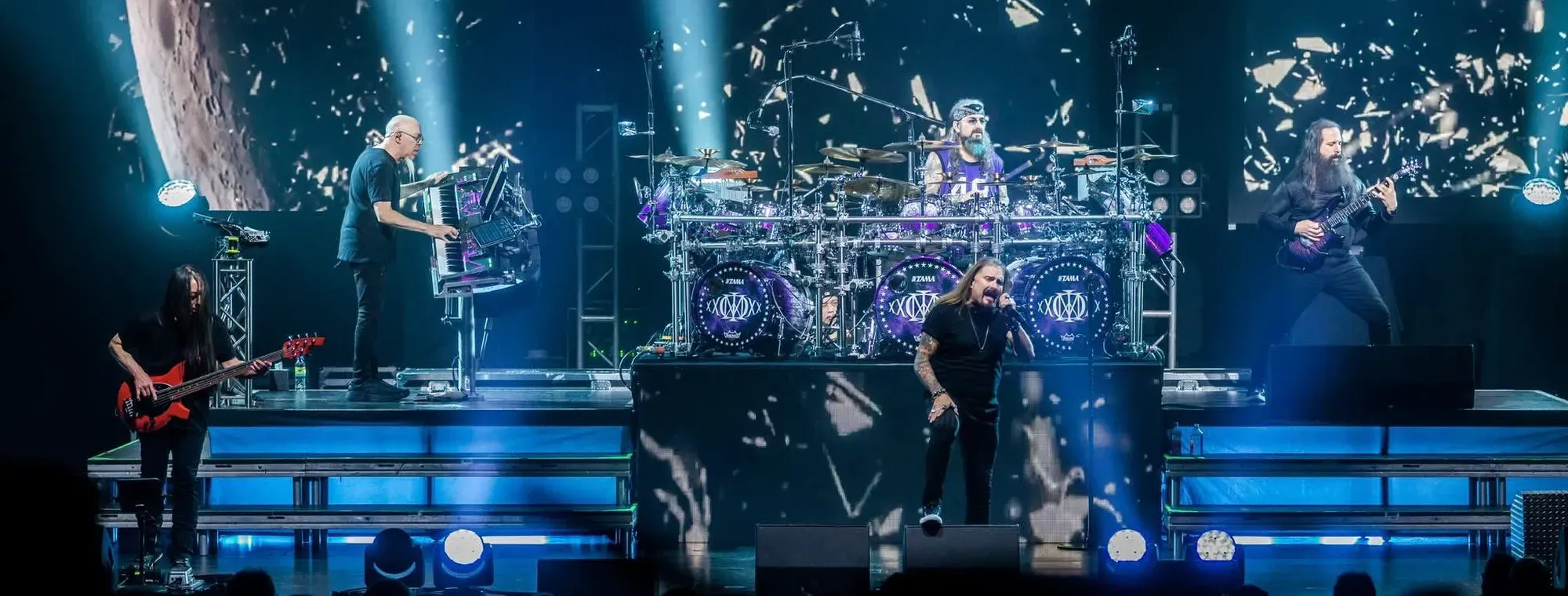
Originally published in Drum Club magazine · February 2019
Distance Over Time – Mike Mangini
By Text by Susy Marinelli
InterviewTranslatedMike Mangini17 min read
Translated from the original language with Google Translate, so the wording may differ from what was actually said.
A touch heavier, a touch less symphonic, and – above all – the unchanged (extremely high) standard of performance that has made Dream Theater one of, if not the, most renowned bands in so-called new progressive rock. These are the words that, in a nutshell, sum up the content of Distance Over Time, the Boston band’s new album, out February 22, 2019...
With the new Distance Over Time, Dream Theater reaffirm their full caliber in terms of sound, spirit, energy, and interplay. Excellence epitomized in a band, one might say... Mike Mangini (born in 1963) contributes to this result, bringing not only his pioneering drumming but also his songwriting prowess to this new album – out February 22, 2019, via InsideOut/Sony Music.
Joining Dream Theater in 2011, Mike Mangini takes over Mike Portnoy’s drumming chair: a daunting task, one he masters to perfection thanks to his high-caliber drumming, his familiarity with the most intricate rhythms and scores, and his ability to immerse himself in the band’s vast fan base, spanning every corner of the globe. With albums like Awake (1994), Six Degrees Of Inner Turbulence (2002), Octavarium (2005), Black Clouds & Silver Linings (2009), Dream Theater (2013), and The Astonishing (2016), to name a few, Dream Theater have sold over ten million copies, earning them a worldwide reputation.
Born in Newton, Massachusetts, but of Italian descent (his grandparents are from Isola di Liri and Fondi, two towns in the Lazio region), Mike Mangini began playing the drums at the age of two and a half, captivated by Ringo Starr. From then until he was nine, he practiced up to four hours a day, trying to imitate Buddy Rich’s performances. His other influences included Bobby Colomby, Danny Seraphine, John Bonham, Neil Peart, and Terry Bozzio.
His first drumming engagements included Boston’s Rick Berlin Band and Steve Perry’s band (Journey), before immersing himself for a few years in the thrash metal of Annihilator. In 1994, he joined Extreme, replacing Paul Geary, and from 1996 to 2000, he was in the band alongside Steve Vai, for whom he recorded Fire Garden, The Ultra Zone, and the live album Alive In An Ultra World.
He won the title of “Fastest Drummer In The World” four times and published drumming methods, including Rhythm Knowledge and The Grid. From 2005 to 2010, he was a professor at the Berklee College of Music in Boston, then left to join Dream Theater.
Susy Marinelli: Let’s start, of course, with Distance Over Time, which came out three years after the previous album, The Astonishing. How would you describe it?
Mike Mangini: This is the first Dream Theater album where I also had an active role in the songwriting, so I’d call it a choral effort in every sense. I added heavier riffs and orchestrations that were different from the usual DT vibe: obviously, not Rage Against the Machine-esque stuff, but elements that relate to the band’s musical style.
SM: Was there a song that was particularly difficult to play in the studio?
MM: I’d say not. ‘Out of Reach’ and ‘Pale Blue Dot’ are among the most challenging tracks on the album, but I confess that the most complex and intricate music is actually the one that resonates with me. The more notes there are to play, the more I can feel the timing... Moreover, my brain is used to managing limb coordination and splitting movements and beats. Paradoxically, the slower moments, like ‘Fall Into The Light’ for example, are more difficult for me to play.
SM: You’re actually well-known for your familiarity with complicated scores... Plus, you’ve won the title of the world’s fastest drummer several times...
MM: Speed is just a tool that allows me to express myself better. I keep my drums far apart so I have to stretch a lot to hit them, and to do that I have to be really fast. However, the young death metal and speed metal drummers these days are much, much faster than me, especially with their feet. It’s something I haven’t done in a long time, but when I hit the drums, I hit them really hard! DT’s music requires wider movements, and I certainly don’t play like I would have ten years ago in a speed metal band. Basically, I haven’t been the fastest drummer on the planet with my feet for a while now, but my bare hands probably are... I’ve never seen anyone else with their bare hands be able to play 20 beats per second like I do! As for sticks, there are many methods, and many drummers have learned different techniques than me, but my speed is what they call “specific force, big hits.” And then there’s always the fact that, as I was saying, I sit far away from the drums, while most speed drummers position them very close.
SM: Let’s get back to the new album. What’s your favorite song?
MM: ‘Pale Blue Dot’ because it’s fun. I have a great sense of humor, and you Italians can relate. Coming from an Italian family, I’m used to eating good food, going to church every Sunday, making noise, having fun, and being surrounded by love and passion. That’s why I like to have fun and laugh even when I play, and ‘Pale Blue Dot’ has a really crazy beat I composed while giggling to myself.
SM: John Petrucci said that listeners will find spirit, joy, passion, and energy in Distance Over Time. It makes me think of a very positive message you want to convey...
MM: That’s absolutely true, John is right. He was excellent at bringing all those elements together, and I’m very proud of what he did, including making the right decision about the location where we went to create and perform the songs. We’re a group of people who get along well: spending time together last summer, playing music and sharing moments throughout the day, was fantastic, and... it paid off!
SM: A few words about the artwork by Hugh Syme, the artist who created several Megadeth covers. It’s a captivating and unique image: a robotic hand holding a skull, representing the past meeting the future: a message decidedly in the style of prog rock...
MM: Hugh created that image and then showed it to us for approval. He was the only one who could do something like that; he’s the best. In fact, DOT [Distance Over Time] comes from a mathematical formula (Velocity = Distance / Time) where the D and T coincide with the initials of Dream Theater. At a certain point, while we were discussing the album title, we started talking about human evolution, about where humanity is going today compared to the past. John told Hugh about that conversation and he perfectly captured those thoughts. The cover image evokes humanity controlled by machines, in its search for the future while never forgetting the mistakes of the past.
SM: Let’s talk about your innate passion for the drums: you started playing when you were just five years old...
MM: Actually, I was already performing when I was five! I started practicing on a mini-drumkit that my maternal grandfather, who was a musician, gave me, and then I moved on to another mini-drumkit that my father gave me: at that point, I was three years old. When I was four or five years old, I played Beatles songs at family weddings, in front of three or four hundred people, and from then on, I got more and more into drumming.
SM: Who were your influences?
MM: The most important was definitely Ringo Starr. My brother and sisters always listened to Beatles records, and I could feel the energy and feeling of that music... And then there was Ringo’s smile, which was infectious: he was always smiling and lit up my heart. Ringo was my first love, and as such, you never forget it! Over time, my brother, who plays the saxophone, instilled in me a passion for bands with horn sections, like Chicago and Blood, Sweat & Tears, a new world for me at the time. Before that, I had been greatly influenced by Buddy Rich: his skill was incredible and a clear reference for me, as a jazz lover in general. After that, I ended up with Led Zeppelin and, consequently, John Bonham, who really changed me... in the end, I fell in love with rock. Then, by force of gravity, I ended up with Rush thanks to Neil Peart. Then it was Terry Bozzio’s turn, then in Missing Persons, and then Frank Zappa, who introduced me to the world of his intricate music. Finally, I’d say Steve Vai.
SM: So your roots aren’t really in prog: how did you immerse your drumming in that territory?
MM: Well... in a certain way, it was prog rock that changed me. As I was saying, as a kid I was a die-hard Rush fan and practiced every day to the stuff Neil Peart played. Little by little, I got into the genre. I wasn’t a fan of bands like Ten Years After or ELP because I thought their music lacked Rush’s punch: in fact, Rush was quite heavy for me. To get back to your question, prog rock is in my roots, but the rougher, heavier kind; So, I found myself in unfamiliar waters the first few times I had to play those “lighter” songs with DT that, for example, our keyboardist likes so much...
SM: How has your life changed since joining DT?
MM: It’s changed in two ways: I have a little more time to practice and improve as a drummer and a composer, and, in my personal life, I have more time to cultivate my spirituality. In the past, I read books on all sorts of religions and philosophy because I wanted to understand and learn how to relate to myself and others. These readings led me to a deeper spirituality, even if they didn’t necessarily make me a better person. To become a better person, in fact, you have to reflect on life: life in general and your own life. Since joining DT, I’m less stressed and I’ve probably grown as a person. In any case, I have more time to reflect, to reflect on the mistakes I’ve made and process them. I’ve learned to be kinder, to care about others and not just myself, since being a musician often leads you to be very selfish, to only care about what you see, what you feel, what you want. There’s only you, and that can be very dangerous...
SM: In March, you’ll be leaving for the Distance Over Time tour: can you tell us how you’re preparing? You do specific exercises behind the drums, you follow a diet...
MM: A diet? [laughs] My diet is probably yours, the one of us Italians who are used to eating everything! I still go to my parents’ house for lunch every now and then... My mother is almost ninety and says she’s retired, so my father has taken her place in the kitchen... now he’s the one making the ravioli! As for the tour, I’m currently practicing the songs from the setlist for a two-and-a-half-hour show, but I’m doing it very slowly, two or three hours a day. Working this way leaves me time for family, like helping my children with their homework, teaching them catechism, playing with them, and also to do some housework, fixing things that break...
Original text
Distance Over Time – Mike Mangini
Testo di Susy Marinelli
Un tocco più heavy e uno meno symphonic e – su tutto – l’invariato (elevatissimo) standard esecutivo che ha reso i Dream Theater una delle band, se non la band, più blasonata del cosiddetto new progressive rock. Queste le parole che, in buona sintesi, possono condensare i contenuti di Distance Over Time, il nuovo album della band di Boston in uscita il 22 febbraio 2019...
Con il nuovo Distance Over Time, i Dream Theater ribadiscono tutta la loro caratura in quanto a sound, spirito, energia ed interplay. L’eccellenza sintetizzata in una band, verrebbe da dire... A tale risultato contribuisce Mike Mangini (classe 1963) che in questo nuovo album – in uscita il 22 febbraio 2019 per InsideOut/Sony Music – porta non solo il suo drumming da caposcuola, ma anche la sua abilità di compositore.
Con i Dream Theater dal 2011, Mike Mangini eredita lo sgabello di Mike Portnoy: un compito arduo, che riesce a sostenere alla perfezione grazie al suo drumming d’alta scuola, alla sua dimestichezza con le ritmiche e partiture più intricate ed alla capacità di entrare nel respiro della band e dell’enorme seguito di fan sparsi in ogni latitudine del globo. Con album come Awake (1994), Six Degrees Of Inner Turbulence (2002), Octavarium (2005), Black Clouds & Silver Linings (2009), Dream Theater (2013) e The Astonishing (2016) giusto per citarne alcuni, i Dream Theater vendono oltre dieci milioni di copie, guadagnandosi una stima di proporzioni planetarie.
Nato a Newton (Massachusetts) ma di origini italiane (i suoi nonni sono di Isola di Liri e di Fondi, due cittadine del Lazio), Mike Mangini inizia con la batteria all’età di due anni e mezzo, folgorato da Ringo Starr. Da quel momento e fino ai nove anni, studia fino a quattro ore al giorno cercando di imitare le performance di Buddy Rich. Tra le altre sue influenze ci sono Bobby Colomby, Danny Seraphine, John Bonham, Neil Peart e Terry Bozzio.
Tra i suoi primi impegni di batterista, c’è la Rick Berlin Band di Boston e la band di Steve Perry (Journey), poi si immerge per qualche anno nel trash metal degli Annihilator. Nel 1994 entra negli Extreme in sostituzione di Paul Geary e dal 1996 al 2000 è nella band che affianca Steve Vai, per il quale registra Fire Garden, The Ultra Zone ed il live album Alive In An Ultra World.
Si aggiudica per ben quattro volte il titolo di “Fastest Drummer In The World” e pubblica metodi di batteria, tra cui Rhythm Knowledge e The Grid. Dal 2005 al 201 O è un docente del Berklee College of Music di Boston, poi lascia l’incarico per entrare nei Dream Theater.
Susy Marinelli: Partiamo naturalmente da Distance Over Time che esce a tre anni dal precedente The Astonishing, come lo descriveresti?
Mike Mangini: Questo è il primo album dei Dream Theater nel quale ho avuto un ruolo attivo anche nella composizione: di conseguenza, lo definirei uno sforzo corale in tutti i sensi. Ho aggiunto dei riff più heavy ed orchestrazioni differenti rispetto al consueto mood dei DT: naturalmente, non roba alla Rage Against The Machine, ma elementi in grado di relazionarsi con lo stile della musica della band.
SM: C’è stato un brano particolarmente difficile da suonare in studio?
MM: Direi di no. ‘Out Of Reach’ e ‘Pale Blue Dot’ sono fra le tracce più complicate del disco, ma ti confesso che la musica più complessa e intricata, in realtà è quella a me più consona. Più note ci sono da suonare, e più riesco a sentire il tempo... Oltretutto, il mio cervello è abituato a gestire la coordinazione degli arti e a splittare movimenti e beat. Paradossalmente, i momenti più lenti, vedi ‘Fall Into The Light’ ad esempio, sono per me più difficili da suonare.
SM: In effetti sei molto noto proprio per la tua dimestichezza con le partiture complicate... oltretutto ti sei aggiudicato più volte il titolo di batterista più veloce del mondo...
MM: La velocità è solo un mezzo che mi consente di esprimermi al meglio. Mantengo i miei tamburi distanti così che sono costretto ad allungarmi parecchio per colpirli e per farlo devo essere velocissimo. In tutti i casi, i giovani batteristi del death metal e speed metal di oggi, sono molto, molto più veloci di me, soprattutto con i piedi. E’ una cosa che non faccio più da tanto tempo, però quando colpisco i tamburi, lo faccio in maniera davvero hard! La musica dei DT richiede movimenti più ampi e certamente non suono come avrei fatto dieci anni fa in una band di speed metal. In buona sostanza, da tempo non sono più il batterista più veloce del pianeta con i piedi, ma le mie nude mani probabilmente lo sono... Non ho mai visto nessun’altro a mani nude riuscire a suonare 20 beats al secondo come faccio io! Riguardo alle bacchette, ci sono molti metodi e parecchi batteristi hanno imparato tecniche differenti dalla mia, ma la mia velocità è quel che si dice “specifically force, big hits”. E poi c’è sempre il fatto che, come ti dicevo, io mi siedo distante dai tamburi, mentre la maggior parte dei batteristi speed li posiziona molto vicini.
SM: Torniamo al nuovo album, qual è il brano che ti piace di più?
MM: ‘Pale Blue Dot’ perché mi diverte. Sono dotato di un gran senso dell’umorismo e voi italiani potete capirmi bene. Venendo da una famiglia italiana, sono abituato a mangiare buon cibo, ad andare in chiesa ogni domenica, fare casino, divertirmi ed essere circondato da affetto e tanta passione. Per questo mi piace divertirmi e ridere anche quando suono e ‘Pale Blue Dot’ ha un beat decisamente pazzo che ho composto mentre ridacchiavo tra me e me.
SM: John Petrucci ha dichiarato che in Distance Over Time gli ascoltatori troveranno spirito, gioia, passione ed energia. Fa pensare a un messaggio molto positivo che voi volete dare...
MM: E’ verissimo, John dice bene. Lui è stato eccellente nel mettere assieme tutti quegli elementi ed io sono molto orgoglioso di ciò che ha fatto, incluso l’aver preso la giusta decisione riguardo alla location in cui siamo andati a creare e suonare i brani. Noi siamo un gruppo di persone che vanno d’accordo tra loro: il fatto di stare tutti assieme per un po’ la scorsa estate, suonando e condividendo i vari momenti di una giornata, è stato fantastico e... ha sortito i suoi frutti!
SM: Due parole sull’artwork ad opera di Hugh Syme, l’artista che ha creato diverse copertine dei Megadeth. Una immagine accattivante e singolare: una mano robotica che trattiene un teschio e vuole rappresentare il passato che incontra il futuro: un messaggio decisamente nello stile del prog rock...
MM: Hugh ha creato quell’immagine e poi ce l’ha mostrata per l’approvazione. Lui era l’unico che potesse fare una cosa del genere, è il migliore. In realtà, DOT [Distance Over Time] arriva da una formula matematica (Velocità=Distanza/Tempo) là dove la D e la T coincidono con le iniziali dei Dream Theater. A un certo punto, mentre parlavamo proprio del titolo dell’album, abbiamo preso a parlare dell’evoluzione umana, della direzione odierna dell’uomo rispetto a quella fatta in passato. John ha parlato a Hugh di quella conversazione ed ha ben interpretato quei pensieri. L’immagine della copertina si rifà all’uomo controllato dalle macchine, alla sua ricerca del futuro ma senza dimenticare gli errori del passato.
SM: Parliamo della tua innata passione per la batteria: tu hai cominciato a suonare quando avevi solo cinque anni...
MM: A dire il vero, mi esibivo già quando avevo cinque anni! Ho cominciato a praticare su un mini-drumkit che ebbi come regalo da mio nonno materno che era un musicista, e poi sono passato ad un ulteriore mini-drumkit regalatomi da mio padre: a quel punto, avevo tre anni. Sui quattro/cinque anni suonavo canzoni dei Beatles ai matrimoni di famiglia, davanti a tre/quattrocento persone, e da lì in avanti sono entrato sempre più dentro il drumming.
SM: I tuoi riferimenti quali sono stati?
MM: Il più importante è stato sicuramente Ringo Starr. Mio fratello e le mie sorelle ascoltavano sempre i dischi dei Beatles ed io sentivo l’energia e il feeling di quella musica... E poi c’era il sorriso di Ringo che mi contagiava: sorrideva sempre e mi illuminava. Ringo è stato il primo amore e, come tale, e non si scorda mai! Col tempo mio fratello, che suona il sax, mi ha trasmesso la passione per le band con le sezioni dei fiati, tipo Chicago e Blood Sweat & Tears, un mondo nuovo per me allora. Prima ancora mi aveva influenzato parecchio Buddy Rich: una abilità mostruosa la sua ed un riferimento marcato per me che amo il jazz in generale. Dopodiché sono approdato ai Led Zeppelin e di conseguenza a John Bonham, il quale mi ha proprio cambiato... alla fine, mi sono innamorato del rock. Poi, per forza di gravità, sono arrivato ai Rush grazie a Neil Peart. E’ stato quindi il turno di Terry Bozzio, all’epoca nei Missing Persons, e poi di Frank Zappa che mi ha fatto scoprire il mondo di quella sua musica così intricata. Infine, direi Steve Vai.
SM: Le tue radici, quindi, non sono propriamente nel prog: come hai fatto ad immergere il tuo drumming in quel territorio?
MM: Beh... in un certo modo, è stato proprio il prog rock a cambiarmi. Come ti dicevo, da ragazzino ero un fan accanito dei Rush e praticavo ogni giorno sulle cose che suonava Neil Peart. Via via sono entrato dentro il genere. Non ero un fan di band come Ten Years After o EL&P poiché per me alla loro musica mancava il punch dei Rush: infatti, i Rush erano abbastanza heavy per me. Per tornare alla tua domanda, il prog rock c’è nelle mie radici, ma quello più ruvido e heavy; quindi, mi sono trovato in acque non familiari le prime volte in cui, con i DT ho dovuto suonare quei brani più “leggeri” che, ad esempio, piacciono tanto al nostro tastierista...
SM: Com’è cambiata la tua vita da quando sei entrato nei DT?
MM: E’ cambiata sotto due profili: ho un po’ più di tempo per praticare e migliorarmi come batterista e come compositore e, riguardo al mio privato, ho più tempo per coltivare la mia spiritualità. In passato ho letto libri su qualsiasi religione e filosofia poiché volevo capire e imparare a confrontarmi con me stesso e con gli altri. Queste letture mi hanno condotto a una spiritualità più profonda, anche se non necessariamente mi hanno reso una persona migliore. Per diventare una persona migliore, infatti, devi riflettere sulla vita: la vita in generale e la tua vita. Da quando mi sono unito ai DT sono meno stressato e probabilmente sono cresciuto come uomo: in tutti i casi, ho più tempo per riflettere, per ripensare agli sbagli che ho fatto ed elaborare. Ho imparato ad essere più gentile, a preoccuparmi degli altri e non solo di me stesso, visto che il fatto di essere un musicista spesso ti porta ad essere molto egoista, ad interessarti solo di quel che vedi tu, che senti tu, che vuoi tu. Ci sei solo tu e ciò può essere molto pericoloso...
SM: Nel mese di marzo partirete per il tour di Distance Over Time: ci dici come ti stai preparando? Fai degli specifici esercizi dietro i tamburi, segui una dieta...
MM: Una dieta? [ride] La mia dieta è probabilmente la tua, quella di noi italiani abituati a! mangiare di tutto! Pensa che ogni tanto vado ancora a pranzo dai miei... Mia madre ha quasi novant’anni e dice di essersi messa in pensione, così il suo posto in cucina è stato preso da mio padre... adesso è lui che prepara i ravioli! In quanto al tour, al momento sto praticando con i brani della scaletta di uno show di due ore e mezzo, ma lo sto facendo con molta calma, due o tre ore al giorno. Lavorare in questo modo mi lascia del tempo per la famiglia, tipo aiutare i miei figli a fare i compiti, insegnare loro il catechismo, giocare con loro e, inoltre, per darmi da fare in casa, aggiustare le cose che si rompono...