

Originally published in InsideOutMusicTV YT channel · November 2018
full band interview
Interview26 min read
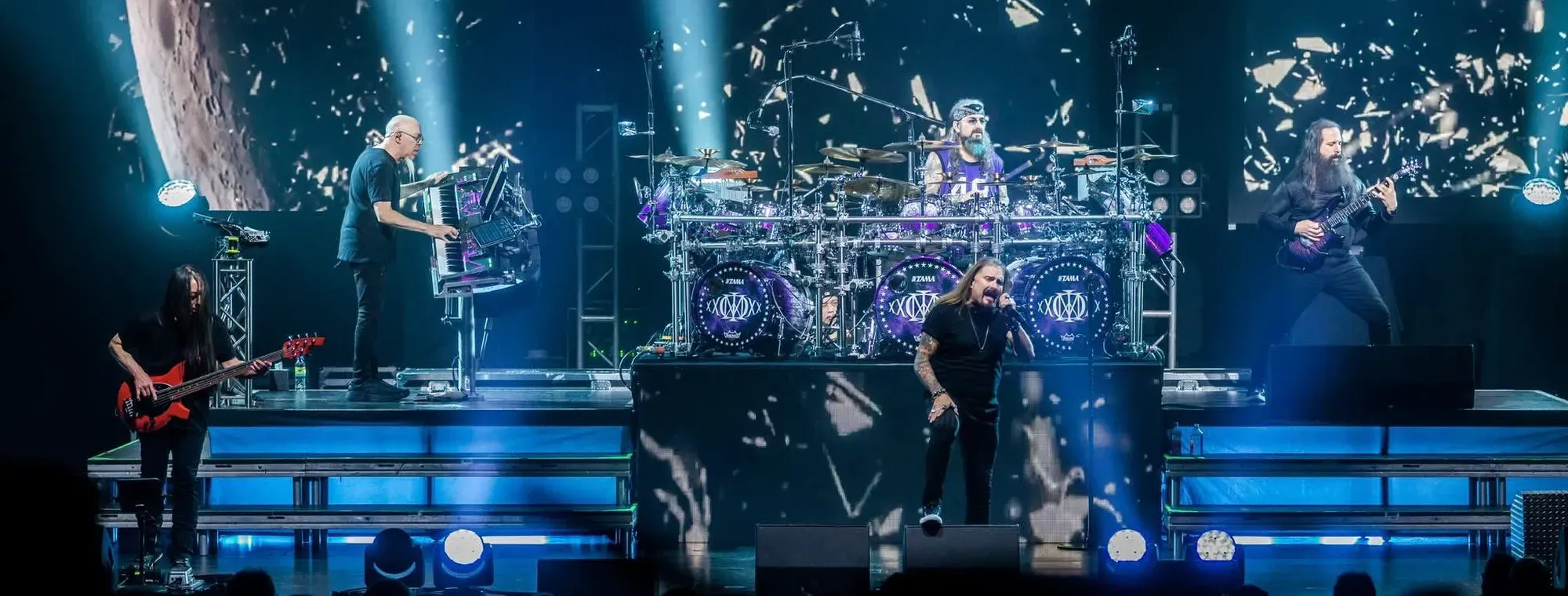
Roie Avin: I’m here with the legendary Dream Theater, holed up in their secret, hidden location, recording their 14th upcoming studio album. I’d like to talk about how this process got started, the writing. When did you guys decide that it was time to work on a new album?
John Petrucci: Well, first of all, let people know that we put a hood on you and put you in a trunk and drove you up here, so you don’t know where you are right now. [lots of laughs]
RA: I really don’t. I couldn’t find my way back home if I tried!
JP: Well, the idea was to do something differently than the last few albums, where a bunch of them we wrote in studio, more of a traditional setting. But we haven’t really done this thing where we all went away together, just to a remote place where we can live and write and hang out and bond and—
Mike Mangini: —eat—
JP: —eat and cook and just be brothers and musicians. We probably haven’t done that since, I don’t know, since Images or something.
Jordan Rudess: I never did.
JP: He never did it with us.
JR: Now that I’ve done it, I don’t know! [laughs]
JP: And he wants to go back to the old way.
RA: Well, that’s a lost art today, right? Recording albums. Everybody just shares files online and everybody’s in their remote home studio with great equipment. What drove you to do that this time around? Just to get a different feel and see if the songwriting changed somehow?
JR: We wanted to reconnect and check out each other’s personalities. Yeah, just be together and make it happen.
MM: But it’s the sound in here, too. It affects the way the songs get put together. It’s echoey and live and vibrant, so it tends to affect how you write, right?
JP: Yeah, absolutely. I think we needed it as a band. You know, the last record Jordan and I wrote together, and it was not a very collective situation, and it was a whole different thing. And I think for the psychology of who we are and to reconnect and get everybody joined into a more collaborative scenario, I think it was really necessary in a kind of cathartic way to do it this way.
James LaBrie: Yeah. I also think when you first put a band together the first thing you’re doing is you’re in a room, all of you together, jamming and playing live off the floor. That’s exactly what was happening here. It’s very spontaneous, everything, because some guys suggest this, but it’s worked out right there in the moment. So you have that excitement, that energy. And it feeds on and it leads to the next part. And it leads to the next part. But it’s just that it’s very electric in here. You’re sitting there and you’re feeling each other’s energy, each other’s interaction. The ideas are going like that and it’s like, “OK, yeah, let’s try that!” And it’s all very experimental. But at the end of the day, you actually have something and you’re listening back and then it feeds to the next session when you come in the next day. And the fact that we’re around each other the whole day, you’re having conversations in between. It might be John and Jordan, or John and Mike, or John Myung and Jordan, or myself, and we’re having conversations about the music. Where is it going? Where is it bringing us to? “Wait a minute!” You’ll see somebody run out.
MM: It helps keep us focused, too. You know, where we have a list, a few dozen ideas, and everyone has their snippets and stuff like that, but being here, really, you know which idea to do, which one not to do.
RA: Does the sort of the sequencing and the idea of how you want the album to go start to evolve as you’re starting to write riffs and you can target, “Oh, this is a good opener” and “This might be a closer” and you start to put things together?
JP: Yeah, although at this point in time, we really haven’t done the final sequencing. We do know what the album closer will be, just because it just screams “album closer.” So we’re still working on that. But, it’s funny, even the first song that we wrote together, after being on the road touring, we did back-to-back tours of The Astonishing and then the Images And Words 30th anniversary. And you think to yourself, even though it doesn’t really, in the end, pan out this way, but the very first thing you write – I don’t know about you guys – but you’re thinking, “What are people gonna hear after all that time as the first thing?” And so the first song that we wrote, “At Wit’s End,” which we call “Song One,” just has this energy of if somebody hasn’t heard us for a while, what have these guys been up to? It had all of that energy in it because it was the first thing that we wrote.
RA: How much of going back and playing Images And Words for the first time in its entirety on tour influenced the direction or the writing this time around?
JR: That’s a really good question. I think it’s so great to connect with the root of what this band is about. I wasn’t there for the writing of Images And Words, but I’ve enjoyed playing it so much through the years, and I value it as a core Dream Theater album. So at a time like this when we all wanted to get together and we wanted to vibe together and reconnect with what it is that makes up Dream Theater, it was really actually amazing to go out and play Images And Words and appreciate that and take that in and use that information to come into this and create what we did.
RA: With the new album, you also have a new record label, InsideOut Music. Talk about how that happened and why the changeover. I know you guys have a relationship with Thomas, who’s the head of the label. Talk about that a little bit.
JP: It goes way back. It goes back, well, [turning to James] you have a relationship already.
JL: Yeah, I mean, I’ve done five solo albums with InsideOut. But, I mean, Thomas was a fan, first and foremost. Thomas was coming out on the Images And Words tour. We’d see him at several shows and then finally, having conversations with him, getting to know this guy and knew how passionate he was about music in general. So the natural course for him, or evolution for him, was to actually be a part of the industry. So it wasn’t very surprising. “I’m starting my own label.” Really? “Yeah.” So throughout the years, Thomas, aside from my working with him with my solo band, he would just constantly be around each and every one of our album releases. Once we got out there, once we’re up behind the album touring it, we’d always bump into him at least three or four times on that tour. So when it came to this chapter, we knew that he was going to be one of the labels that was definitely interested in seeing if we wanted to go with him.
JP: I remember meeting him for the first time a long time ago. It might have been one of the first times we actually came to Europe. I remember he was talking about this band IQ. At the time, he was really into IQ. Like James said, he’s just stayed in contact all that time. I think it’s cool for him, if I may speak for him, being at one point a fan and now working together professionally. It’s like he like shares his thoughts and opinions and creativity with us in where he’s coming from – it just has a lot of credibility. He’s not just a typical exec guy, he’s coming from a guy that’s a really genuine fan of the music and the genre. It’s really cool.
RA: You guys have had your share of ups and downs with record labels that’s been documented. Has it been different with InsideOut in that regard, since he’s someone you’ve known for so long and he’s a fan of this music and a fan of the band, that it’s been maybe more comfortable?
JR: What’s interesting to me about the whole process is that when I first joined this group 20 years ago, we were of a whole different kind of mindset – the way that we dealt with the labels and people in the business. When we were in our recording process creating an album, there was nobody that had anything to do with it. Nobody heard it. We didn’t talk about it. When we were done, then we said, “OK, here it is.” And it was kind of like a thing. Slowly but surely, over the years, over many years, we relaxed that and came to more of a point where we felt like, “You know what? Involving the people that we work with can be a really good thing.” So fast forward to being with InsideOut and working with Thomas, especially somebody who’s been with the band for so long, the whole thing has come together. Now we’re more open. We look forward to working with the team. We like hearing what Thomas has to say, and it’s a new way for Dream Theater. I think it’s more open, it’s more productive, everybody’s having a better time, and it really works for us.
JL: If there was anyone that we would actually allow to come in and actually speak about the music, I can’t see very many people beyond Thomas where we’d actually say, “OK, what do you have to say?” Because usually that was, the door’s closed, no. Let us do our thing and here you go. But he’s known the band intimately when it comes to the music since the very beginning. And he’s been extremely vocal over the years with whatever we have released. He says to us, “Yeah man, loving it, yeah it was great to see it,” or whatever he might have to say. So it was an industry person, if I may say so to come in and have that – Thomas is the guy that we’re going to go, “You’re not coming from a place where you don’t get it. You do get it. You know who we are.”
JP: I think it’s also important to say, just on a professional level, anybody that gets involved with Dream Theater is somebody who believes in what we’re doing. Because we’re not the typical band, genre-wise. It’s not pop music. And I have to say, even with the previous labels and everything, we had great relationships – the last several records with Roadrunner, and we had a great time with everybody there. They’re wonderful, amazing people to work with. We just felt at this time it was time to do something different after several records with them. But it’s important to say, I think, that whatever label that we were on – there’s not many – that we did work with some really incredible people, very professional, very artistic and creative, that put a lot behind Dream Theater. So this is another step in a positive direction, something new.
RA: What has it been like recording here, and how long have you been here actually writing and working on the album?
JP: I didn’t have the beard before. [lots of laughs]
MM: We booked like, what, two months to write it, and we did it in 18 days.
RA: That’s a lot faster than normal for you guys?
JR: How many notes is that a day?
MM: [mimicking Dr. Evil] One hundred million! [laughs]
JP: Actually, the writing pace is pretty typical for Dream Theater as far as how long each song takes to get written. The thing that slows down the pace of a record is whether or not we’re in a studio writing and simultaneously recording, because that always takes really long. Or if we just write together and then we quickly demo it and move on. So like Train Of Thought, similar record, we wrote it in three weeks. This one we wrote in three weeks. Nothing fast or slow about that pace. It’s pretty normal. But the fact that we booked this place from June until September, I guess, so it’s four months total... We actually wrote in this room. Let’s talk about the room for a second. Jimmy T and Maddi did some scouting, and I believe Jimmy T, our engineer, found this place, checked it out, and discovered that there was this beautiful room in the middle of wherever we are. It’s built as a professional studio, but the original owner sold it and moved everything out, so there’s no equipment in here. But it’s all professionally wired and ready to go. It’s a beautiful, beautiful studio. So we decided to just set up all our gear. We’ll mic it up, literally. How many mics were on the drums?
MM: Four.
JP: Four. Everything was just like, as we write a song, they set us up with a very easy way to just record. “OK, press record.” And we live demoed everything. So we literally write, finish the song, struggle to play it. “OK, you think we can do it?” So all the demos are live. And then the original plan is we were then going to move out of here and go into a professional studio and start tracking drums. Ae point, we looked at each other and went, “Why would we move out of here? Let’s just stay here.”
JR: “This is amazing.”
JP: Yeah, and not only that, but the vibe that we captured, I think, in the songs – the energy and the spirit – we didn’t want to lose that by moving somewhere else. So Jimmy T and Maddi spec’ed out what it would be require to be able to record here. We had to buy and rent some microphones and preamps and stuff, and they did it in like a weekend. And we recorded the entire record. It’s pretty crazy.
JR: We turned the place into a full-fledged studio.
RA: It looks amazing and comfortable which is great.
MM: James was right in that chair. And he sat there right in front of me staring, looking, observing [lots of laughs], conducting, bursting with melody. Right in that chair.
JP: And we picked who was going to cook. Mike made wings one night. James made burgers. I made chicken.
RA: Well, that was the only secret film to come out of these recordings was the burger sessions, right?
JR: We have some wing footage.
RA: That’s great. John, I want to ask you, conceptually, you guys have had a few concept albums – The Astonishing, obviously, being a major one. What can we tell people about this album without giving too much away?
John Myung: Well, we went back to what we used to do. Things, I think, were a little freer, not as limiting when we’re just all in a room working on stuff. And we all really care about how the process unfolds. So that’s the key. And as a result, I think, you hear it in the music.
RA: I did get to hear a little bit of it, and it sounds amazing. And there’s a few twists and turns in some of the other – I don’t want to give too much away – but quintessential Dream Theater, 100%. Is there pressure when you go into writing, especially this album, like you were talking with coming off The Astonishing and what you guys wanted to do with the fan base that you guys have? They’re so rabid and loyal, and they expect sometimes a million notes all the time. So is there pressure to write a certain way or release a certain album, or how do you remove that distraction?
JR: I think that we’re all just, first and foremost, we’re very dedicated musicians. We want to create something that is going to make us feel good, make us happy, make us smile, something that we think is cool. And of course, there’s a strong awareness of who our fans are, who we’ve played in public three million times, and we know what they react to. So while we’re creating the music that we love, we have a definite idea of what kind of music will affect an audience a certain way. So it would be wrong of me to say that we don’t even think about it, we just do it for ourselves. Yeah, we do it for ourselves, but we also are gonna be going out and playing this music. So we stay very clear on the energy that we’re putting out and what’s going to come back to us. So we might write a beautiful melody and say, “You know what, in this part, everybody’s gonna be singing along!” And we feel good about that.
MM: It’s not a distraction. It actually, it’s welcoming. I mean, we didn’t fall off turnip trucks. We know what they want. [laughs]
JR: And that’s the beauty of being a performing musician is that you put the energy out there and you get it back. So there’s that real awareness and we care about that when we’re creating our music. This album is just a lot of fun.
JP: It was fun. I was going to say it almost felt like less pressure in a lot of ways, because of just where we are and just being together and not having constraints of time, being in an expensive hourly studio or having distractions, having to go back and forth. It felt more fun, I think. And I think that spirit is in some of the songs as well.
MM: With that in mind, interestingly, we were speaking about each of the tracks. And we had a lot of humor going on here. One of the things that is funny in a comedy sense kind of way, but was the – I think the first thing heard was a riff John Myung played. And every time we went – this is funny – but every time we [said] “All right, let’s go with that riff”, it became another song! And then it’s like, “OK, all right, we’ll do that.” And then “All right, John play the riff again”, and it became another song, and we never did the riff! [lots of laughs] So finally the record was over. We’re like, “We finished. No, we’re not. We’re going to make a song out of that.” That riff was amazing!
JL: So in other words, the next album will be made with John Myung’s riff. [laughs]
RA: Wait, did that riff end up being a song?
MM: Yes!
JR: It did. We wouldn’t leave until—
MM: The last one we did. It got made, and it was the right time, though.
JR: And it turned into a big song, too.
JP: It’s so fun.
RA: James, lyrically and vocally for this album, where does this album lie for you, and what did you bring, maybe emotionally, to some of the lyrics and the music?
JL: Musically, I think that it’s brilliant what’s going on throughout this album from beginning to end. I think lyrically, I’m influenced by things that I hear in conversation, things that I watch, literature that I read. You know, just being a human being is basically the palette for anyone’s inspiration when it comes to a lyrical approach. Also vocally, to be quite honest with you, I’m not approaching this album any different than I would any other album. I listen to the song, whether it’s my own lyric or one of the other guys’ lyrics, I always like to jump into it, understand it as thoroughly as I can personally, and if there’s parts of it that seem a little unclear to me, then I’ll talk to the lyricist. But through that whole process, I pretty much know what kind of voice or what parts of myself I need to create as far as the sound and how I need to express it.
JR: I have a question. Did you bring out your true pirate self?
JL: That’s coming. That’s coming, yes.
JR: Not quite yet?
JL: Not quite yet.
RA: One of the things you guys have done better than any band in this genre and doing what you guys do, is really find space for the singing and the melodies between all the crazy instrumentation that’s always going on. How do you manage that? Is that ever a challenge? Is there ever a song that you intended it to have vocals, but it got too out of control and you have to find some space? Or really, it’s a marriage that works well?
JR: Well, I would say that we love to play our instruments, we love to be virtuostic, but I think most of all we love making music that is emotional and melodic, and we care so much about that, that the academic side of making music is secondary to wanting to make music with heart, making music that is gonna be possible for people to sing along with, and we really love that. So it’s that balance that I think sometimes separates what we do than a lot of other bands that are in that kind of virtuosic, proggy metal domain.
RA: Because sometimes lyrics can be forced in, but it never feels that way with what you guys do.
JP: Well, we don’t make it secondary. It’s not two different things to us. It’s a song, and the song has to be meaningful on all levels. It has to be meaningful musically, lyrically, performance-wise. Anything that happens in the song, even if it’s somebody’s solo, it could take away from a song or it could bring it to another level. And the vocals and the song structure and the melodic feel and the hooks and the message are not secondary to us – they’re just as important. It’s part of the whole big picture.
RA: Who is the biggest perfectionist when it comes to recording in the studio that needs a hundred takes?
MM: You’re asking the five of us that?! [lots of laughs]
JL: Everyone’s on that level. We only want to present our best.
JR: We’re really, really picky. As an example, I’ll be in my own world of being incredibly anal, picky about it, and then John will come in and will say, “Bbut Jordan, what about that measure?” And I’ll go, “Damn it, you’re right!” Or I’ll do the same thing to anybody else. “What is that note I hear? Maybe it’s not happening.” So we’re really all very aware of the picture of the way the music is being created.
MM: But we know that going in, so it doesn’t take us very long to record it. It’s not like we’re sitting there picking on every little thing. We just play and we’ll leave things, as we know that sometimes stuff comes out that you can’t repeat. And it’s got a soul.
RA: How often does it happen where you thought, “OK, we recorded the live demo, it’s done, we like it, lyrics were written”, and then you have an idea that we got to change it because this thing has to be put in the middle section. “I just hear it and I got to do it.”
JP: Sure.
JM: It was kinda like that with—
JP: Which one?
JM: The one that Mike came up with.
JP: Yeah, ‘Song Five’. Yeah, I would say things like that aren’t huge changes. They’re slight edits. And probably the difference this time is that because we wrote all the songs together and then we would have to play them live. Like, we forced ourselves to be able to play it live. You get a feel for if it works or not really on the spot. You’re not experimenting where it’s only on a recording. It’s like this weird thing that you just know. You’d look at each other and if something’s wrong, we’ll stop and, like, flag on the play. So there isn’t a lot of what you’re talking about. The things, like John said, they’re mild edits. Like, “Oh, that intro should have happened two more times.”
RA: When you’re holding a studio and you’re focused on your own music, how much attention do you pay to other bands, other music, other things that are going on? Do you still buy albums? Do you still listen to music? How do you treat that stuff?
JP: It might be different for everybody. I try to stay away from it.
MM: I’m just busy making it. That’s how I see myself, as a maker.
JR: When we’re in the process, I think when we were writing the music over whatever it was, 18 days, I don’t know about any of you guys, but there’s no time. Like, we are completely focused on what we’re doing. That’s why we get it done so quickly.
JP: Personally, I try to disconnect from anything out there before. It’s almost better after it’s all said and done and you’re in the recording mode and you’re thinking about production techniques and you might reference, “Oh, you know what? It’s a cool bass sound on this record. Check this out”, and you might try to go for things. But before that, during the creative process, I think you can get really dangerous if you’re listening to too much stuff and then you find yourself borrowing from this and that. I’m not into that.
RA: What are some of the best places that you’ve played and maybe some places that you haven’t played yet that you’ve always been dying to go to?
JL: One of the best places was Poland when we did the Woodstock Festival over there and we were in front of 750,000 people. That was pretty bizarre. That was surreal. That was like, “Oh my God.” I mean, as far as you could see, there was people going out there. I think they said they had four tiers of PA systems out, and each PA system was 100 yards away from the other. It was insane. It was crazy. For me, that was just an unbelievable experience.
RA: Yeah, that’s amazing. Anywhere you guys haven’t been able to play that you think about that you’d like to go to?
JP: We played in many, many, many countries.
JR: Yeah, we finally played in India not long ago. That was a place that for many, many years we were like, “OK, we’ve gotta play India, we’ve gotta play India.” And just, I guess, the last tour we played in India, it was pouring rain. There were about, like 5,000 people in torrential rain, nobody moved. What was crazy is—
JL: Well, we had to stop.
JR: It was exciting. So about five minutes into the show, we had to stop because it was lightning. And I was like, “Oh my God, we’re not going to play in India after all!” And then it stopped and we went back on stage and then we were able to get through the whole show. A bunch of soaking wet Indian fans.
JP: We haven’t played in Hawaii. I’d love to play in Hawaii.
JR: ...for about a one month long...
RA: Just book it and stay for a month. [laughs]
JP: And we haven’t played at all on the African continent. We haven’t played Morocco. We haven’t played South Africa.
RA: So you’ve still got some places to try and visit.
JP: So many of the countries that we play, including here in America and Canada, we’ve played some incredible places, but the ones that stick out – don’t you guys agree, like the weird, unique ones – like we’ll be in a palazzo in Italy, and the background will be this beautiful architecture. Or we played Roman ruins in France. You know, just like you’re out there, and it’s this unbelievable thing. Or in Greece on top of a mountain looking out. Those types of venues you remember as being just such great [experiences]. Because it could all blend in.
MM: The meaning is different. For me, I love seeing that because I’m such a sports fan. When I’m in the venue and I can see the championship banners for these teams that I watched when I was a kid, I go back. In fact, it distracts me! “1970... I remember...” it’s really fun. So it depends on what’s meaningful to you, I guess.
JP: We played bull rings in Spain and cool things like that. Because sometimes when you do the amount of touring that we’ve done, the venues could just all blend. You don’t know where you are, but the place stands out.
JR: But sometimes the audience will make it stand out as well. I remember the first time that – I guess it was the first time we played – in Istanbul. And we were playing along, playing this one particular song. And there’s this one part where the entire audience raised their fist, and I was scared, literally scared, because it was shocking to me. I didn’t know what was going on. All of a sudden, everybody in unison raised their fist, and I almost jumped, but I kept playing. So that was memorable. And recently we played in Manila and that was an interesting experience because the ride from the airport to the hotel was absolutely frightening. The guy was taking some kind of back route. But anyway, the audience was amazing. They were really a standout audience. They were so energized and so into it that it left a big effect. And the other place I was remembering the other day was Costa Rica. Remember when we played there? We didn’t know what to expect. We thought maybe it was going to be a mellow audience.
JL: El Salvador was pretty crazy, too.
JR: Yeah. But it was an amazing, memorable audience.
MM: We should make it clear that we don’t necessarily choose. We don’t book it. So when people say, “Why did you come to us?” It doesn’t work that way. It has to be routed. That’s tough business of trying to make a choice. So there are people that do that. So sorry.
JP: You’re right, because you can’t leave out – I mean, we’ve had such great experiences in South America – Brazil and Chile and Argentina, and Australia and Asia. I mean, it’s a whole realm into itself. And right here in America, just some of the coolest gigs. We’ve been doing this for a long time, so we’re very fortunate to have that experience.
RA: What about at this point with so many songs, picking a setlist? So is it a little easier when you know you’re gonna play Images And Words from beginning to end – so, all right, we’ve got half a set covered. But if you go into a new tour with all the songs to choose from, how do you pick? Who decides?
JP: We came up with this Excel spreadsheet, every album and every song.
RA: Do you know which songs you’ve never played?
JP: Yeah. It’s a weird balance because it’s based on, like you were saying at one point, how long of a show you’re playing, what songs you haven’t played for a while, and there’s some staple songs that you don’t want to disappoint people. They come to see the band. So it’s hard.
JR: Sometimes somebody just doesn’t want to play a song, and you have to respect that. So it’s always a challenge to get through.
RA: Is there a song that is, between the few of you guys, just the most challenging or exhausting because it’s long or – maybe “A Change of Seasons” or something? Is there something like that, that you still enjoy playing obviously, but it takes more out of you than another one, maybe.
JP: Sure. I mean, off the top of my head—
MM: After we learn it, yeah. It’s a whole different vibe, because after we learn it, it’s amazing. When we leave the stage, we have this little bubble conference and everyone talks. We know the five notes that were out of place in a three-hour show, and everybody knows it, and we’ll discuss it and like, “OK, well, let’s fix it now”, and then we move on to the next thing. It’s pretty cool. I forgot what I was going to say. [lots of laughs] I went back there. It was traumatic for a minute. I’m like, “Oh my gosh, I missed a note.”
JL: I don’t necessarily think it’s a song that’s intimidating. “I don’t want to go there, guys. I don’t feel it.” I think it does come down to what are some of the songs that we haven’t played for quite some time. You know, and we know that the fans love these songs, but we haven’t played them for maybe a few tours or even longer. Maybe it’s about time to bring that one back or that one back. Like John said, we have that Excel program where everybody submits the songs that they would like to see. And whoever else is also saying that same song, it like, “OK, well, there’s three guys out of the band that really want to do that song that we haven’t played for 15 years live. Let’s do it,” or whatever. But I think it does come down to trying to create a balance. We pretty much know what the fans really wanna hear. And if we don’t play maybe two or three of those songs, they’re going to be somewhat upset. But it’s a little more challenging as you stay in the industry longer.
MM: I remember what I was going to say – that once we learn it, it becomes one – it’s almost like the set’s just one giant song. So there’s nothing, there’s not one piece of it that’s necessarily challenging. The whole thing is, and you just want to get that perfect show and play it all right. I don’t know.
JP: Yeah, that’s true.
RA: But I suppose between you guys being the perfectionists that you are, you’ll never admit you played a perfect show, right? Or do you?
JP: No.
MM: It’s unbelievable how many – I know for me – how many times it’s gone to the last, the last chunk. And the minute, or the second I think, “Ha, ha, ha! I did it!” I was like, bing, doink, pfft.
JP: It’s like you’re pitching a perfect game and then you’re at the last—
MM: I give up a home run. You’ve got to be kidding me if I did that.
RA: So at what stage is the album right now as we’re sitting here, and how much more work is left to go?
JP: Well, the only thing left to do is the recording of the vocals, and James is about halfway through that process. So all of the instruments are recorded. And we’re just at that last stage. We’re probably just a couple weeks away. End of September we should be done.