

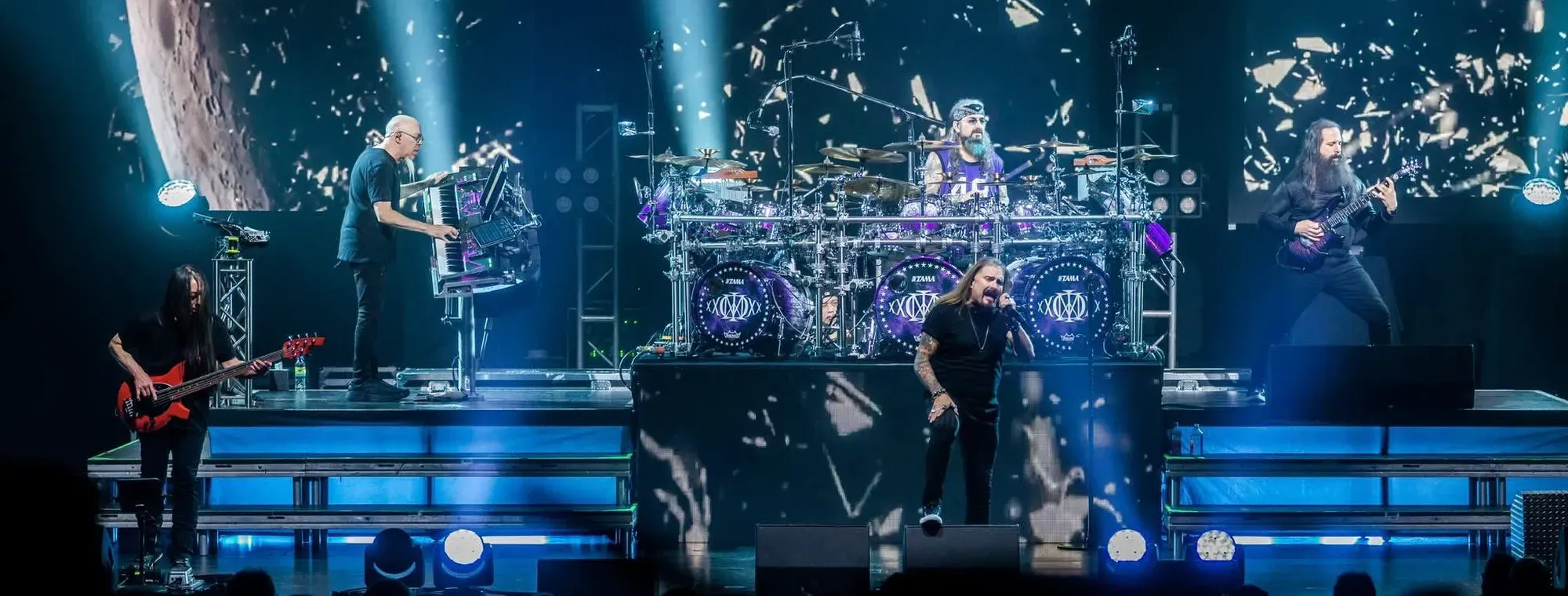
Originally published in Music Aficiando.com · 2016
Dream Theater’s John Myung Is Sweet on the Jelly Jam
By Joe Bosso
InterviewJohn Myung8 min read
For bass virtuoso John Myung, 2016 is all about life on the road. Currently in the middle of an extensive world tour with Dream Theater, supporting the epic 34-song rock opera The Astonishing, Myung is looking forward to shifting gears and playing dates with his second band, The Jelly Jam, later this year.
“Tour, tour, tour,” Myung says enthusiastically. “All’s going great with Dream Theater. Everybody’s settled into the new record – the audience, the production crew. We’re all in a really good groove. And as for the Jelly Jam, the plan is to utilize any and all breaks. I welcome it – it’s sort of become my purpose to do as much as possible. This summer there will be a window, and hopefully at the end of this tour we can assemble something.”
The Jelly Jam, which also includes King’s X guitarist-vocalist Ty Tabor and Dixie Dregs/Winger drummer Rod Morgenstein, will release its fourth album, Profit, May 27. Commitments to their respective main bands kept the trio from working together for much of the past five years. However, the three managed to convene at Myung’s home studio in Long Island, where they recorded the majority of the new record during two 10-day sessions.
Myung is, of course, no stranger to concept albums – Dream Theater have issued a number of long-form narratives, including the two-hour-plus ‘The Astonishing’. With ‘Profit’, he and his pedigreed bandmates focus on “the fight between progress and jobs at all cost, and not thinking about any future payment that is going to have to be made.” The album’s bounty of chops come in the form of slick grooves, elegant vocal harmonies, ferocious guitar solos, and melodies that stick themselves in the thicket of your senses and stay there.
Myung sat down with Music Aficionado to discuss the band’s freewheeling, experimental approach to the new album, as well as his methodical practice schedule for Dream Theater’s ‘The Astonishing’ tour.
As a bassist, do you approach the Jelly Jam differently than Dream Theater?
The material is very different, of course. It’s more about us writing shorter songs that are catchy. We don’t venture into prog the way Dream Theater does. To me, music is music – it doesn’t matter whether it’s jazz or classical or anything. It’s a bunch of notes that resonate. Sometimes the story is visual; other times it’s lyrical.
I can’t really compare the two situations. Dream Theater is very established – we’re 30 years into our career. It’s a different intensity and focus when we go about writing. The amount of time and money that is spent, the resources that are available – it’s night and day compared to the Jelly Jam. The Jelly Jam gets together for about 10 days and we try to come up with 45 minutes of music, and it’s done with nominal amounts of gear that I set up in my home studio. It’s about starting with little seeds of ideas and seeing them unfold.
Over the course of how many years I’ve been doing this, the most satisfying thing to me is collaborating with other people. The end result is more rewarding. I don’t know if I could ever be happy working on my own.
Do you ever have song ideas for Dream Theater that end up with the Jelly Jam?
That has happened. If I have an idea that the other guys aren’t into and if it’s something I feel passionate about, I feel as though it’s important on a personal level to turn it into a song. One of the blessings about Jelly Jam is that I can take out some of those ideas and bounce them off of Ty and Rod. It’s a really cool thing to have that secondary outlet.
And what’s really cool is when the ideas start to unfold and they become songs, and when that happens it’s almost like there’s this stream of consciousness that takes place. People lock in and [it’s] just the perfect thing – nothing they do is wrong. It’s really cool. I love those moments when you look at one another and you’re like, “Do you hear that?” I never get tired of that. It’s so rewarding.
Rhythm sections are all different. When playing with certain drummers, some bassists lay back a little, while others lean in more. How do you lock in with Rod?
Rod sort of sets the energy tone and creates the world that I live in. He’s got a really amazing feel, and I feed off of it. It’s spatial – there’s a lot of space and room for melody, so I work with that. To be honest, when he’s playing, the best thing I can do is listen. He gives you a lot to work with, but you have to be tuned in.
Do you use different gear in the Jelly Jam to try to get a different tone than you do with Dream Theater?
As far as gear, there’s more concoctions that I came up with at home. The introduction for Water is more of a distorted chordal bass part that I played through a Mesa/Boogie Rectifier and into a guitar cabinet, and I harmonized that with bass pedals underneath. I was a little more experimental, and that happens when you have the time and freedom to explore.
That experimentation really extends to just the way I allow myself to play. I’ll find myself playing for three hours sometimes, just letting my hands go. When I do that, I find myself listening differently. Things have a way of sounding more musical than they did before I started playing. And then if something sticks out to me that has some merit, I’ll record it.
What were your basses for the record?
I used my custom Music Man Bongos. I’ve been using them from a while now. Some of the tracks might have been with a prototype, just because some material has been with us for a while, so I was in a prototype phase at that point. I’m really happy with the Bongos – they’re great basses.
Both “Stain on the Sun” and “Water” marry classic rock and grunge in a way that’s reminiscent of Alice in Chains. But to my ears, Alice kind of tipped their hats to King’s X.
Yeah, I think I know what you’re talking about. It’s funny – we don’t toss around references like that when we’re working on music; if it happens, it’s just a fluke. Things mature into songs in their own way.
I hear some noticeable blues elements in your playing in the song “Mr. Man.” Is that an influence or genre you can expand on more in the Jelly Jam?
That song is my favorite type of writing, when you can come up with a riff or a groove and it’s the foundation for the whole song. It’s repetitive, but it’s interesting enough so that you don’t get tired of hearing it. I didn’t think of it as being blues or not blues; to me, it’s a cool groove that we were able to turn into an arrangement.
With Dream Theater, you’re playing ‘The Astonishing’ in its entirety – that’s 34 brand-new songs. When most bands tour, 60 to 70 percent of their sets comprise material they’ve played for years.
That’s a really interesting point. The way I approached the new Dream Theater set was to look at it as one two-hour song. There was no other way to accomplish internalizing something like that. What good would it have been if I only knew songs one, two, and three really well, but I didn’t have the other 31 songs down as well? So what I did was, one day I played through the whole thing, and then during the course of a month I would play a song a day. After that, I isolated certain parts of songs that I needed to concentrate on. And then I went back to some individual songs – things I needed to get tighter on. But it was that month of learning a song a day that really made me feel comfortable with everything. When I was done with that portion of things, I was ready to tackle the entire album from beginning to end. It was something that really pushed me – I’ll say that.
John Myung’s Top 5 Tips for Bassists:
1. Get a copy of the book Writing Down the Bones: Freeing the Writer Within by Natalie Goldberg.
These aren’t arbitrary pieces of advice per se; this is more of a five-part exercise that I’ve been doing myself. The first part involves getting a copy of Writing Down the Bones: Freeing the Writer Within. It’s a book about writing down stories and getting through writer’s block. Some of the concepts are a little Zen-like, but I think you can apply them toward anything. In my case, I applied them to bass. Rather than working with words and text and quotes, I create musical words with notes. Tips two, three, and four relate to that thought.
2. Find patterns utilizing the tones 3, 5, and 7 of a scale.
Allow yourself to play those notes in any configuration you wish. You can play those notes sharp or flat, as well, and that will enable you to create even more patterns. After you’ve gotten into a groove and found out how that sits with you, those patterns can be viewed as words.
3. Find patterns utilizing the tones 1 and 3 of a scale.
Again, play the notes any way you want – you can go sharp or flat – and see what kinds of patterns or words you can come up with. Settle into that and let it become part of your physical memory.
4. Find patterns utilizing the tones 5 and 7 of a scale.
Same as tips two and three – create different combinations with these tones. The important thing is that you know where you are within the diatonic scale, as if it’s a shape. You kind of know what it is you’re working with because you can visualize it.
5. Combine tips one through four.
What this means is, you’re viewing an hour of time as a page in a notebook. One of the important things in Natalie Goldberg’s book is that you allow yourself to write anything. It doesn’t matter what it is – just play. I do this myself. I view it as what I do to warm up, to maintain callus or hand strength, which is such a big part of being a bassist. If your hands and fingers aren’t conditioned, the sound will change in ways you might not want. So keep your hands and fingers in good shape so that your playing will be consistent.