

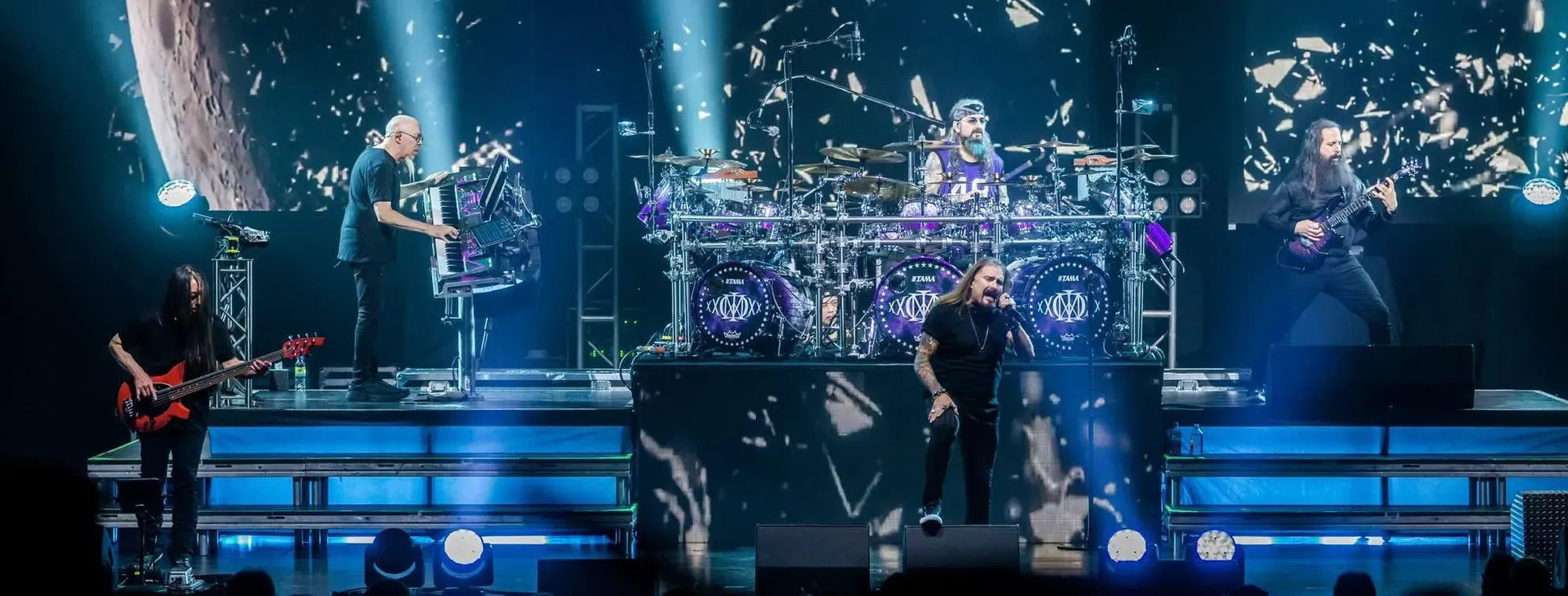
Originally published in Fireworks magazine 60 · November 2013
Dream Theater
InterviewJohn Petrucci11 min read
If 2011’s A Dramatic Turn Of Events proved that Dream Theater could function perfectly well without their former drummer and band leader, then the new self-titled album is further proof, if any was needed, that they can continue to challenge themselves and make music of the highest calibre. Phil Ashcroft caught up with John Petrucci in London to find him in a very positive mood indeed, despite his busy schedule.
“We were in Berlin for a couple of days before this, and then we go to Paris and then Stockholm,” he explains without a hint of irritation before going into the reasons for self-titling the album at this point in their career. “It’s a good question as it’s obviously not our debut album. We wanted to illustrate to the world that we were making an album that we felt was a strong and confident statement, even twenty-seven years into our career, that we’re still very passionate and confident in our band and the future, and pushing things forward, but also being able to look back and pay tribute to and respect our past. The timing felt right after A Dramatic Turn Of Events, it felt like that was a bridge to get us to this point. Now we feel a sense of freedom and a desire to push forward in a very positive way. It also creates a bit of mystery and intrigue, it’s served its purpose of giving the fans something to talk about, it’s created a lot of anticipation.”
Despite its contemporary sound, Dream Theater is nearer to the style that first made them popular than some of their releases in the previous decade.
“It definitely maintains those initial stylistic leanings that we had when we were younger,” agrees the guitarist. “We were very much into progressive music and progressive rock, like Yes, early Rush, Pink Floyd, Genesis and stuff like that, but we were also into hard rock and metal like Metallica and Maiden, so we naturally combined those styles when we were young guys, teenagers and into our early twenties. Some of our early music had that spirit, along with a strong melodic side that we’ve always felt was a very important element in any kind of music. This album retains that, but at the same time it has an edge to it, a very in your face kind of spirit that an album like Awake or Train Of Thought might have, and a very adventurous spirit that an album like Octavarium might have, that same progressive and metal mixture as an album like Images And Words. It definitely pays respect to our past but pushes forward, in my opinion, to also sound like it’s something new, something fresh in our arsenal of music.”
The writing and recording of the album has followed a similar process since they decided to do everything themselves after a bad experience making Falling Into Infinity with producer Kevin Shirley.
“In this case there are some similarities in that ever since Scenes From A Memory when we went into the studio in about 1999, we decided at that point we wanted to write and record and have the whole experience in the studio, skip the demoing phase and just lock ourselves in there, shut out the outside world, and be as creative as we could. We’ve been that way ever since, with the exception of maybe Train Of Thought”, explains Petrucci. “It has a similar vibe to all the albums since in that we did it the same way, we went into Cove City Studios in New York, set everything up and wrote together as a band. There were a couple of differences on this one, we brought in Rich Chycki as an engineer and mixer. From the very beginning we were not only going to mic everything up and be ready to record, we were going to dial in the exact sounds that would be on the album from the very beginning. If anyone had any moments of inspiration we were able to record anything on the spot at the moment it was being written, and often we did end up using it on the album. At the same time it was very clear the kind of album we were making because sonically it was almost already mixed and it was very close to what you’re hearing on the finished product, even in the first couple of weeks. That was something that was different to how we’d done it before.”
Whilst most of the album was written in the studio, the band do prepare some bits and pieces on the road.
“We have some pieces but not really to the extent of entire songs demoed out, they’re more like seeds of ideas,” confirms the guitarist. “Obviously being a guitar player you can’t help but write and come up with riffs and I like to record all those moments. I have a whole collection of riffs, melodies, chord progressions and things like that, all archived and ready to go. As do the other guys, and sometimes when we’re on the road, during soundcheck we’ll refine some of those ideas and end up with one or two minute little seeds. A lot of them just remain as ideas, but as we get together and we’re writing, we sift through and we have them to pull from if we need them. If we’re writing a song and we remember a bit that might fit I’ll say ‘I have the perfect riff for that’, and I’ll call up the file and there it is. It’s not like we use everything we have, the real creative magic happens when we’re all in the studio together.”
The amazing Mike Mangini came in and played drum parts already written on a drum machine for A Dramatic Turn Of Events, but here it’s obvious his inventive playing is a big part of the new album.
“Yeah, Mike had a lot of input this time, he was there from the beginning. He’s not only a tremendous drummer who can pretty much do anything you can imagine, but he’s also very creative as well. When we were writing, all the instruments were live so we were able to jam with him immediately and try out ideas. We would say ‘Hey Mike, where would you take this?’ He was right in there and he had tons of great ideas and a really great attitude,” says Petrucci with obvious respect for his bandmate.
As with the previous album the production has fallen solely on Petrucci’s shoulders, not that he minds one bit. “I absolutely love it!,” he enthuses. “It’s something I discovered I was really into ever since Mike Portnoy and I started co-producing for Scenes From A Memory. I’m so into, not only sounds and soundscapes and the way everything comes across sonically, but all the psychology behind getting musicians to get to that point where they can shine for who they are and get the best performance out of them.”
I wondered if all the members had their own unique writing styles or if they all contribute to the different types of songs?
“That’s a very good question,” John concedes. “I think some us might have our leanings where we’re stronger at a certain thing, but in some capacity everyone is able to adjust to the different styles. For instance, as you said, if we were doing a section that was maybe a little bit simpler or more melodic or has bigger shapes to it, it’s not like Mike Mangini is sitting back there saying ‘I can only play technical and heavy’, he knows how to lay back and play in the pocket. Certain guys have their specialties. Jordan, having gone to Julliard and having a classical background can pull all those references, so if we want something in the style of Rachmaninoff or Chopin, he has that knowledge. Those big riffs and heavy and chunky rhythms usually come from me, as well as all those romantic melodies. So basically everybody has their strong points, but we’re all sensitive to those stylistic changes and that’s what makes us able to make this music as a band.”
It’s certainly obvious that James LaBrie’s vocal melodies have reverted back to the style used on earlier albums, complete with some harmony parts.
“Absolutely!,” states the guitarist. “I think what we’ve done on the last two albums is try to spend a bit more time making sure that the vocals were as strong as they could be, melodically speaking. When I listen to Scenes From A Memory it’s very easy for me to get into, not only the melodies but also the vocal performance. Part of that is being very conscious of James’ range when writing, James’ voice has an incredible range but he definitely has a sweet spot where he sounds really, really beautiful. We’ve sometimes managed to strip away the instruments and get down to some parts that are just piano and vocal, or acoustic guitar and vocal, and just sing along and see if it works, almost on a singer/songwriter level. You’re not the only person to mention that so I gather we’ve been successful at that.”
It’s strange that the band now have this accessibility to a lot of their music when they’ve finally found a record label in Roadrunner who just want them to be true to their legacy. John laughs at the irony.
“Yeah, we basically have the freedom to do whatever we want to do, this is our fourth album with Roadrunner and since we signed with them they understood that we’d become successful doing what we do and there’s a large audience out there, not only where we’re from in the US and North America, but on a global level, that really get into progressive music, progressive metal and instrumental music, all the things that we’re known for. We’ve always had a lot of support from the label and have never had any pressure at all from them to change what we do, so it’s a really great relationship.”
The band received criticism for the ‘growly’ vocals that Mike Portnoy had introduced on the albums prior to his departure. That style of vocal has been permanently abandoned by current line-up despite playing a big part of James LaBrie’s solo career.
“That’s not us, that’s not where we come from or what we relate to. James is an incredible singer with a very unique voice, he has a great range and a very soulful and sensuous voice, and he can also belt it out in a great rock and roll way, so there’s no reason to do anything different. To try to be something that we’re not is not what we’re about!” states Petrucci flatly.
With tour dates already announced for next year there’s the problem of what to put into the setlist.
“What’s going to help us on the next tour is that it’s going to be ‘An Evening With...’ so there won’t be an opening act. We’ll have more time to play, we’re going to do two sets with an intermission, but it’s still going to be difficult. If we want to pull out things like ‘Octavarium’ and some of our bigger epics, they take up a lot of time so obviously it becomes harder with the more music we record. Some bands when they come this far, and we’ve been guilty of this too, play medleys to solve that issue, but I hate medleys. You know you’re not going to satisfy everybody but I’d rather commit and play whole songs rather than little bits of each song.
“Changing the setlist every night is something that I’m sure fans who go to multiple Dream Theater shows probably appreciate, and it’s part of the culture that surrounds our listeners, a lot of jam bands do that, but it becomes counter-productive and almost impossible to try to put on a professional show. If you go to see Rush or Metallica, or Pink Floyd, or any big show where a lot of thought has been put into the video content, pyro or lasers or whatever, you can’t do that as well if you’re changing it every night. The crew won’t be together, the music suffers, the lighting director doesn’t know what to do, everything just becomes kinda sloppy. I’m sure some people would rather we do multiple nights of different sets but it really makes it almost impossible to make the show great. I think our show has become a lot better since we stopped doing that.”
The band have also cut down on the number of solo and outside projects, and whilst John doesn’t rule out the possibility of more solo albums and ‘supergroup’ projects, he feels no urgency to fill his time with other musical diversions.
“I’m totally satisfied within Dream Theater,” he says honestly. “It’s everything you could possibly wish for as a musician. Not only am I satisfied as a guitar player, but also as a songwriter, as a lyricist, as a producer and a performer. I put out a solo album in 2005 and people keep asking me when the next one is. I’m actually planning to do one, but I don’t feel like there’s an empty hole and I have something I need to get out because Dream Theater is so fulfilling.”
Mike Portnoy was heavily involved in most aspects of running the band. Surely the band have had to get involved in all manner of things to fill the void?
“I think we’ve spread it out more,” states Petrucci. “Obviously Mike did a lot of PR and other work behind the scenes, but we’ve certainly divided a lot of it among the band members, it’s the kind of thing where there are a lot of capable people in our band and in our organisation. Mike liked to be involved in everything and micro-manage things, but we don’t find that necessary now. It’s working out really well.”
The release of the album is followed by the much-delayed Live At Luna Park DVD, originally scheduled for April/May but finally hitting the streets on November 5th. John explains the reasons for the delay.
“The DVD is a very big project, it’s our biggest undertaking so far. There’s a ton of music, it was filmed over two nights, there are bonus tracks, a stereo mix and 5.1 mix, digital release, DVD and Blu-Ray release, theatre showings, 3D footage, a sixty page photo book, so many things that we weren’t able to make the proposed spring release date. We didn’t want the timing to clash with the new album, so we just pushed it back to November 5th. We wouldn’t want to disappoint the fans by putting something out before it’s the best that it can possibly be.”