

Originally published in Rhythm magazine 191 · July 2011
Mike Mangini – Dream Theater
InterviewMike Mangini14 min read
The battle for the most coveted drumming gig in the world is over. Dream Theater’s Mike Mangini tells Joel McIver about stepping into a certain drum legend’s shoes...
Dream Theater have never done things by halves. The biggest prog-metal band on the planet knew a year ago that when one of their founder members and drumming demigod Mike Portnoy chose to quit the band after 20 years, finding his successor would be damn near impossible. After all, how many players wield sticks like the multiple award-winning Portnoy?
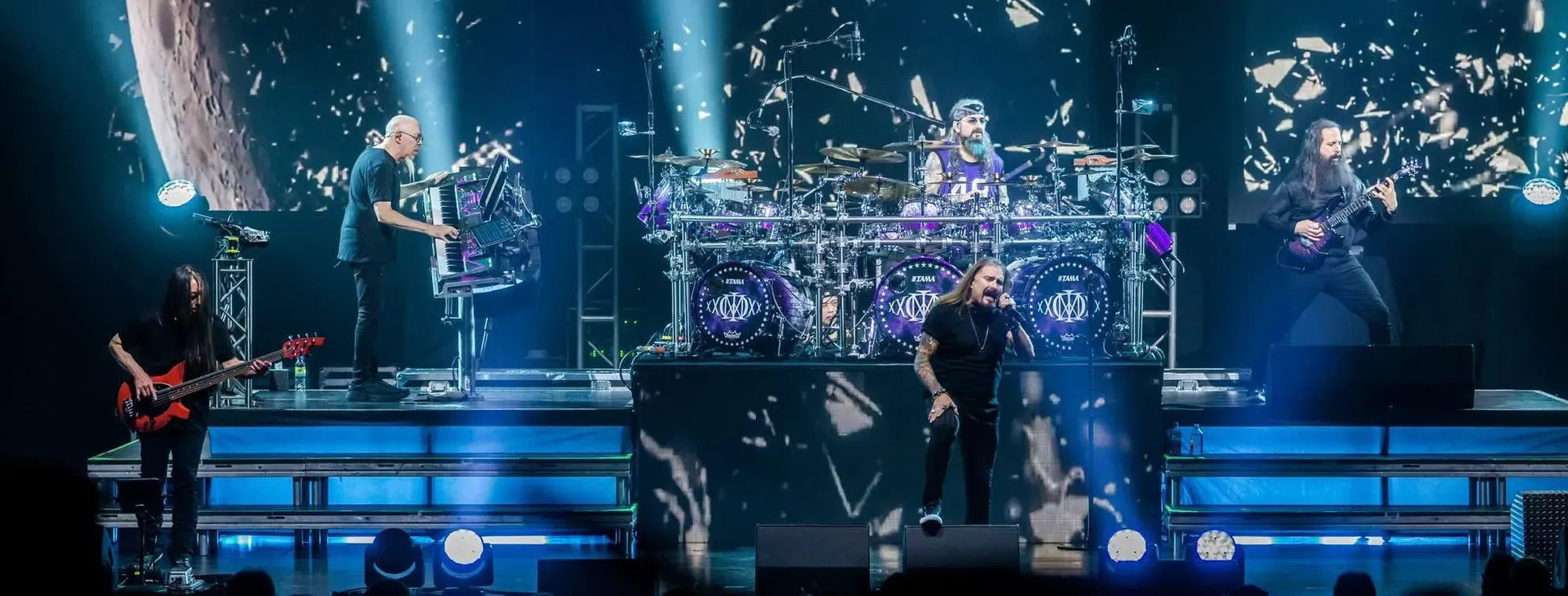
Hiring a camera crew to document the process, the band – singer James LaBrie, guitarist John Petrucci, bassist John Myung and keyboardist Jordan Rudess – spent most of 2010 setting up top-secret auditions for seven of the most experienced drummers in the business... and, while the metal world held its breath, made their decision at the end of the year. They still didn’t tell us what was happening, though, and while Portnoy has gone on to several new projects, news from the DT camp has been sparse to say the least.
Five months on, Dream Theater have finally broken their silence to reveal that the new man is Mike Mangini, a veteran of bands such as Annihilator, Extreme and Steve Vai, holder of three WFD world records for drumming speed (see YouTube for the frankly gobsmacking proof), a drum teacher at Berklee and a session ace with James LaBrie and others.
A chap with much to offer Dream Theater, then. Within days of the announcement, Rhythm was invited over to Mangini’s home studio in Quincy, Massachusetts to get his exclusive account of the audition process. Just don’t try to play tom rolls on his kit: you’ll end up looking pretty stupid...
Congratulations from Rhythm on landing the Dream Theater job, Mike. It’s one of the all-time dream gigs, isn’t it?
“It is. I only told my parents about it last week, so nobody should feel left out of knowing what was going on!”
You got the gig in late 2010, but it was only announced to the public on April 29, 2011. Was it tough keeping your mouth shut for all that time?
“It was terrible, ha ha! I only told my wife. But there was so much at stake: a very, very expensive [film] project designed to give back to the fans – the most generous thing I’ve ever seen in my life – and also my word. I’m with a new family now, who asked for my trust. The thing that really made it extra-double-triple difficult was that maybe a dozen or so people knew that I was auditioning – and all of a sudden they didn’t hear from me! I read so many online postings from fans who said, ‘People in the industry must know who the new Dream Theater guy is,’ and it was just not true. My own family didn’t know. It had to be like that, otherwise it wouldn’t have remained a secret.”
When Dream Theater asked you to audition, did you say yes immediately?
“I had no second thoughts! When the request came in, the first thought that came into my mind was that as much as I was kicking and screaming on different levels of life’s challenges, it was almost like it was supposed to be this way. I really wanted to grab the ball, just like when you’re on the bench at a soccer game and you need to be out on the field. They want that ball.”
Seven drummers tried out for the DT gig. Tell us about your audition.
“My audition was the first of the lot. All I could think of was, ‘Gee, on American Idol the first ones that audition just get forgotten!’ It was on 18 October, and we all had about three weeks’ warning. It was in New York City, about four hours’ train journey from my home, at SIR Studios. The whole band was there, plus a few crew people and their manager, and the videographers. We were all emailed three songs to learn, and with Dream Theater three songs means 30 minutes! They were ‘A Nightmare To Remember’, ‘The Spirit Carries On’ and ‘The Dance Of Eternity’.”
How did you find out who the other six candidates for the position were?
“We were all in a group email when we were sent the songs, ha ha! I admire them all very much, but I wasn’t communicating with them about this other than with Marco Minnemann, because we’d been on a drumming tour together in 2010. It was very brief: we just yakked a little bit as friends.”
What kit did you play in the audition?
“I just used whatever they had – a rented kit – but I did have my usual cymbal set-up, because I’d contacted Zildjian and got them to set it up. There were a lot of disadvantages to auditioning first, such as being the one who had to set up all the gear. Everybody after me at least had the drums on stands and the hardware bits in place.”
So did you feel much pressure?
“No, and I will tell you why. One of the things that I do when I prepare for an audition is to mentally visualise myself already there. So when I am rehearsing a song and I’m making mistakes, I imagine myself in a room with them making mistakes, to help me become comfortable with already being there. So it was the most fun ever, with one exception: when I started playing I hadn’t had a warm-up. I’d wanted to warm up because the drum configuration on the kit was radically different to the one I normally use, and the hardware didn’t allow it.”
What was the problem?
“My drumset is absolutely unique in the world: the toms don’t ascend from the left or right, they go from the middle outwards, even though I’m a right-handed player. So I had to jump into it cold, and despite critics thinking that I’m not a hard hitter because of my ‘world’s fastest drummer’ YouTube videos, which are a misrepresentation of how hard I actually hit, I was hitting the drums so hard that I disengaged a cymbal tilt the very first time I hit it. I had to stand up and fix it while I was entering a drum fill: apart from that, everything else was fun.”
Did you make any screw-ups in the audition?
“I played Mike Portnoy’s parts as spot-on as my ears would allow, with the exception of a few adjustments, and I’ll be very specific with you : I adjusted some of the transitions and some of the drum fills to orchestrally match the musicians. For example, in every song there was always a point in John Petrucci’s and Jordan Rudess’s solos where I picked my favourite lick and matched it. I also picked my favourite parts that James LaBrie sang, and accented them with the cymbals. Likewise with John Myung: where he was playing something slightly different to the recorded version that I knew, my eye contact was so intense. I was watching his foot and was able to predetermine what he was about to do, because I was so in touch with him. If John was going to anticipate rather than hit the beat, I was all over it.”
What happened after you had played the three Dream Theater songs?
“They sat down and questioned me about a lot of different things, like what I thought I would bring to the band and why I thought I was there. I made sure to let them know that I really love what they do musically, but also that I love that they use the gifts they’ve been given. I’m paraphrasing here, because I was babbling and babbling to them at the time, but basically I wanted them to know that I recognise that despite the critics who say, ‘You play too many notes,’ those guys respect the gifts that they’ve been given and they don’t shy away from using them. The other thing I wanted to tell them was that I love the previous parts and Mike Portnoy. Now this is very important: I had a career before Dream Theater, enough that I was on the cover of two drum magazines in 2010, so it’s not like I came out of nowhere – but I felt it was important to communicate my genuine respect.”
So you’re a fan of Portnoy’s drumming?
“I want to make sure the world knows that I’m gonna preserve Mike Portnoy’s legacy. I’m not faking it. I’ve known Mike for 15 years: we’ve hung out numerous times and he’s been very kind to me. It’s his darn seat, for crying out loud, and I’m gonna make sure I respect that. I mean it. It’s important, not just on an ethical level but also on a musical level.”
How did you find out that you’d got the gig?
“The first one to actually tell me that I got the job was James LaBrie. I received a group phone call from the band, two weeks after the audition.”
That must have been a stressful two weeks...
“Yes, with 27 exclamation marks! The entire band took turns to express themselves to me. To hear their excitement for the future was so amazing.”
Presumably they wanted a guy with the right personality as well as the drumming skills?
“Sure. If I had to sleep three feet away from someone on a tourbus, I would be concerned about his personality too!”
Let’s talk about your career up until this point.
“Well, Annihilator was my first major gig, in 1993. I’ll never forget arriving in London to play at the Underworld, or the feeling of going onstage, having rehearsed diligently for those people. I could hear the crowd screaming from the backstage and I couldn’t figure out what the noise was. I would have paid to be there: that’s how much fun it was.”
You moved to Extreme in 1994. Was that a major change of style?
Not really, in a way: the world will never, ever hear us playing the material that we constructed at soundcheck. That’s one of the saddest things in my career, right there. There’s a song from Extreme’s new record called ‘Comfortably Dumb’: that’s from my era. A lot of tunes like that came from my drum beats. After that I went to LA to work with Steve Vai.”
That must have been a lot of fun.
“Oh, man. It was a match made in heaven. Steve Vai dictates the drum parts to his drummers, and a lot of them don’t like that, but I liked it because Steve came up with great ideas that challenged me. He’d ask me to play things where I’d have to move my arms in a different way, and I used to laugh about it. He might ask me to hit a specific cymbal on a specific note, and in order to do that when I’m in the middle of a run – when my arms were on another side of the drumset – it was challenging for me to move my body and orchestrate it. I loved it.”
How would you sum up your drumming style?
“I’m an orchestrally-trained musician, but my passion is prog rock and heavy metal. Look at the band that I’m in, ha ha! My style fits into Dream Theater because I have an extraordinary passion for hitting a specific drum or cymbal with regards to the frequency relationship. I don’t just play a drum fill during a transition when the entire band is playing a riff: I play that riff, as note-for-note as I can. My drumset allows me to do what a traditional drumset does not allow.”
How did you come up with your unique tom configuration?
“It was because I played in the drum corps when I was at school: the marching band. I played tri-toms, which meant the high drum was in the middle, the mid drum was to the left and the low drum was to the right. If not for the invention of the cable hi-hat, I couldn’t do it!”
Have you been replicating Portnoy’s parts exactly, or are you bringing your own spin to them?
“Of course I have to put my spin in there: I think that everybody naturally does that. But I’m really not changing the beats or the fills too much: I’m playing his parts, except I might choose a 12” tom instead of a 14” tom – it depends. There are moments when I’m embellishing what the others are playing, because he recorded his original drum parts before he knew what everybody else was going to play. I did the same with James LaBrie: when I listened to the record, I said, ‘Oh, I didn’t know about this bit – I missed this and I missed that!’ As far as what people can expect from me on the tour, they should just listen to the record, because I’m gonna go there for the most part.”
Have the band given you any direction about playing like Portnoy, or not playing like him?
“The song is the song. It’s really not solely about Mike as it is about the band as a collective. The snare needs to be in a particular place because the band are used to it that way.”
Talk us through the unusual kick drum configuration in your Pearl kit.
“I have a 26” kick drum on the left, two 22” kicks in the middle and an 18” kick to my right, and on the far left and right I have an electronic trigger for each foot. So there are eight pedals, because I also have two cable hi-hats. I’ve been working on the drum set-up for years, and I didn’t know where I was gonna use it, ha ha! I play left-busy with this kit, because I don’t like the sound of two bass drums that are the same, unless it’s a standard double kick pattern. I like the different dynamics: I’ll hit the 26” kick drum on the downbeat of the measure but then add the 18” kick for a less important hit. I get so many people saying to me, ‘Why have you got so many bass drums?’ or ‘You should be able to do this with just one bass drum...’ Blah, blah, blah!”
They won’t have the balls to say that now you’re in Dream Theater.
“Ha ha! For once! But look, people who know me know that I like playing on a four-piece kit too. I think it would be a blast to do a Dream Theater acoustic set some day, where I play a simple, one hi-hat, four-piece kit. That would be so much fun.”
What are the other main components of your kit?
“My rack toms radiate out from the centre, as I said, and I use my signature snare. I also have the cannon toms up high because there’s no room for them down below. The kit is the way it is because I need it to complete my potential: it’s who I am, musically. I don’t play traditional drum fills where you’re just whipping around the kit – or not always, anyway: I play a melodic line on them.”
So tell us about the new Dream Theater album. Are there any particularly tough drum parts on there?
“I finished my drum tracks for the album some weeks ago – and yes! I’m trying to honour what I’m hearing, and there were some moves that I had to practise for hours and hours because they were co-ordination moves. I had to get my muscles used to hitting the drums with velocity, strength, power and feel. I’m not just talking about learning a drum part: I had to mix right and left parts in my brain.”
Did you feel that you had to stamp your mark on the album, as the new guy?
“Yes and no. Of course I do, but I’d do that anyway. I didn’t do any writing: I wanted to see what those four guys would come up with. It’s not just about the past with Mike: it’s about the future with me, too: I wanted to see what they’d do without any drummer and they wanted to write as a foursome. When JP informed me they were going to do that, I was in agreement, especially as I had more work to do on getting some new drum kit parts. I had to carry several thousand pounds of drum gear up and down three flights of stairs. I received new gear and had to disassemble the old and do it all over again because I was preparing one kit for the album in one room and changing my studio kit in another.”
Do you still have the same drumming speed that won you those world records?
“Oh yes. I never really practised for any of those speed records: I just warmed up. I did all my practising as a teenager. Honestly, I can wake up, get out of bed and instantly play 20 beats a second with my hands for 10 seconds. The muscle memory doesn’t forget that. My legs are a different story, though: I never practised my legs properly, and I had a bad knee injury. It was worse than those injuries with tears usually are and the recovery took three times as long. I missed many rehab sessions being subject to the schedules of two very small children at home. After surgery in 2009 I could only do 100bpm, and I had to prepare for a May clinic tour. I was still under 200bpm by that time. But I’ve had some time to practise, so things are pretty good now.”
What can we expect from the summer shows like High Voltage?
“Passion, for sure. I want to be a piece of this. I want the kit to be heard, like a tribal thing: I’d like to share some moods, and I’d like to satisfy people who haven’t seen me before. I’m good with whatever happens. I’m having a ball!”
Box
The Dream Theater Shortlist
The six other world-class drummers who auditioned for Mike Mangini’s job
1 Aquiles Priester: A fearsomely accomplished sticksman, best known for his work with Angra.
2 Virgil Donati: The elder statesman who has played with Planet X and many other bands.
3 Peter Wildoer: The ‘Wild’ card best known for his work with extreme metal band Darkane.
4 Derek Roddy: The blastmaster whose playing has anchored death metallers Hate Eternal and Nile.
5 Marco Minnemann: A thrash metal specialist who also plays technical beats with Joe Satriani.
6 Thomas Lang: Europe’s finest session drummer? Just ask proggers John Wetton and Robert Fripp.
Box
Mike’s Guide To Odd Time
Mike Mangini on playing odd time signatures
1 “Know what a polyrhythm is. It’s made up of at least two patterns happening at the same time.”
2 “Use your voice to hum out the pulse, while a limb divides the other notes.”
3 “Use another sense – like sight – to keep track of grouped notes: eg: a paradiddle of eight notes.”
4 “Don’t just play a triplet – everyone knows what that is [ie: try a more ambitious number]. You’ll feel a triplet, not count it!”
5 “Start with 19 notes: count to 10 and then to nine. That way you’re forced to develop your internal time.”