

Originally published in Metal Italia.com · September 2011
Dream Theater – A Dramatic Change of... Life!
by Dario Cattaneo · Published on 09/19/2011
InterviewTranslatedMike Mangini15 min read
Translated from the original language with Google Translate, so the wording may differ from what was actually said.
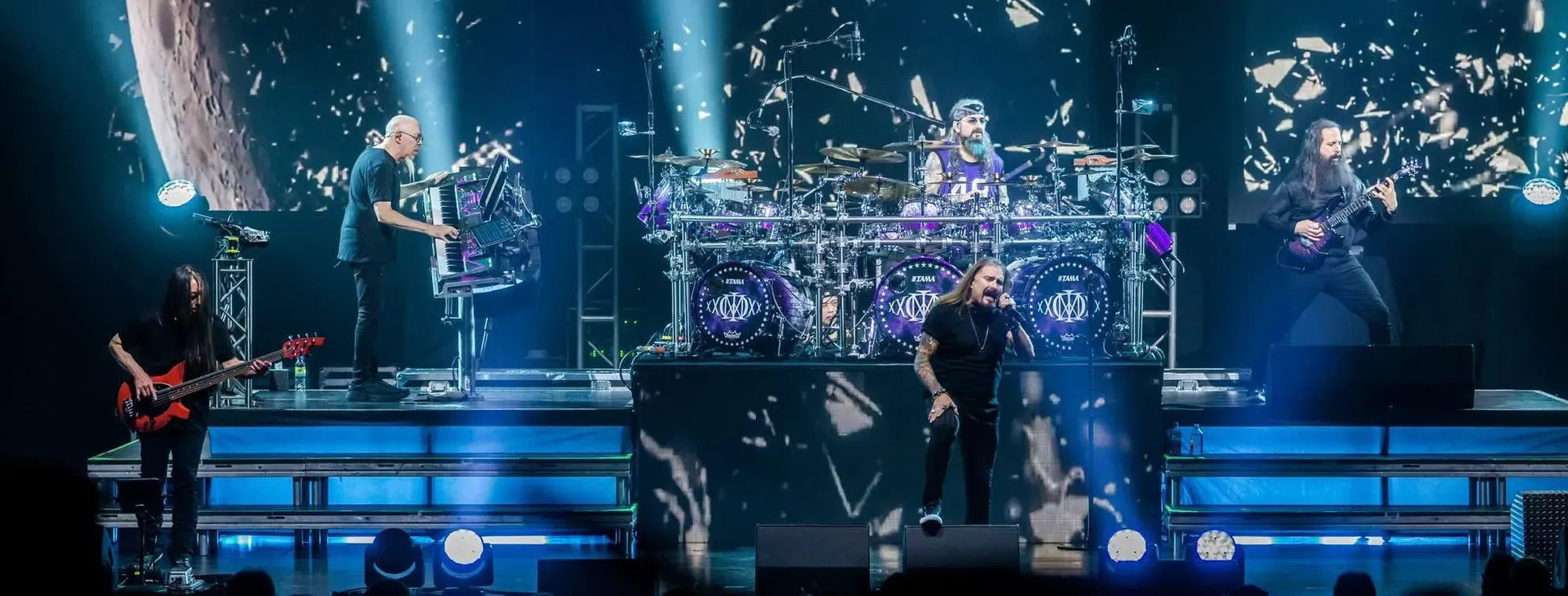
The feeling of a completely new atmosphere within Dream Theater is palpable even backstage. Before their concert at Verona’s Castello Scaligero, the second date for the new band led by Petrucci, the musicians’ faces seem relaxed. Even though immediately after the sound check, some of them are immediately engaged in a round of interviews for major Italian media, the desire to talk seems strong, and the atmosphere is relaxed. And a sense of relaxation is precisely what Mike Mangini, whom Metalitalia has the honor of interviewing first, offers us. He introduces us with a very long cigar in his mouth and casual gray shorts. In his hands: CDs, sticks, bands, cables... all things he’s just taken off the stage where he’s just finished setting up the evening’s drum set. Sitting on a sofa backstage, the drummer smiles, happy to tell us about his new adventure...
Dario Cattaneo: Is Mangini an Italian last name? Is part of your family Italian?
Mike Mangini: I’m Italian on both sides. Both my mother and father’s sides were from Italy. I love your homeland.
DC: Okay, you’re the new drummer for Dream Theater... can you tell us how you feel? How do you feel now that the real work is starting?
MM: There’s only one way to put it. I feel “complete.” I’ll give you an example: when I’m playing my drums, and there’s no one around, and I can put together my set just for fun—I can choose different toms, for example, or a different effect on the pedal, just to play for myself—I’m the happiest person in the world. And this is the only band, really, the only one that doesn’t want to discuss what I do with them! They want me to just express myself. And so, I couldn’t be happier.
DC: It shows in your expression too! Even during the audition, you were the one smiling the most!
MM: Yes, I’m happy when I play!
DC: While we’re on the subject of auditions... can you tell me which drummer you feared the most among your “rivals”?
MM: Well, my first impression was that the most dangerous one was Virgil Donati, because he played in a Dream Theater cover band. So, at first I thought he really knew their music; he’d learned it, not just heard it. I’d never learned it in that sense, I’d only listened to it. In reality, right after having this thought, I realized that the real rival was Marco Minnemann. Then, of course, all the people there were great drummers, so I had something to fear from each of them, but with Marco it was different. I played with him at a concert in London, and I realized that he learns what he has to play down to the smallest detail. He’s a perfectionist, and he has an extraordinary ability to get into the music he’s playing. So, that’s even better. Yes, I thought, he and Virgil have an advantage because of their knowledge of the songs. I knew they could play them perfectly. From a purely ‘mechanical’ point of view, everyone in attendance was incredibly talented. Everyone can play the drums at incredible levels. What made the difference was not the way they played, but the way they performed those particular songs. The skill was the same, the preparation different. But, to tell you the truth, in the end, what really got me chosen for this place was that I didn’t make any mistakes. None. Absolutely perfect. Both on their songs, in the improvisation, and in the jamming. The only places where I deviated from what was supposed to be done were to try something better, different, and in any case, I didn’t make any mistakes. It went well.
DC: Okay, let’s move on to the new album, A Dramatic Turn Of The Events. When you auditioned, were there any songs already finished?
MM: No, not even one.
DC: So you were able to participate in the songwriting process of the album?
MM: No, not at all. I’ll explain why. There are two reasons: the first is that I was a professor at Berklee College, a full-time job that I didn’t quit until I was sure I was going to be in the band, and I couldn’t leave without a notice period, especially because I have a family I love. Also, I had to build the drum set for Dream Theater. I had to practically memorize Mike Portnoy’s catalog and build list to find the right sounds for their songs. I had to study really hard; it’s a set that’s truly different from anything I’ve ever played, and it took me every day from December to February to buy and assemble all the pieces I needed. Three months! All by myself! I couldn’t tell anyone I was in Dream Theater, not even my family. So, I was really too busy to work on the album. The second reason is that the other four guys have been together for a really long time. And they’ve never had the opportunity to write anything without the cumbersome presence of the drummer. And I wanted to see what they could do! Don’t get me wrong, though, I don’t feel left out at all. I didn’t need to work on the album right now. I didn’t feel the need. And then, being new, I didn’t want to infiltrate too much, or at least not too soon. And you know how it went? I think fans will be able to hear Dream Theater as they would have been with Portnoy with A Dramatic Turn Of The Events! Because the music is 100% theirs, not another drummer’s! And let me tell you, the result is incredible!
DC: So the drum parts were written by the other members?
MM: The songs were written by them, complete, and with a drum track programmed by Petrucci himself. I wanted to hear how it would sound, what he would think. And then I was able to work on the samples, add my own, overdubbing on the drum machine. Of course, I haven’t had time to learn everything well yet, so what’s recorded so far is a mix. A mix of what I would play, what I think Mike [Portnoy] would play, and what the band saw as optimal for the compositions. You see? A combination of three things! Anyway, to return to the previous question, the second motivation was respect. Respect for Dream Theater’s music, wanting to let it evolve as it should.
DC: There’s been a lot of talk about styles: Portnoy’s style, yours, the fact of merging them into one. Could it be said that the point of contact between you and him is actually... Neil Peart?
MM: Yes! BELLISSIMO! [said in Italian] You could really say he influenced both of us. But he comes first. He wins!
DC: Can you tell us about the cover? Every element on it seems to convey a sense of danger, of instability. Is this what the band wants to communicate? That danger is just around the corner, that life is constantly in a precarious balance?
MM: That’s exactly the message. Too many things have changed so quickly for them. Not just the drummer change, but so many other changes that have profoundly affected the band’s outlook on life. You hit the nail on the head; that’s exactly the message.
DC: Just a little curiosity... is the sky you see beyond the door on the cover of Black Clouds And Silver Linings the same sky you see on the new album? The color and style are definitely the same, and Dream Theater have accustomed us to strange games and hidden meanings in almost all their covers...
MM: You know, you were the only one to notice this detail. No, I don’t think there’s any hidden meaning this time. Nothing the band could have thought of. The artist is the same, I think the similarity comes from that alone. Anyway, since you’ve introduced the topic, I have to say something about the cover, which you should tell everyone: when we posted the cover on Facebook, as always, some people liked it, others not so much. But there’s a trick. If you look at the cover on a big screen, in high resolution, your stomach flips. You feel the depth, you feel exactly like the man on the unicycle suspended in the void, a sensation that makes you hold your breath. You have to see it this way! In full resolution! The only way to truly appreciate it is to see it in giant format. You have to tell everyone this fact!
DC: But did the split with Portnoy and the other events you mentioned in any way influence the lyrical aspect of songwriting?
MM: No. I’d say no. It’s something you should ask John, John, James, and Jordan, but I don’t think it had any influence because now they’re totally free to express whatever they want. Take ‘This Is The Life’. It’s the first song I heard, and it was written entirely by Petrucci. I don’t know how it worked before, but I think everyone didn’t have this freedom before, since the songs had multiple authors. Now everyone is free to express themselves... so I don’t think this could have influenced the songwriting except for the better, or the lyrics either.
DC: But can you give us any more information about the album itself? How long will it be? Are there any very long songs?
MM: The album has it all. It really has it all, even for a Dream Theater fan. It even has songs without drums at all. You’ll be really happy to hear it! The only thing I can say is that the album is coming out soon. You just have to wait, let the man with the unicycle on the string guide you, and enjoy the music. You shouldn’t start with concepts like: ‘Oh, is it light?’, ‘Oh, is it heavy?’, ‘Is it long?’, ‘Is it short?’. No, just listen to it in its entirety and judge.
DC: One last question about tonight’s setlist. You included a single selection per album. Doesn’t that seem like a coincidence... is there a message behind it?
MM: Yes, definitely. Not mine, but I appreciated it nonetheless. It allows me to immerse myself in each album. To feel a part of all the albums. It allows me to immerse myself a little in Scenes From A Memory, a little in Awake... to be a part of the band’s history in every way.
Original text
Dream Theater – Un Drammatico Cambio Di... Vita!
da Dario Cattaneo
Pubblicato il 19/09/2011
Che all’interno dei Dream Theater si stia respirando un’aria tutta nuova lo si percepisce sin dal backstage. Prima del concerto al Castello Scaligero di Verona, data numero due per la nuova formazione capitanata da Petrucci, i volti dei musicisti sembrano distesi. Anche se subito dopo il sound check, alcuni di loro vengono immediatamente impegnati in un serrato giro di interviste per i più grossi media italiani, la voglia di parlare sembra essere tanta, e il clima rilassato. E proprio un idea di relax ci da Mike Mangini, che Metalitalia ha l’onore di intervistare per prima, che si presenta a noi con un lunghissimo sigaro in bocca e degli informali pantaloncini grigi. In mano: CD, bacchette, fasce, cavi... tutte cose che si è appena portato via dal palco ove ha appena finito di settare il drum set per la serata. Seduto su un divanetto del backstage il batterista sorride, felice di raccontarci di questa sua nuova avventura...
Dario Cattaneo: Mangini e’ un cognome italiano? Una parte della tua famiglia e’ italiana?
Mike Mangini: “Sono italiano da tutte e due le parti. Sia dalla parte materna che quella paterna, i miei parenti provenivano dall’Italia. Amo la vostra patria”.
DC: Ok, sei il nuovo batterista dei Dream Theater... ci puoi dire quali sono la tue sensazioni? Cosa prova ora che il vero lavoro sta iniziando?
MM: “C’è un solo modo di dirlo. Mi sento ‘completo’. Ti farò un esempio: quando suono la mia batteria, e non c’è nessuno intorno, ed io posso compormi il set al solo scopo di divertirmi, posso scegliere ad esempio diversi tom, o un diverso effetto sul pedale, con lo scopo di suonare solo per me stesso, io sono la persona più felice del mondo. E questa è l’unica band, davvero, l’unica che non vuole discutere ciò che faccio con loro! Vogliono che mi esprima e basta. E quindi, non potrei davvero essere più felice”.
DC: Si vede anche dalla tua espressione! Anche durante l’audizione eri quello che sorrideva di piu’!
MM: “Sì, sono felice quando suono!”.
DC: Gia’ che siamo in argomento audizione... puoi dirmi quale era il batterista che temevi di piu’ trai tuoi ‘rivali’?
MM: “Be’, la mia prima impressione è stata che il più pericoloso fosse Virgil Donati, perché ha suonato in una cover band dei Dream Theater. Quindi, all’inizio ho pensato che lui conoscesse veramente la loro musica, l’avesse imparata, non solamente sentita. Io non l’avevo mai imparata con quell’accezione, l’avevo solo ascoltata. In realtà poi, subito dopo aver avuto questo pensiero, ho capito che il vero rivale era Marco Minneman. Poi certo, tutti i presenti erano grandi batteristi e quindi avevo qualcosa da temere da ciascuno di loro, ma con Marco era diverso. Ho suonato con lui in un concerto a Londra, e mi sono accorto che lui impara quello che deve suonare fin nel più piccolo dettaglio. E’ un perfezionista, ed ha una capacità straordinaria di entrare nella musica che sta suonando. Quindi, è ancora meglio. Sì, ho pensato, lui e Virgil sono avvantaggiati per via della conoscenza delle canzoni. Sapevo che le avrebbero sapute fare alla perfezione. Da un punto di vista puramente ‘meccanico’, tutti i presenti erano mostruosamente bravi. Tutti sanno suonare la batteria a livelli incredibili. Quello che faceva la differenza era non la maniera di suonare ma il modo in cui si sarebbero eseguite quelle canzoni in particolare. La bravura era uguale, la preparazione diversa. Però, se ti devo dire la verità, alla fine quello che veramente mi ha fatto scegliere per questo posto è stato che non ho fatto veramente alcun errore. Nessuno. Assolutamente perfetto. Sia sulle canzoni loro, che nell’improvvisazione che nella jam. Gli unici punti in cui mi sono distaccato da quello che si doveva fare era per provare qualcosa di migliore, di diverso, e comunque non ho commesso errori. E’ andata bene”.
DC: Ok, passiamo al nuovo album, “A Dramatic Turn Of The Events”. Quando hai fatto l’audizione, c’erano gia’ dei pezzi pronti?
MM: “No, nemmeno una”.
DC: Quindi hai potuto partecipare al processo compositivo dell’album?
MM: “No, per nulla. Ti spiegherò il perché. Ci sono due ragioni: la prima è che ero professore al Berklee college, un lavoro full time che non ho lasciato fino a che non ho avuto la certezza di far parte della band, e che non potevo lasciare senza un periodo di preavviso, soprattuto perché ho una famiglia che amo. Inoltre, dovevo costruire il drum set per i Dream Theater. Ho dovuto studiarmi praticamente a memoria il catalogo e la lista della build di Mike Portnoy, per poter trovare i suoni giusti per le loro canzoni. Ho dovuto studiare veramente a fondo, è un set veramente diverso da qualsiasi cosa abbia mai suonato, e mi ha impegnato ogni giorno da dicembre a febbraio per poter comprare ed assemblare tutti i pezzi che mi servivano. Tre mesi! Tutto da solo! Non potevo dirlo a nessuno che facevo parte dei Dream theater, nemmeno alla mia famiglia. Quindi, ero davvero troppo occupato per poter lavorare al disco. La seconda ragione è che gli altri quattro ragazzi sono assieme da davvero tanto tempo. E non hanno mai avuto l’opportunità di comporre qualcosa senza l’ingombrante presenza del batterista. E volevo vedere cosa avrebbero potuto fare! Non mi fraintendere però, non mi sento assolutamente lasciato da parte. Non avevo bisogno di lavorare al disco in questo momento. Non ne sentivo la necessità. E poi, essendo nuovo, non volevo infiltrarmi troppo, o comunque non troppo presto. E sai come è andata? Che secondo me i fan potranno sentire con ‘A Dramatic Turn Of The Events’ i Dream Theater come sarebbero stati se Portnoy non se ne fosse mai andato! Perché la musica è 100% loro, non di un altro batterista! E fammi dire che il risultato è incredibile!”.
DC: Le parti di batteria sono state dunque scritte dagli altri membri?
MM: “Le canzoni sono state scritte la loro, complete e con una traccia di batteria programmata da Petrucci stesso. Volevo sentire come sarebbe venuto, cosa avrebbe pensato. E io poi ho potuto lavorare sui samples, aggiungere del mio, sovraincidendo sulla drum machine. Certo, non ho ancora avuto il tempo di imparare bene il tutto, quindi quanto registrato fino ad adesso è un misto. Un misto di ciò che suonerei io, di ciò che penso avrebbe suonato Mike (Portnoy, ndR), e di quello la band ha visto come ottimale per le composizioni. Capisci? Un insieme di tre cose! Comunque, per tornare alla domanda precendente, la seconda motivazione è stato il rispetto. Il rispetto per la musica dei Dream Theater, di volerla lasciare evolvere come doveva”.
DC: Si e’ parlato tanto di stili: lo stile di Portnoy, del tuo, del fatto di fonderli in uno unico. Si puo’ dire che il punto di unione tra te e lui sia in effetti... Neil Peart?
MM: ”Sì! BELLISSIMO! (detto in italiano, ndR) Si può proprio dire che lui abbia influenzato entrambi. Ma lui viene prima. He wins!”.
DC: Ci puoi parlare della copertina? Ogni elemento in essa sembra comunicare un senso di pericolo, di instabilita’. E’ questo che la band vuole comunicare? Che il pericolo e’ dietro l’angolo che la vita e’ in costante equilibrio instabile?
MM: “E’ esattamente questo il messaggio. Troppe cose sono cambiate in fretta per loro. Non solo il cambio di batterista, tanti altri cambiamenti che hanno profondamente influito sulla visione della vita della band. Hai centrato il punto, il messaggio è proprio quello”.
DC: Una piccola curiosita’... il cielo che si vede al di la’ della porta nella copertina di “Black Clouds And Silver Linings” e’ lo stesso cielo che si vede nel nuovo album? Il colore e lo stile e’ decisamente lo stesso, e i Dream Theater ci hanno abituato a strani giochi e significati nascosti in quasi tutte le loro copertine...
MM: “Sai, sei stato l’unico a notare questo particolare. No, credo che non ci sia alcun significato nascosto questa volta. Niente che la band possa aver pensato. Il disegnatore è lo stesso, credo che l’uguaglianza derivi solo da quello. Comunque, già che hai introdotto l’argomento, devo dire una cosa sulla copertina, che devi riportare a tutti: quando abbiamo postato la copertina su Facebook, come sempre ad alcuni è piaciuta, ad altri meno. Ma c’è un trucco. Se guardi la copertina su uno schermo grande, in alta risoluzione, il tuo stomaco si muove. Senti la profondità, ti senti esattamente come l’uomo sul monociclo sospeso nel vuoto, una sensazione che ti fa trattenere il fiato. Dovete vederla in questo modo! In piena risoluzione! L’unico modo di apprezzarla veramente è di vederla in formato gigante. Devi dire a tutti questo fatto!”.
DC: Ma lo split con Portnoy e gli altri eventi che hai citato hanno in qualche maniera influenzato anche l’aspetto lirico del songwrinting?
MM: “No. Mi sento di dirti di no. E’ qualcosa che dovresti chiedere a John, John, James e Jordan, ma io penso che non abbia influenzato perché ora sono totalmente liberi di esprimere tutto ciò che vogliono. Prendi ‘This Is The Life’ (nuova canzone, ndR). E’ la prima canzone che ho sentito, ed è stata scritta completamente da Petrucci. Non so come funzionasse prima, ma credo che questa libertà prima non ci fosse per tutti, visto che i pezzi portavano più firme. Adesso ognuno è libero di esprimersi... quindi non penso che questo possa avere influenzato il songwriting se non in bene, e nemmeno le liriche”.
DC: Ma ci puoi dare qualche altra informazione sull’album in se’? Quale sara’ la sua durata? Ci sono canzoni molto lunghe?
MM: “L’album ha tutto. Ha veramente tutto, anche per un fan dei Dream Theater. Ha pure canzoni del tutto senza batteria. Sarete veramente felici di sentirlo! L’unica cosa che posso dire è che l’album sta per uscire. Dovete solo aspettare, farvi guidare dall’uomo col monociclo sulla corda e godervi la musica. Non bisogna cominciare con concetti come: ‘oh, è leggero?’, ‘oh, è pesante?’, ‘è lungo?’ ‘è corto?’. No, ascoltatelo solo nella sua interezza e giudicate”.
DC: Un’ultima domanda a proposito della setlist di stasera. Avete messo una singola scelta per album. Non pare una coincidenza... c’e’ un messaggio dietro?
MM: “Sì, decisamente. Non mio, ma comunque l’ho apprezzato. Mi permette di entrare in ciascun album. Di sentirmi parte di tutti gli album. Mi permette di entrare un po’ in ‘Scenes From A Memory’, un po’ in ‘Awake’... di far parte della storia della band a tutti gli effetti”.