

Originally published in Guitar One magazine · December 2006
Dream Come True
InterviewJohn Petrucci10 min read
In 1986, three Long Island natives dropped out of Berklee to start making music with quirky rhythms, epic arrangements, and impossibly fast riffs – in other words, music with very little mass appeal. But 20 years later, Dream Theater have scored a loyal global following and are going stronger than ever. John Petrucci reflects en the band’s improbable ascent.
By Michael Mueller
“I think I'm probably playing it too fast,” says John Petrucci while filming our video lesson on his “Under a Glass Moon” solo (see CD-ROM). “That take was pretty good, but by no means was it perfect.” And so it goes, for nearly 20 minutes, as take after take zips by, any one of which would thrill a mere mortal. But the words “good enough” apparently aren’t part of the Dream Theater guitarist’s vocabulary. (In fact, Petrucci is so concerned about his performance, he calls back later that day, apologizing for taking so long, and even offering to redo it, at Avatar Studios, to “get it right.”)
If you’ve listened to any Dream Theater album (or to his side-project recordings with Liquid Tension Experiment, or to his solo album Suspended Animation), it should come as little surprise that Petrucci is a perfectionist – he’s had to be in order to execute the complex, challenging material that’s come to define his style. He also has the discipline of a drill sergeant. That this lesson is taking place at all is a testimony to his grit; about one week ago, Petrucci, an avid weightlifter, sustained an injury to his left wrist during a workout, prompting him to put down the guitar and put on a brace. Conflicted about the situation, Petrucci asked his wife what he should do about today’s lesson. “Cancel!” she said. “This is your career we’re talking about!”
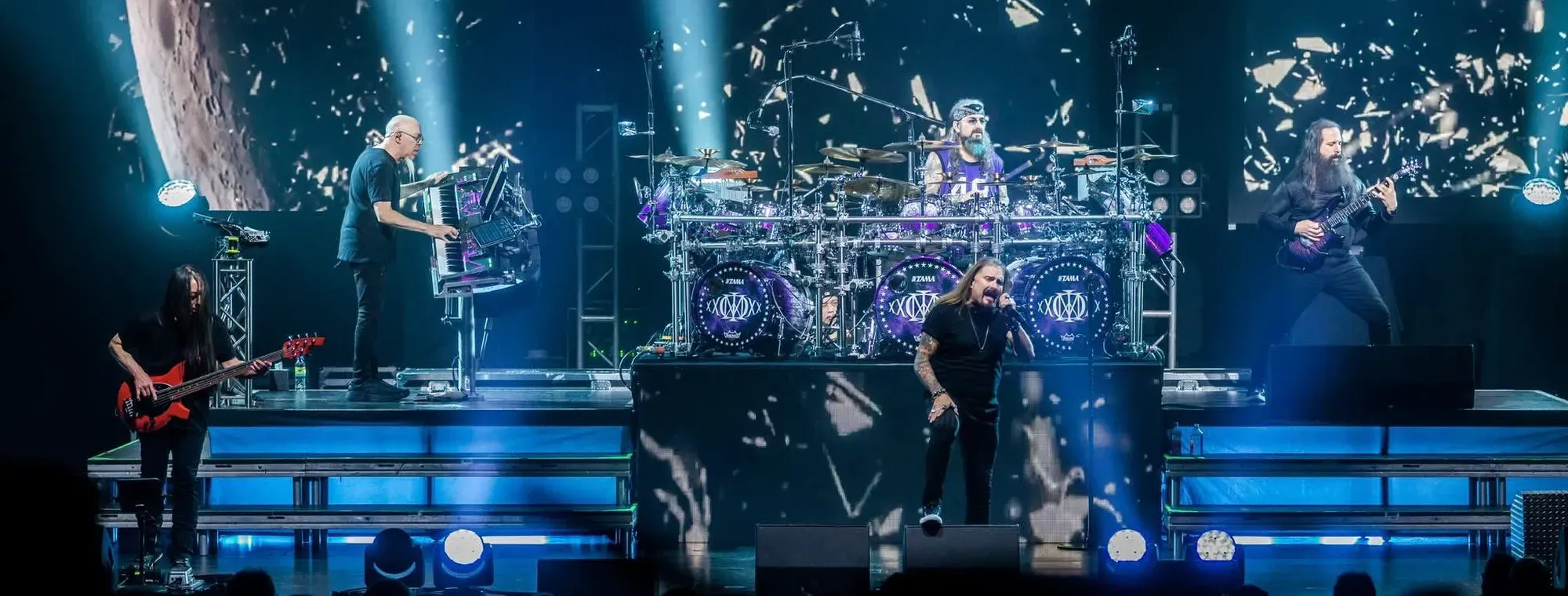
And what a career it’s been. This August, to commemorate the band’s 20th anniversary, Dream Theater released the three-CD set (also a double DVD) Score, which was recorded live at New York’s Radio City Music Hall on April 1, 2006. One particular extra on the DVD should be of special interest to Dream Theater fans: a mini-documentary that kicks off with founding members Petrucci, bassist John Myung, and drummer Mike Portnoy going back to their alma mater, Boston’s Berklee College of Music, where they formed Dream Theater.
“Walking into Berklee, you think you’re great because you can play an Yngwie solo,” Petrucci recalls, “but you get there and it’s all jazz theory and harmony, and there are all these cats who can read, and who can play through a fake book – it’s a real slap in the face.” Still, the toughest challenge the three friends came up against wasn’t learning how to arrange for horns; it was finding enough time to study and, at the same time, pursue a career as a band. After only one year, Petrucci, Myung, and Portnoy left Berklee. Says Petrucci, “We didn’t even get to declare our major!”
Apart from this brief brush with formal guitar education, Petrucci learned to play mostly by ear, either by moving the record player stylus back and forth or by slowing down tapes of songs he’d recorded off the King Biscuit Flower Hour. Soon he discovered his innate curiosity for more complex music. “I can remember, like it was yesterday, hearing the tapping part in ‘Eruption’ and thinking, ‘How can that be a guitar?’” he says. “It was that kind of mystery that drew me to guitar. And the better I got, the more I wanted to learn, and be stimulated, and be challenged. So I got into more interesting, more progressive music.”
Petrucci started devouring the music of prog icons like Rush and Yes, fusion luminaries Al Di Meola and Allan Holdsworth, and heavy yet musically interesting bands like Iron Maiden. But his biggest discovery was Dixie Dregs guitarist Steve Morse. “Not only did I think he was the most amazing guitar player – the man – but I was really into his music,” says Petrucci. “And every time I see him live, it seems he’s gotten better. I love his attitude about practicing and improving, and he’s so humble about it all. He’s still my hero.”
Today, some two decades later, as evidenced by the opening scenes of the Score DVD, thousands of fans across the globe are heaping similar kinds of accolades on the man sitting across from me. On the day that he and his mates are to begin writing the band’s 10th studio album, Petrucci discusses not only Dream Theater’s progression as a band but the progression of his own playing as well.
Guitar 1: You’ve continued to improve as a guitarist with each record. There was an especially noticeable difference in your technique from your first album to your second, Images and Words.
John Petrucci: Yeah. After we did Images and Words, I remember someone making a comment to me, like, What did you do, take steroids or something? And I didn’t know what he meant, but he pointed out that he noticed a major technical improvement. I think it’s just my nature to want to get better.
Your tone changed quite a bit, too.
When we did When Dream and Day Unite [1989], I had a B.C. Rich, and that’s also when I started my relationship with Ibanez. And I think I was using Randall solid-state heads back then, but I don’t remember for sure; it’s pretty sad. There was a huge amount of development between those two records. One factor was learning how to record properly, and how to get a good guitar sound, and I think that’s carried through as the albums have progressed.
Images and Words came out in 1992 and was your biggest-selling album. What makes it special to you?
For one, it was our first record with James [LaBrie]; we felt like we’d finally found the right vocalist. And coming off the first record, we thought we had a career going, but it just stopped, leaving us to wonder if we’d ever be able to do this again. We had written such a wealth of material through that period, and having a singer and being in such a great studio [Bear Tracks], living with all the guys in upstate New York, and feeling like “Yeah, we can do this,” made the whole experience just amazing.
The next album was Awake, which contains “Erotomania” – certainly a highlight among your guitar-playing fans.
That song was originally written as a joke, almost. We said, let's put together some stupid riffs and see what happens. And that classical middle section was originally in “Pull Me Under,” but it didn’t work. So when we did this song, I finally had the perfect place for it. But that album was a little difficult. Our keyboardist, Kevin Moore, left while we were recording. He was a longtime childhood friend, so that was kind of traumatic.
Derek Sherinian was Kevin's replacement. But after two albums with him, you brought Jordan Rudess on board for Scenes From a Memory.
Derek’s a great keyboard player – I just played on his solo record – and we had a lot of fun while he was in the band. When Mike [Portnoy] and I did the Liquid Tension Experiment records with Jordan, there was some real magic in the studio. We were able to write fairly effortlessly, and we wanted that in Dream Theater.
Next came Six Degrees of Inner Turbulence.
That was a double record, where one entire CD is one song. Writing in the style of the song “Six Degrees,” because it’s very orchestral, was a first for us.
Who spearheaded those arrangements?
We all chipped in, but there was this thing we used to do with Jordan – who’s a master musician – where I’d dictate a mood, like, OK, play a love melody, or play something that sounds like the end of a movie, or play something Disney, and he’d do it. So we had all these different riffs and musical ideas that we put together to make themes, and those themes run through the song.
That must make it easy when you come across writer’s block.
But that’s the thing: there’s never a road block. There are so many ideas, riffs, licks, constant notes flying back and forth. It’s almost like you’re in this giant Home Depot and you need the smallest part, and you find it.
Do you have that same chemistry with bassist John Myung?
The thing that I love about John, and it’s always been this way, is that he knows exactly the right thing to play. Dream Theater is about a certain musical concept, and John is the core of that concept. He might be sitting there quietly listening to us go back and forth with notes, and then he’ll drop the bomb with the best riff of the record.
Train of Thought may be your heaviest record, but it was also a super-shreddy album.
The record before that was Six Degrees, which was sparser guitarwise, so my attitude on Train was that I just wanted to rip. And I wanted to make a leap in technique, too. I was thinking about that “steroids” comment my friend made when I did Images, and I thought, I haven't heard anyone say that in a long time, so I’m gonna make people say that on this record. I really practiced more techniques, and newer techniques, and put all that into the record.
Over the years, what’s been most challenging for you from a technical standpoint?
Being in Dream Theater, one of the most challenging things has been having to double or harmonize lines written by a keyboard player. You find yourself having to do huge intervallic stretches or string skipping or other things that are unorthodox. The other thing – playing threehour shows, with various guitars and 40-minute songs – is the stamina. Conditioning your hands to be able to play all that...it’s like a marathon.
My hands hurt just watching the “lnstrumedley” on Live at Budokan.
I always say it’s like being in the Olympics. You have to condition yourself, and prepare: stretch out, warm up, get into the right mental headspace. My kids are in gymnastics, and that song is like performing a gymnastic routine on the guitar.
Do you still practice jazz or sight-reading?
I still practice a lot, but I don’t really do that. What I’ve found over the years, and this is fairly typical of guitar players, is that playing classical pieces written for solo instruments – violin, piano, flute – on the guitar is one of my favorite things to do. You come up with different fingerings, different ways of looking at the music, different harmonies, different techniques – it just catapults your technique, especially if you use a metronome.
Your left-right hand synchronization is amazing.
Playing with a metronome was a major, major breakthrough for me. I discovered that that’s how you get your hands synchronized; you have to start slowly, have proper technique, and build up speed. Just like any classical musician would do to execute a piece perfectly. My little digital metronome goes with me everywhere, and that’s how I still practice. There’s no substitute.
Tell us a bit about your Music Man signaturemodel guitar.
Sterling Ball and those guys make the best guitars in the world. It really is the ultimate guitar. And the amazing thing is that every single guitar they make is beautiful – their consistency of quality is unbelievable.
It’s got a new pickup in it.
Yeah, we changed the bridge pickup. It’s still a DiMarzio, but it’s the D-Sonic, which gives me a little more thickness for the higher notes. The neck pickup is still the DiMarzio Air Norton, same as the original model. This guitar also has a piezo pickup. I’ve done some clean things where I blend the piezo sound with the clean tone, and it’s really nice. But for the most part, when I do acoustic parts in the studio, I use a Taylor.
Are you still using Ernie Ball strings?
Of course. The gauges depend on the guitar and the tuning, but the six-string set for standard tuning is .010-.046.
Which Boogies are you favoring these days?
For this record, I brought in my Road King; my Mark IIC+, which is one of my favorite amps ever; a Lone Star; a Mark IV; and a Stiletto Ace. So I have a lot of options. The Road King has that heavy, rectifier sound; the Stiletto has EL-34s and is more of a British sound; and the Mark amps, especially the IIC+, are just classic, heavy crunch, and sweet. And the Lone Star is a beautiful amp for single-note and clean stuff.
Is your effects rack still huge?
I don’t record much with effects; that’s mostly for touring. But the TC Electronic 2290 is a staple in my rig, as is the M3000. I can’t leave home without those two things. I’ve also been getting into certain pedals; I have some Keeley-modified overdrives, like the Katana, which is great; the modified Tube Screamer; and the modified Boss pedals. I kinda swap them in and out.
While we’re on the topic of gear, was that an Aria Pro II in your hands in the early footage on the Score DVD?
Yeah! My friend had an identical one, but a different color, and we’d have these little duels, playing Boston solos.
So, 20 years...how does it feel?
It’s amazing. When we were young, John Myung and I used to lug our amps in shopping carts down the street just to be able to practice for a couple of hours after school. And not only are we still playing together, we’ve made a career of it. It’s unbelievable. And then I think about what’s happened during that time: we’ve all grown up together; our kids are all the same age. It’s like we have our own Dream Theater society or community!
You up for another 20 years?
As long as I can still play, absolutely!