
Originally published in Electric Basement.com · March 2004
Dream Theater’s James Labrie **Exclusive**
by A. Lee Graham
InterviewJames LaBrie17 min read
Posted 3/22/04
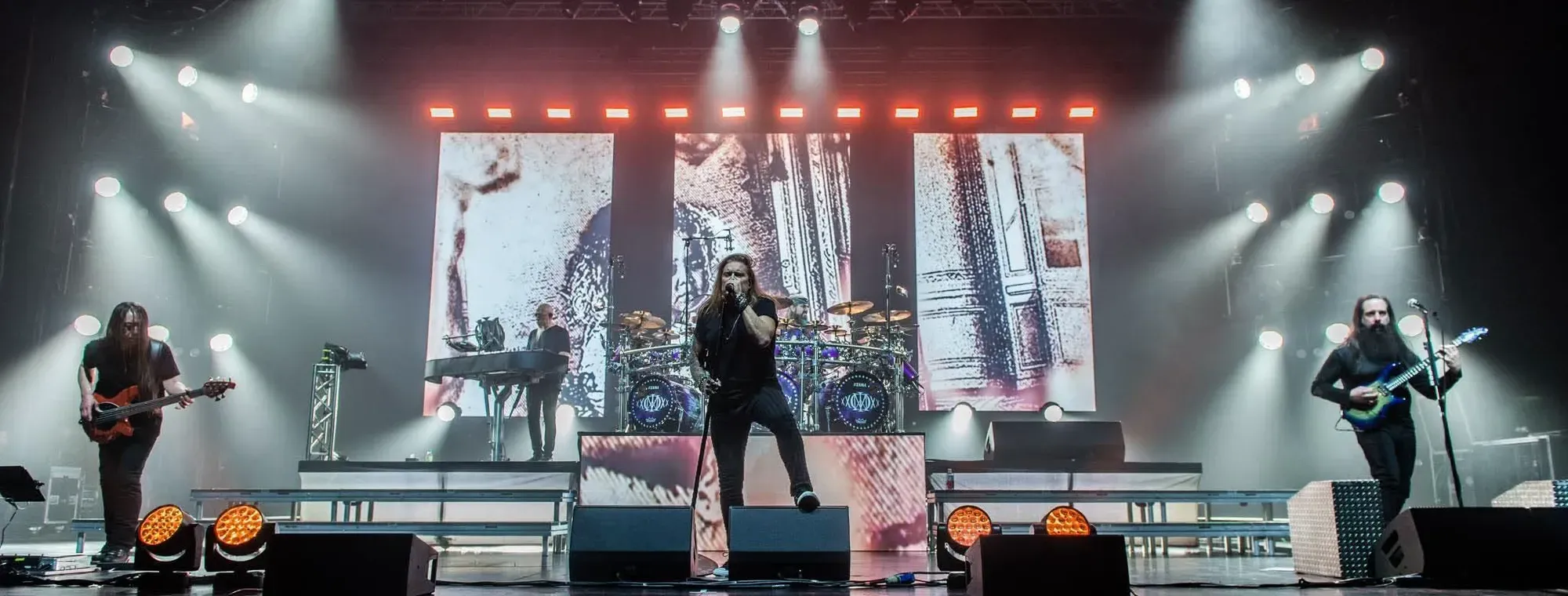
James LaBrie stalks the stage.
Arms outstretched, the Dream Theater vocalist invites fans to join in. He whips around, grabs a bottle and takes a swig.
“It’s only water,” says LaBrie, whose confession would constitute mere trivia in other media. But this is rock ‘n’ roll – metal rock ‘n’ roll, where hangovers and deafness go hand in hand.
“Water is incredibly important for the voice,” says the frontman. “You’ve got to drink throughout the day – especially during showtime.”
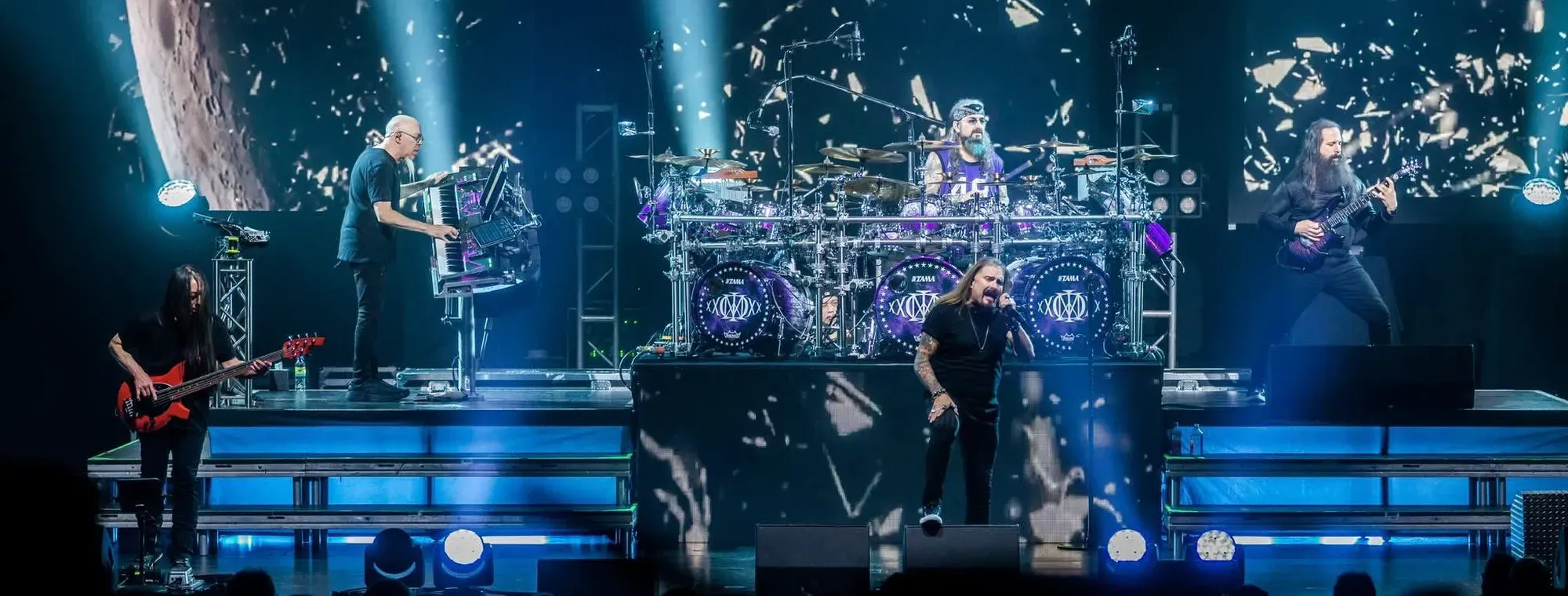
And when sets span three hours – as most Dream Theater performances do – stamina is mandatory. It’s that dichotomy, that balance between health and hell-raising music, that fuels Dream Theater.
Since joining the band for Images And Words, LaBrie has caressed the sweetest melodies and pillaged some of the heaviest riffs – at least in the progressive rock pantheon (these guys may be metal, but they’re not Deicide.)
The ability to incite mosh pits one minute and invoke lullabies the next – without losing its considerable fan base – has vaulted Dream Theater ahead of most acts. This isn’t any metal outfit; the New Yorkers are a musical phenomenon, free to explore the musical jungle without criticism.
OK, Falling Into Infinity drew derision, most notably from drummer Mike Portnoy. “The production just didn’t click,” he told this scribe last year.
Yours truly disputes that contention. Sure, Kevin Shirley draped slick production over the 1997 release, but it stands proud to this day. “Peruvian Skies,” “New Millennium” and other tracks continue to ...
Wait. This isn’t a disc retrospective; this is a James LaBrie interview. And throngs of Milwaukee fans await what’s billed as An Evening With Dream Theater.
“We chose to go out on our own this time since we’ve got so much material,” says LaBrie, his voice growing more animated. His excitement is palpable.
“The disc is our strongest in a long time. It’s really going over well live.”
The platter in question is Train of Thought, arguably the band’s heaviest yet. So heavy, that some fans bemoan what they consider its lack of experimentation. Less aggression, more exploration, they seem to say.
“But that’s the way it always is,” sighs the vocalist. “Some fans like one release more than another, and I understand that. But our fans are special. They always stick by us and give whatever we record a chance. We’re truly lucky.”
Good fortune has followed the Ontario native since childhood. The LaBrie household reverberated with sweet melodies in the mid-’60s when James discovered the radio.
“Even if I didn’t always get the words right, my parents seemed to get a kick out of me singing along,” laughs LaBrie, intrigued by vocals as well as percussion.
“I finally got a drum set when I was 5 since I was already tapping on everything else.”
But vocals were his first love, an all-consuming passion that knew no limits. “I was into radio pop, opera, rock ‘n’ roll. You name it.” He even joined his father, uncle and brothers in a barbershop quartet.
But nothing captivated the budding singer like British hard rock and progressive music. “The moment I heard Zeppelin and Yes – man, that was it. I was hooked.”
LaBrie surrendered the drum stool at age 15 to focus on vocals. Guiding the budding singer was vocal coach Rosemary Patricia Burns. Under her tutelage, LaBrie honed what would become a mighty instrument.
“I was singing with different bands and eventually fronted this group called Winter Rose.” The act would play a pivotal role in LaBrie’s career. While opening for ‘80s metal queen Lee Aaron, LaBrie was approached by Aaron herself. She noticed his vocal strength and contacted Pierre Paradis of Aquarius Records.
“Meanwhile, Pierre got a call from Mechanic Records saying that this band in New York was looking for a vocalist,” says LaBrie. The band was Dream Theater, and it sought fresh blood even while Chris Cintron claimed membership.
“They just really weren’t satisfied and wanted someone else,” recalls LaBrie, whisked to New York to meet the musicians. They jammed, recorded a four-track demo and the rest, as they say, is history.
“I really lucked out,” says LaBrie, still radiating excitement. “Dream Theater was exactly the sort of band I wanted to be a part of. They were ambitious, liked all styles of music and were creative.”
The revolving door that ushered in Chris Collins, Charlie Dominici and Cintron had shut, and LaBrie was the man.
Images And Words introduced LaBrie to a world audience. The 1992 effort followed When Day And Dream Unite, a debut that, while strong, paled when compared to its successor.
To this day, many fans consider Images And Words among the band’s crowning achievements, without dismissing its subsequent catalog. From the dark angst of Awake and commercial flirtation of Falling Into Infinity to the wildly experimental Six Degrees Of Inner Turbulence and epic ambition of Metropolis Part II: Scenes From a Memory, the Dream Theater canon knows no boundaries.
Though lacking a hit single (“Pull Me Under” being the glaring exception), the band has survived on word-of-mouth loyalty. Fans pack amphitheaters, which sell out despite no airplay or promotion. One might call Dream Theater the Grateful Dead of prog rock.
“I guess I can see that,” laughs LaBrie. Fans crawl out of the woodwork to support their heroes. Year after year, promoters underestimate the juggernaut that is Dream Theater.
“It’s nice to have a following that sticks with you for the long haul. That’s something not every band enjoys,” says LaBrie. The frontman commands the spotlight, but Dream Theater is a rock anomaly in which the instrumentalists garner most press.
But LaBrie is too busy to notice. While his bandmates pursue myriad side projects – Liquid Tension Experiment, The Jelly Jam, Transatlantic (R.I.P.), O.S.I., Hammer of the Gods, Yellow Matter Custard, among others – LaBrie enjoys equally prolific diversions.
Whether portraying the titular character on Trent Gardner’s Leonardo: The Absolute Man or laying down vocals for Ayreon, Frameshift or his own Mullmuzzler project, LaBrie keeps busy.
No grass grows beneath his feet.
With 42 minutes before sound check, LaBrie takes time to discuss the past, present and future of a career that shows no signs of slowing.
Before we begin, please allow a personal question. When’s the Dallas date?!
I don’t know. I guess it all comes down to the way our agency is booking us. We always love playing Texas. You guys are great, but it’s a matter of scheduling. We definitely want to go down there but, for some reason, it’s been difficult.
NextStage – or Nokia Live, as it’s now called – is almost like your second home around here. You’ve played the last two Dallas tours there.
Nice place. Really big.
You’re always welcome here. At any rate, it seems like Dream Theater never stops touring. If Train of Thought never came out, I would have thought this tour was another leg of the Queensryche-Fates Warning package.
We do tour a lot. But that’s not the case this time. We went out for that six weeks with Queensryche, and the previous tour had finished in November of 2002. And basically, when we were out with Queensryche, we were already fully into recording Train of Thought, and it was my vocals that needed to be finished after that summer tour. So we kind of got back into the studio, finished Train of Thought and chilled out until this tour started in January.
Train of Thought is the band’s heaviest release in years, possibly ever. What inspired you guys to such aggression?
We like all kinds of music, including the heavy stuff.
Given that most of you are family men, some fans may be surprised that you can still “summon the demons,” as it were.
(laughs) Well, family and music are separate entities. But you can enjoy both. You have to realize where we’ve gone with our career and our albums. No one album can say where the next will go. We’ve always liked unpredictable risk-taking and always had the freedom to go where we wanted to go. And our fans have come to expect the unexpected.
That allows us to create what we want to create. With Train of Thought, you’re talking about five guys who, over the years, have been listening to various heavy bands. Whether Led Zeppelin, Deep Purple, Metallica, Megadeth or Slayer – and Meshuggah being a more contemporary example. And Pantera. I love those guys.
How did you develop the new material?
At sound checks for the Six Degrees of Inner Turbulence tour, we would experiment with ideas and songs, and it all seemed to be each time we’d be fooling around with riffs. It was sometimes very aggressive and dark. So when we got together in the studio to start writing, Mike (Portnoy) had all these ideas on DAT (digital audio tape) and brought them into the studio and picked what struck us and we developed it more.
How have fans responded to the new songs. Do they already know them by heart?
It’s been great. Obviously, when you do an album as such, you have controversy. Some people accept it and think it’s great. It’s relentless and in your face, and they like it because of that. But other people say, “I don’t know.” The element that hits you immediately is the heaviness.
From the outside, Mike Portnoy and John Petrucci – especially Mike – appear to run the ship. Is that true?
Mike does in the sense that when we are out touring, he’s always putting together set lists. So, in that sense, yes.
He’s known for losing sleep over compiling the perfect sets.
Oh yes! That’s absolutely true. He keeps track of everything we do in every city and goes through it and sees what it is we haven’t done lately or says “let’s do this.” So he’s very serious and very passionate. You need that type of person in a band that takes fans’ likings into serious consideration. So it’s excellent in that sense. He’s also really involved in our web site and Ytsejam bootlegs, too.
As far as the rest of it, we’re all hands-on and involved in terms of where we want to see the band going each and every album.
Where does James LaBrie fit in with the songwriting process? Do you have a different role since you’re a vocalist? True or not, vocalists are known for sticking to lyrics writing.
That’s a real misconception. Whoever thought just because you’re the vocalist, you’re a lyricist? Mullmuzzler and other projects I’ve done, I’m hands-on with lyrics and 80-percent of those are mine. And I’m hands-on with the music, too.
With Dream Theater, I’ll make suggestions here and there: “Guys, that’s not really hitting me right.” But let’s face it: the riffs and songs start with guitar, bass or keyboards. From there, everything is evaluated and ideas are then taken to other levels and arrangements are made to complete the songs.
With me, I more or less voice my opinion if I think it’s getting wacky or out of control.
Our of control? Dream Theater? Surely that never happens.
Yeah (laughs)
But really, I’ll step in with writing melodies with songs. Like “Vacant.” John Myung started playing this riff and Jordan (Rudess) played something on his keyboard, and I sang the melody. Then I went to the motel and wrote the lyrics.
With Mullmuzzler, I’m there from day one making suggestions, ideas for musical arrangements, melodies.
Does Dream Theater’s songwriting process change from album to album, or do Mike and John Petrucci write most of the material every time?
We have no one particular course. It might be John fooling around with a couple of riffs. Sure, there are moments when someone starts playing something and John joins in and gets a jam going. And then revisions are made, which may lead to a song. We might say, “Let’s elongate that” or create another section. There are various ways to composing.
Was the Train of Thought recording process more straightforward, with less experimentation than on Six Degrees?
With Train of Thought, we took lots of things and put them down on DAT from sound checks for Six Degrees. And we were able to take those and kind of embellish them and create different sections and parts on top of them. Once you get into one song, it feeds or fuels the direction of where you want to go with other song ideas. Just because of the nature of this album – it’s heavy and relentless – it creates sections that were madness (laughs), which is cool.
You recently performed When Day And Dream Unite in its entirety. I’m eternally jealous of that LA audience!
It was a great show.
Did you interpret the vocals differently than Charlie Dominici, or did you stick to his style?
I stuck with his melody or melodies as they were written like 85 percent of the time. It would vary here and there.
What did you bring to the delivery?
I brought more power to the songs and more conviction, inflections among melodies and melody changes here and there.
While we’re discussing vocals, I understand you follow some rather unorthodox methods to maintain your singing. Instead of relying on herbal tea, for instance, I hear you sleep long hours. Is that true?
First of all, for the last 16 months, I’ve studied with a new vocal coach. Her name is Victoria Thompson. She’s incredible. She’s a voice major and has performed in European operas for 20 years. She’s now back in Canada where I am, so it was a blessing for me. She took what I’d been taught before and told me it was a crock of shit!
Really?
Yeah. She said. “A month from now, tell me if I’m not telling you the truth.” Well, I can already sense more endurance, control, power and range.
I understand you utilize or emphasize what’s known as the “mask of the face” or facial cavities.
The mask exists, but the way I was utilizing it was completely out the window, according to her. She focused on my breathing, diaphragm utilization and certain placements of the chin, mouth and tongue and then being able to really take the mask and project these notes at places in the face. And she told me how to take care of myself.
How I do that is by jogging a half hour every day, watching what I eat, taking vitamin B12, lots of zinc tablets. And I drink lots of water and orange juice.
Isn’t orange juice rather acidic?
Yeah, but I don’t drink right before the show. And drinking enough water is crucial, so I keep sipping water throughout the day. And when I get to the venue, I do vocalese.
Vocal ease?
No, vocal e-s-e (singing words to a pre-arranged tune) I do that and continue to walk around the hum throughout the day: mmm, mmm. And then I do my vocalese before the show. And during the show, I’m sipping on hot water and honey, so there’s a silver bullet thermos on the (drum) riser with me. And the liquids help keep you loose and open. It’s good for the vocal chords.
How about sleep?
I try to get anywhere from 8 to 10 hours a night. I’m an insomniac, so me being in a band, I’m sometimes getting 7 hours.
Still, that’s good by rock standards. Touring is known as a sleepless experience.
Yeah, not getting enough sleep is a problem. It’s also difficult getting sick. I started the tour with bronchitis and now have a wicked cold.
That sucks.
It’s OK. John (Petrucci) is very sick. He has the flu. Because you’re on a rigorous schedule, it’s tough, especially when you’re expected to do a three-hour show.
Touring must wear down your immune defenses.
Absolutely. Fans don’t see that behind the scenes, the road can be quite grueling. But you chose your vocation and you have to do it. I eat lots of vegetables and fruits and jog so that keeps me on top of my game.
In Dream Theater, the instrumentalists receive most of the attention. Do you ever feel underrated or overlooked performing with such virtuosos?
I depends on the individual. If one musician doesn’t play as much in a particular song, I suppose he’s not noticed as much.
But do you feel overlooked?
No. You know what? As you grow older, you find more important things than adulation. If people accept me as a musician, great. If they don’t, I’m not going to convince them otherwise.
Is it more challenging writing lyrics around multiple time signatures? As a vocalist, shaping phrases, rhymes and rhythms must be difficult when the music changes so much.
I love it. First of all, I grew up listening to Rush and Queen – my all-time favorites. Freddie Mercury is still my all-time vocal god, and Pink Floyd and Yes and Genesis, I loved, too. So getting into a band like this was the ultimate for me. Being a vocalist, you have to remember, is the highest standard of expression because music by nature is eclectic. There are so many ways a vocalist can express himself and utilize the many levels of voice.
It’s not about being into one type genre of music and sticking to those boundaries or parameters. Being in Dream Theater, the music is what it is and is very diverse. It allows me to be as diverse as possible.
Since Images And Words, I’ve wanted to ask you this. What do you do backstage during long instrumental jams? You’ll have to admit, it’s a most unusual situation!
Stretching exercises and doing jumping jacks. I keep the blood flowing and sip hot water and honey and drink water. I just basically keep my energy up.
Maintaining the momentum?
Absolutely. When I return onstage, I’m at the same energy level I was when I left.
Tell me about the Madmen & Sinners project. How did you hook up with Tim Donahue?
It’s very Black Sabbath-meets-Rush music.
Cool.
It’s dark at times and can be technical at times. It’s just a different approach, more in the hard-rock singing style. It’s a great album.
So many artists seek you out for their projects. How do you hook up with the Arjen Anthony Lucassens and Henning Paulys of the world?
They go through my management or try to get the web master to get in touch with me. In interviews, someone might say, “You should hear this guy,” and A&R (artists and repertoire) people might represent other potentially interested musicians.
For Frameshift, for example, with Jerry George (with ProgRock Records), I said, “If you hear of any new artists I’d be interested in, let me know.” He e-mailed me immediately and said “Henning wants to get a hold of you.” And I got a message and freaked out. They were just ideas at that point.
Frameshift’s Unweaving The Rainbow is great stuff. Not only its evolution subject matter, but the music itself is quite a departure for you.
Thanks. Henning is an incredible musician. It got me excited the second I heard it.
Evolution – particularly the works of Richard Dawkins – is pretty controversial stuff. It makes Frameshift quite unique. You dealt with similarly provocative themes with “The Great Debate” (from Six Degrees of Inner Turbulence). Are you drawn to such subjects as an artist?
To me, there’s been enough love songs written, enough lyrics written about relationships that it becomes mundane. It’s great if you can word them well, and songs about understanding one another will always have their place. But for me, I like to explore different subjects. Evolution – even though I am not a believer – it makes for a great argument. And the way Richard Dawkins expresses himself, you can’t help but to be captivated by what he says.
I’m more of a spiritual man, so to get myself in the headspace of where the lyrics were coming from, I read his “River of Eden” and it was an amazing book. He’s on another plane.
You seem to have assimilated his themes since you sound so confident on the album.
Thanks. Letting people hear my voice now is nice since I think it’s better than it’s ever been. I’m singing in ways people didn’t know I could.
I’d go as far as to call Frameshift your best vocal showcase. You mentioned Freddie Mercury, and I hear a lot of vocal layering like he used to do with Queen. Am I off base?
Thank you. No, I definitely utilized some different approaches with the album. After reading the book, it really enabled me – the communicator of it – to honestly get behind it and sing it as sincerely as I could. It was great.
Did you and Henning swap sound files, or did you actually record together in the same studio?
I sat down and wrote with Henning. Some sound files were traded, but it was mostly all songs once they were completed and together. Once we were all comfortable with how the music was going, I took each song and laid down all these melodies. And Henning finished lyrics with Matt Cash and I flew out to California and recorded my vocal tracks.
I sang once I got to California. What I did was send him discs with melodies before doing the final tracks.
Did those discs have just rough ideas?
No, they were pretty damn complete.
Any possibility of touring the material?
No, but we’d like to. Reaction has been overwhelming. It made the editor’s list in an Italian magazine and we’re on the cover of the next “Hard Rock” with Dave Mustaine.
I’d love to hear “La Mer” live. That’s such an awesome song. I can see the lighters swaying already.
Yeah, that’s gotten good response.
How about Ayreon? What was the process there?
With Ayreon, it was through Gary Wehrkamp of Shadow Gallery. He gave me a CD of Ayreon’s Inside The Electric Castle, and I freaked out. This stuff is incredible!
Even better is his Universal Migrator project. The guy’s amazing. As for James LaBrie, Mullmuzzler seems the ideal vehicle for your artistic expression. It seems to be the project closest to your heart. Is that accurate?
Of course. This is my little baby. It will be good to record more Mullmuzzler late this summer.
Will it have the same lineup?
At this point, it looks like Matt Guillory once again, Mike Mangini, Bryan Beller on bass and Andy Timmons on guitar.
Awesome.
The Ayreon should be out pretty soon, like early summer.
James, thanks for taking the time to chat.
No problem, Lee. But excuse me. It’s time for sound check.