

Originally published in Mars Music.com · March 2001
Drumming to the Max
by Howard Goldberg
InterviewMike Portnoy9 min read
A student of both the Zappa School of Music (self-taught) and the prestigious Berklee College of Music, Dream Theater founder, drummer and creative force Mike Portnoy talks with marsmusic.com about his career, his inspirations and his signature line of Sabian cymbals: Max Stax.
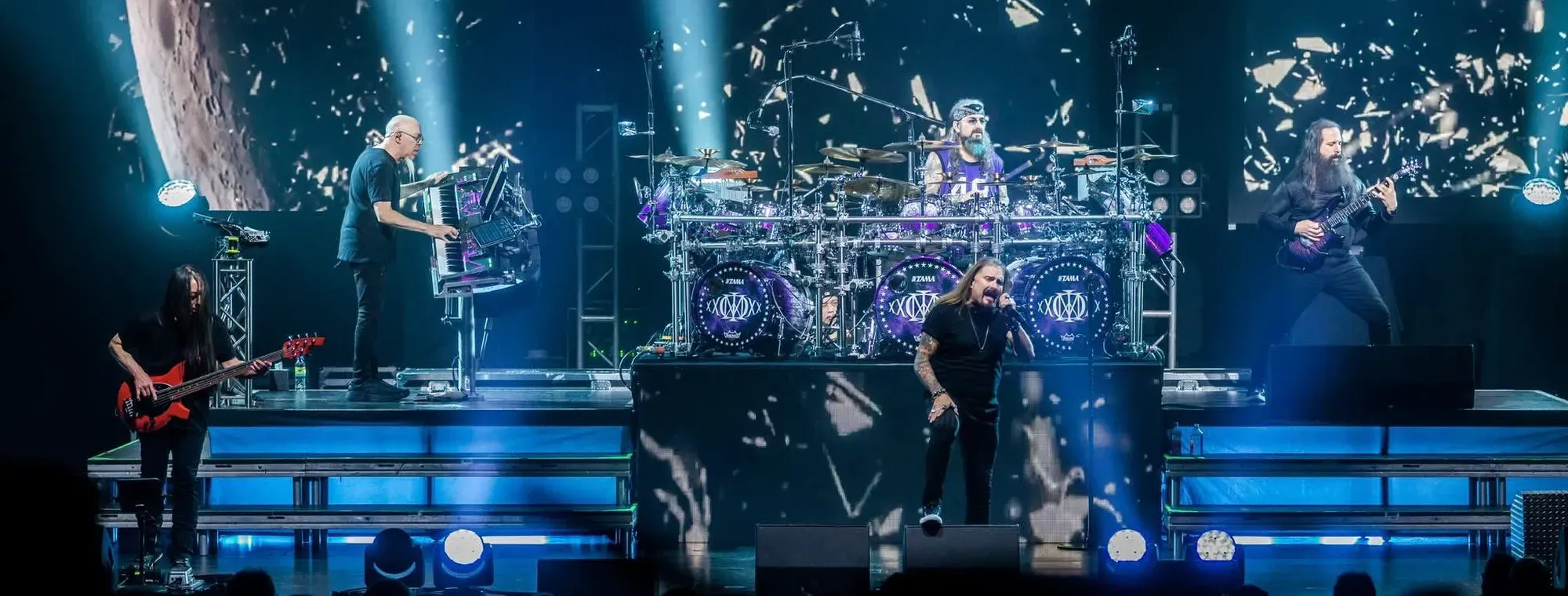
With musical trends coming and going, most players and bands have a small window of opportunity to find their pot of gold at the end of the proverbial rainbow. There are, however, a small number of bands and players that have been able to transcend the ever-changing taste of the general public, finding their pots of gold year after year. One such band is Dream Theater and one such player is Mike Portnoy. Mike Portnoy began his drumming career in 1985 when he hooked up with guitarist John Petrucci and bassist John Myung to form Dream Theater. Fifteen years later, Mike continues to find success doing the things he loves most.
marsmusic.com (mm): What made you gravitate toward the drums?
Mike Portnoy: Growing up in a house with a rock and roll dad, I knew I was going to gravitate to music from day one. He was a DJ on the radio. So, from the beginning I was exposed to the Beatles, The Who, Led Zeppelin and The Doors. I knew that I was going to end up in music somehow. When I was around nine years old, I started on piano. Then, when I was eleven, I gravitated to the drums -- the piano just wasn't rock and roll enough for me. It was Keith Moon [the Who]who really inspired me to be a drummer -- his whole personality -- he was the coolest one in the band. As I got into the drums, Keith Moon, John Bonham, Peter Criss, and Ringo were the big four for me early on. Then, when I got into more technical playing, I got into Bill Bruford, Neil Peart, Simon Phillips, and Terry Bozzio.
mm: What kind of formal musical training did you receive?
Mike Portnoy: I am mostly self taught on drums. I guess you would say that I went to the Frank Zappa School of Music. I taught myself by playing along with his records. I also taught myself how to read music. Starting in high school, and then in my year at Berklee, I received a lot of formal training in theory and harmony, as well as sight singing and arranging.
mm: How do you incorporate your training in theory and harmony into your drumming?
Mike Portnoy: I approach the drums melodically and rhythmically instead of just from a rhythmic perspective. I am always thinking of different ways to approach music. Mostly, my training comes across in my song writing. I am an equal writer in Dream Theater. I write all of the music and a lot of the lyrics and produce.
mm: How did Dream Theater come about?
Mike Portnoy: We formed at Berklee in 1985. I met John Petrucci (guitar) and John Myung (bass) within the first week of school. We were all from Long Island with the same musical influences. We hit it off instantly. We all liked the musical complexity of Rush and the metal edge of Iron Maiden, so we formed a band. After 1 year at Berklee, we all left to pursue the band. I haven't been able to get rid of them since. That was 15 years ago.
mm: Over the last 15 years, you have had a fruitful career, playing drums in Dream Theater, Liquid Tension Experiment and Transatlantic. On top of that, you are an extremely active clinician. How do you find a balance between such an active career and your family?
Mike Portnoy: That is one of the hardest things to do in the music industry. This past year, I was on the road for a year straight. I have two young children. When I have to be away from them, I miss them dearly. Luckily, Dream Theater does well enough on tour that we could make accommodations to bring our families with us. So I have my family with me for about 50% of the time when I am on the road. I love touring and I love my family, so luckily I am afforded the best of both worlds. As my kids get older, it will be more difficult. Actually, everyone in Dream Theater has a family, so we are all understanding of one another in that respect.
mm: What do you see in the future for Mike Portnoy?
Mike Portnoy: I am in the middle of directing the new Dream Theater DVD and home video which should be wrapped up sometime in February. For me, that is a dream come true. I am even more of a film fanatic than music. I am due to wrap up another Transatlantic album by the beginning of February. Then, Dream Theater regroups to start another album that should take us through the rest of 2001. In 2002, we will hit the road. I am sure Sabian will come through with many more clinics to fill in the gaps in between.
mm: What do you think about PAS (the Percussive Arts Society convention)? I understand that this is your first time performing here.
Mike Portnoy: When I was at Berklee, my roommate and I went to PAS in L.A. It was the first time I was able to meet all of my drum heroes. I couldn't believe how accessible those people were. Now, for me to come back and play, it is a great honor. I hope there are a lot of young kids who are getting the same out of it as I did.
mm: How did you get into doing clinics?
Mike Portnoy: At first I really wanted no part of clinics. I was intimidated by the whole idea, but because of requests from many of the dealers, my companies were very persistent. They finally convinced me to do a couple of clinics in Germany.
They had a few dealers out there that requested me. As soon as I did one, I realized how comfortable they are to do. At my first one, the audience was 75% Mike Portnoy or Dream Theater fans. As soon as I got through the first one, the floodgates opened up. I did them all over the world. I have done hundreds by now.
mm: How does it feel to be in such demand?
Mike Portnoy: I don't know how to take it. It doesn't mean that I am better than anyone is. It means that people enjoy what I do. I'll be the first to tell you that when I am in the presence of drummers that I look up to, I am completely humbled and intimidated. I walk around with my tail between my legs. I really appreciate how supportive the fans are. I guess I just touch a nerve with them with the way I play. I am tapping into a type of drumming audience that I was a part of when I was coming up listening to Neil Peart. Back in the 1980's he was that kind of drummer. I count my blessings every day.
mm: How does your setup change from group to group?
Mike Portnoy: Although the size of my kit varies a lot depending on which group I am playing with, my cymbal setup stays consistently large. I like the sound variety in a big cymbal setup. I guess my cymbal setup does change minimally. I go from four crashes with Dream Theater down to three; and from two Chinas down to one. All of the little knick-knacks and bells and splashes are the same.
mm: How did you first hook up with Sabian?
Mike Portnoy: They came to me in around 1993 when Dream Theater was starting to get some recognition and exposure. At that point I was using other cymbals. Out of every manufacturer out there, they were the first company to approach me. It meant a lot that they recognized me and appreciated what I was doing musically. Steve O. [Artist Relations at Sabian at the time] sent me out a huge variety of cymbals to work with. I just needed to hit them once to be sold on them. I have been with them ever since.
mm: Do you use the same cymbals live as you use in the studio?
Mike Portnoy: Yes. I had a consistent setup for years. Now that I am doing different side projects, I have been a little more open to using different things. Actually, this year, I will be developing a brand new drum set for Dream Theater. Sabian agreed to be very flexible in what they provide for my clinics during 2001 so I could do some experimenting.
mm: Are you partial to a specific line of Sabian cymbals?
Mike Portnoy: The Max line, of course. That is my baby (no pun intended). Before I was using the Max line exclusively, I was using the AAs, the AAXs and the Hand Hammered cymbals.
When I first started playing Sabians, I was really into the AA and AAX lines. Now, I am leaning toward the Hand Hammered Line. With my future setup, I think I may lean more toward the hand Hammered stuff. I also really like the new HHXs. I fiddled with some of them at the NAMM show and I really liked what I heard. I am open to different things. You throw it my way. I'll hit it.
mm: You have your own signature line of cymbals named after your son, called Max Stax. How did you get involved in designing your own cymbal line?
Mike Portnoy: It is a funny story. I was doing a clinic in Cincinnati and the dealer didn't have my cymbal setup. We had to build something out of their stock. As I was putting it together, I found myself playing a Chad Smith Crash, a Jack DeJohnette crash, a Chester Thompson Ride and Terry Bozzio Radias. I was playing everybody's cymbals, but mine! I stopped and asked myself, "What the *%)$ is wrong with this?" I called Sabian and the rest is history.
mm: Every thing happens for a reason.
Mike Portnoy: I should call and thank that dealer in Cincinnati who didn't have my set-up.
mm: How did you get the idea for Max Stax?
Mike Portnoy: I started stacking cymbals years back. The first time I saw stacking was with Terry Bozzio. I was experimenting with using existing Sabian cymbals: mini Chinas on top of crashes, or China Kangs on top of splashes. I was experimenting with cymbals from their existing line and I would always get asked about them at my clinics. When it was finally time to focus on my own signature line, I knew that I wanted to focus on stacking. I went to the Sabian factory and we customized the different sounds and the different sizes. I actually visited the factory a few different times before we had the line fine tuned.
We decided on leaving the edges unlathed so that the edges would be durable and ultimately, I think what we came up with is great. For the type of music I play and the way I play, Max Stax are great.
mm: To wrap it up, There are a lot of kids here [at PAS] to see you tonight. If you could sit them all down and give them advice on how to pursue a career in music, what kind of advice would you give them?
Mike Portnoy: There are many things I could say. The music business, especially in rock music, is very tough. It is very "dog eat dog." The trends are always changing. In Dream Theater, we have been very fortunate to be able to sustain a career by staying outside the trends and by remaining true to ourselves. Bands like ours can easily get lost in the shuffle. Try to stick to your guns and do something that comes from your heart. Trends come and go. There are a million Limp Bizkits and Backstreet Boys out there. You could jump on the bandwagon, but you are better off following your heart and doing something that you really love.
The other bit of advice I would say to drummers is try and be as open minded to your musical surroundings as possible. For me, as I said before, the drums are only a small piece of the puzzle. When I am listening to or making a record, the drums are just one part of it. I will spend just as much time concentrating on the arranging of the music or the writing of the lyrics or the melodies or the production. There are so many other aspects to music other than drumming. Try to branch out and become as well rounded as an overall musician as you can.