

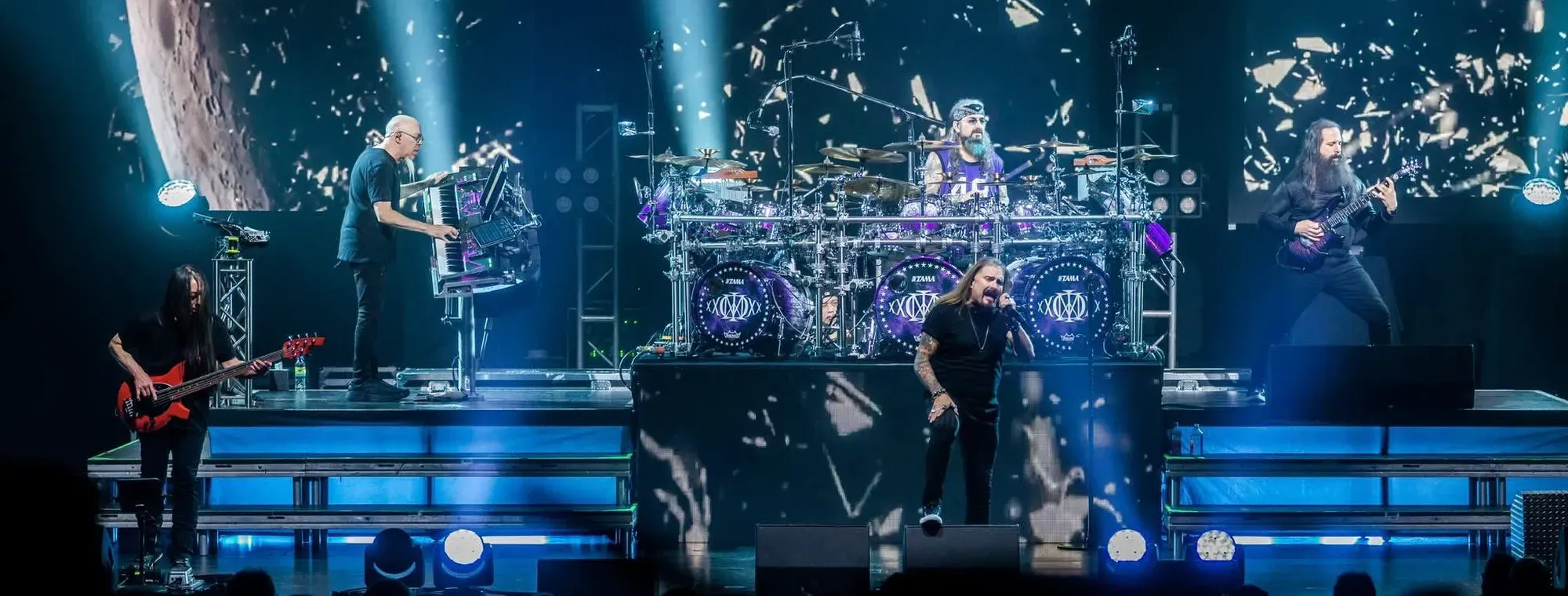
Originally published in Shockwave magazine-Hardradio.com · July 1999
Derek Sherinian interview (excerpt)
InterviewDerek Sherinian5 min read
Jon Thibault: Alice Cooper’s called you “arrogance personified.” Is that a compliment?
Derek Sherinian: Yeah. It’s all tongue-in-cheek. We have this shtick where when I see him, we both act like we’re royalty. It’s all fun and games...
JT: You went to Berklee for three years?
DS: Actually, about two years. I didn’t graduate. I was to a point, after four semesters, that I felt ready to move to Los Angeles and take my best shot. Berklee was an incredible experience, but I felt that if I’d stayed the full four years it would have been counterproductive.
JT: Back to Planet X... What does the title of the first track, “Apocalypse 1470 B.C.,” mean?
DS: With the whole Atlantis Trilogy [the first three tracks] I’m kind of making a mockery of progressive rock, because I think a lot of progressive bands take themselves very seriously, with their pompous titles and their opera singer vocalists, and that’s not what Planet X is about. We’re about making totally sick, kick-ass music. We have no message, whatsoever. We’re not into gargoyles or Dungeons and Dragons, or any of that stuff.
JT: Do you think progressive rock is becoming its own Spinal Tap?
DS: It is. And it always had an overtone of these “musician” types that are so prim and proper, with no dirt under their fingernails, playing the tunes. And that’s cool, but Virgil and I take a very hard rock approach to our prog. You could almost call us “glam-prog-fusion.” That’s what we call Planet X.
JT: I was listening to “Day in the Sun” and I thought I heard some Chick Corea influence in there.
DS: Yeah! Good ears! I love Chick Corea. I’ve been a fan since Return To Forever, and his solo works incredible.
JT: What do you like better, playing the sicker stuff, or the slammin’ stuff?
DS: I like all of it. Every song on the record is a different shade of my personality that I like to tap into. That’s why it’s cool live, because you can just tap into all sorts of vibes. It’s all about vibes.
JT: Because of your chops, I would think you’d get sort of bored playing the straight-ahead stuff.
DS: Like “State of Delirium” – it’s so heavy that you can just sort of dig in. It’s very cool.
JT: Why don’t I throw some musicians’ names at you and you can tell me what you think of them.
DS: Okay.
JT: Eddie Van Halen.
DS: The reason I play music. When I listened to him play as a kid, his playing moved me so much – all the intricacies and nuances, and his style, the way he approached things, and the fills in between the vocal lines... It just fascinated me how someone’s personality could come through on a record like that, and I’ve pretty much dedicated my whole life to trying to come up with a style, an individual, original style on my keyboard, so when people hear it they can identify who it is. And that’s what I’m working towards. Eddie’s the king.
JT: Randy Rhoads.
DS: Awesome. He’s right up there with Eddie. His playing moved me when I was at a very vulnerable age, like 15 to 17, right in there. In my solo style, there’s a lot of the same Van Halen, Randy Rhoads spirit in the way I bend notes and use my pitch wheel.
JT: Pat Metheny.
DS: He’s an incredible musician, but he’s a little too light in the loafers. A little too soft. I need balls in my music. But he’s an incredible player.
JT: What about Rick Wakeman?
DS: What I love about Rick Wakeman and Keith Emerson is that those guys were rock stars. If you look at them, Rick Wakeman has the cape, and he’s got the Heineken beers behind him on his keyboard rack, and Emerson was putting knives in his keyboard. I think that’s cool! A lot of prog bands today, they don’t subscribe to that show business mentality.
JT: Jon Lord, from Deep Purple.
DS: Great. A lot of my organ sound, like how Elton John influenced me on my piano playing, Jon Lord – whenever I play distorted organ – I think Deep Purple.
JT: Dave Weckl.
DS: Incredible. Great fusion drummer.
JT: Jens Johansson
DS: Great keyboard player. He’s probably one of my favorite guys that are out today. He’s an aggressive player, and he plays heavy... Just very cool. Very cool player.
JT: Wasn’t he going to join Dream Theater before you?
DS: I think he auditioned before I did, but for some reason it didn’t work out.
JT: Why did you leave Dream Theater?
DS: I got fired [long, uncomfortable silence].
JT: You want to, like, go into that at all?
DS: Sure. Basically, I was in the middle of recording my solo record and I got a phone call – it was a conference call from the other guys – and they said that they wanted to hire someone who they had worked on in some of their side projects. It came as a total shock, because I went and played some shows for the holidays and we were talking about recording the album in February, and I get home a week later and I get the phone call that I wasn’t in the band. And it shocked me, at first, but at the same time it was very clear to me what I had to do, and I looked at it as an opportunity to springboard off a bit and start my own thing, which is Planet X. And it was great timing because I had that solo record coming out and I could use that to start planting seeds in the public and let them know that Planet X was starting to happen. I’m better off now. I have no hard feelings.
JT: What was it like playing with them?
DS: I have very mixed feelings. It was very good for me, because I definitely improved as a player in a lot of ways. But at the same time it was very restricting. My hands were tied in a lot of situations and it was extremely frustrating to be in a band where I didn’t have the control, and I think after a while it just clashed...personalities clashed. They’re all married, with families. I’m single...I didn’t belong in that band. I was too Hollywood.