

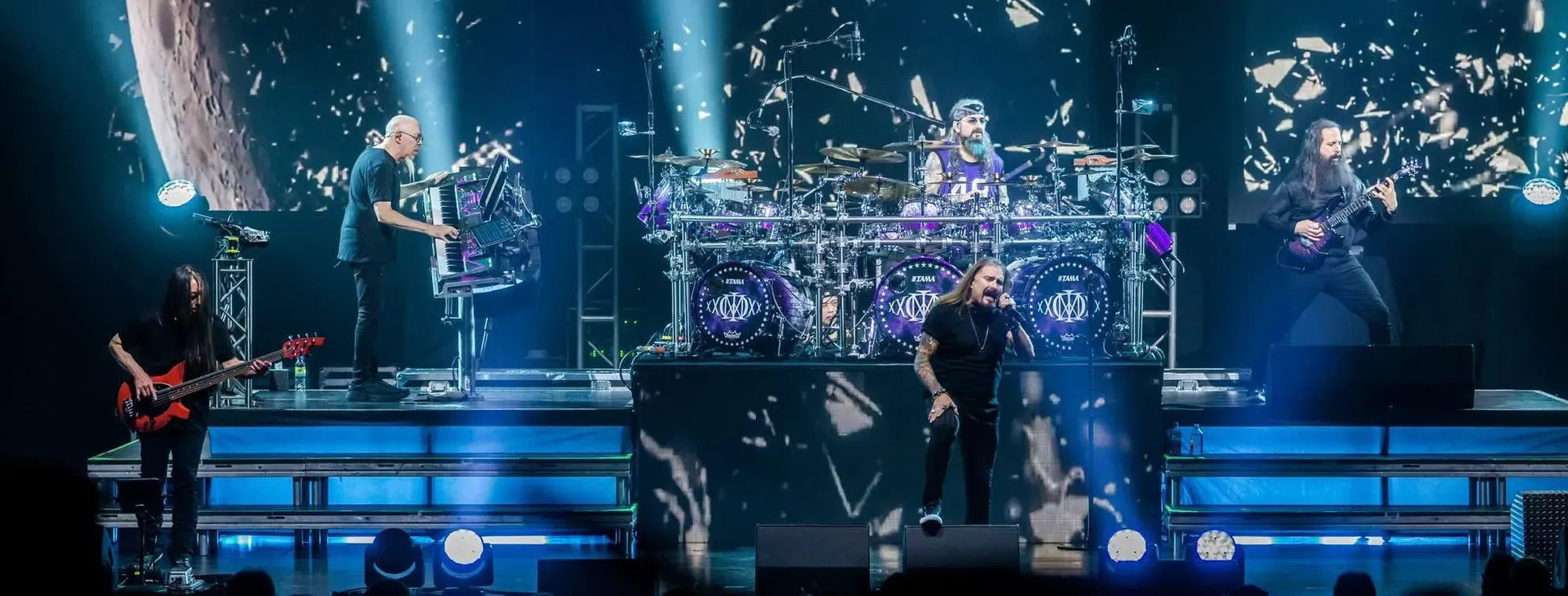
Originally published in Hard Radio.com · October 1999
Dream Theater – Reincarnation For The Progressive Nation
by Martin Popoff
InterviewJames LaBrie14 min read
It’s been a career of fits and starts for Dream Theater. Four proper studio albums, one odds ‘n’ sods, and two live releases have not sufficiently shaken fans to move ahead with this unique band, folks still pining back to the band’s second album Images And Words as the standard against which Dream Theater records must be harshly measured. This seems to happen with most progressive or progressive metal bands, fans fixating on a record way back, upset when they receive the dark lumbering force of an Awake, or more incensed at the moody mellow strains of a Falling Into Infinity.
The new record however, will probably have Dream Theater’s fanatic fanbase dancing a furtive fingers a’ flyin’ fretboard jig. Can’t tell you what the thing’s called though, only that it is subtitled Scenes From A Memory. Seems the main title is a secret, one of the items lead singer James LaBrie can’t divulge (note: this feature was written in October. The album is since out and it’s called Metropolis Pt. 2: Scenes From A Memory).
James explains with an apologetic laugh, why they are being so mysterious. “Basically because we really wanted to keep the interest and excitement very much alive when the album finally does hit the street. We found that with the way the Internet works now, you can get soundbites from the upcoming albums, you can get the total scoop, you can get advance copies left right and center. And by the time it comes out and it’s been all talked about, there’s mainly two things happening. One is that people have over-anticipated the album and it’s worse than they thought and they’re disappointed. Or second, the excitement has dulled because everything has been accurately divulged already. All I know is that they wanted it to be stressed to all journalists that all the details about the album are strictly for use for their articles and are not to be posted or reproduced anywhere on the Internet before Oct. 26.”
But it seems everything else is pretty much fair game, so deep into the record we go, Scenes From A Memory being well worth the wait and worth a bit of explaining, given that it’s the band’s first full-blown concept album, smacked upside the head with all sorts of bright, combative progressive metal playing that is likely the most vital the band has ever projected onto shiny aluminum. James sets the stage for the story, again, without giving away too much. “The concept is that it’s a story of a young man, whose name is Nicholas. And he’s constantly being haunted at night by dreams from another lifetime. And upon his being regressed by his psychotherapist, he discovers that he is indeed a reincarnated soul of a young girl whose name was Victoria, who lived earlier in this century. So once he does this regression and he finds out that, hey, there is such a thing as past lives, he starts to investigate the details of his past life. And through his investigation he is horrified to learn that Victoria was tragically murdered at a very young age. So throughout the story Nicholas finds out more and more about this secret life that Victoria was leading, and that she was, in fact, involved in a dangerous life of lies and deception and a love triangle involving two brothers.”
“OK, we’re getting pretty deep here, aren’t we?”, James laughs, almost self-consciously, summing up that, “it’s basically that through this love triangle, we are getting into the concept that most of the time, murder is either caused by money or love. I don’t want to go much further into the details of the story because I want to leave it up to people to figure out the plot for themselves. But that’s the basic premise.”
And the moral of the story would be? “I think we’re putting forth the concept that we have lived before and that we will live again. It is an eternity. The soul is transcendent and moves on to a higher plane, and that we learn from our past lives and we do it over again until we get it right. It’s a positive message. Even though the story has a plot, there’s also this overshadowing message that we do go on. The soul does live forever.” Does the current soul suffer from the previous soul’s transgressions? “I guess you could say that, yes,” supposes James. “We definitely are a reflection of our past lives. We are what we are today because of what we were yesterday.”
Asked for a highlight of the record, James offers the following. “‘The Spirit Carries On’ I think is very beautiful because of its message, that the soul really does move on. I think it’s directed at the disbeliever who thinks that we just go for the big dirt nap when we’re dead. It’s really disputing that notion; it’s saying that the spirit is just too precious. The consciousness that we have, there’s a reason for it. I don’t believe it’s something that just lasts 80 years or however long you live, and then the light goes out. I don’t believe that. I think for that reason, I’m very partial to that piece, just because I find it very positive.”
Musically, Scenes From A Memory is as bombastic and quick-stepping as the storyline. It is a record for the fans. So much so, that one has to ask, was it directed with that in mind? “You can’t help but be influenced by what you have become to be known as, which is usually what the fans saw as your introduction. You want to get back to that intensity. No doubt, we did get to be known as Dream Theater because of the music on Images And Words. So we asked ourselves, ‘why don’t we get back to that and do something really exciting and special, and take it further and tie it all together in one long conceptual piece?’ So after the other guys were done with Liquid Tension Experiment and Platypus (ed. well-received side-projects for the band), and I had just started with my Mullmuzzler project, we talked about what sort of album we want and it was unanimous: let’s just go in there and do a really intense, technical, very progressive album.”
“What definitely hits me right away is that I can say this is our best album ever. I think the material is just very mature and very powerful throughout; very emotional, a lot of feeling. There is the entire spectrum of feelings within this album and a lot of excitement. I think people will be very much ecstatic about the whole situation. If they listen to the album at least once through, they’re going to realize that it’s going to regenerate the excitement we had when Images And Words came out.”
“People have asked us, ‘wow, do you think all of this solo stuff is an interruption? Do you think the side projects sacrifice any cool moments that could have been Dream Theater music?’ And I’ll say to all of that, I think the side-projects have been incredibly invaluable because what it’s done is create a different environment for us in working with different musicians, different approaches, and that added a lot of excitement when we came into the actual learning sessions for Dream Theater. We were in excellent shape creatively and technically, because we were constantly at our craft in our time away from the band. Everybody has really come together much more on their instruments. And collectively, I think we are more aware of each other and how we write. What has been going on around us has added focus and attention on this album.”
New to the line-up is, of course, Jordan Rudess, who has manhandled both crazy-legged Liquid Tension progfests with core Dream Theater writers John Petrucci and Mike Portnoy. After losing two keyboardists to a variety of personal and musical differences, Dream Theater has likely collared Rudess for the long haul. He’s just too valuable to lose, rifling this album with an arsenal of refreshing keyboard tones and performances that keep the listener glued to the speaker grill in anticipation of his next feat. “He’s incredible,” reveals James immediately and enthusiastically. “He’s got a library full of sounds and programs and he’s constantly working on this thing. I mean this guy is technically, I think, at the top of his field. Really. I think he is just absolutely outstanding. And we’re talking about a person who, when he was 9 years old, went to Julliard, and he was there until he was like 20, 21. And then he had the fire that he wanted to do rock ‘n’ roll and his teachers and his mentors were all completely aghast and dumbfounded. They thought he was going to grow up and be a concert pianist, and get involved with more orchestral-type music, which in away, is what Dream Theater does as well (laughs). He is just really a very accomplished musician, and he really knows how to work with you. He’s not aggressive. He’s very open-minded; it just comes with maturity I guess.”
Guitarist John Petrucci also gets a major work-out here, blasting in with a number of axe-crazy leads. James offers that this was all part of the plan. “Him and I would talk, and he would say ‘you know, I think I want get back into some really ripping leads. That’s where my headspace is at.’ And with Liquid Tension there’s stuff like that all over the place. And as well, when we got into these conversations, I’d say, ‘you know what would be really cool, is if you incorporated both the fast heavy leads, and the more David Gilmour-type leads. Because that would really show a really well-rounded accomplished musician.’ And he goes, ‘I already had that in mind.’ So he was very focused on the fact that he wanted to create a balanced presentation.”
Credits-wise, Scenes From A Memory finds Petrucci and drummer Mike Portnoy getting the nod as producers. Musically, James credits pretty much the whole band except himself, basically, “the guys who are playing the instruments.” And the rest? “For all the melodies it was myself, John Petrucci and Mike. And then for all the lyrics it was myself, John Petrucci, Mike and John Myung.” The record took only eight to ten weeks, working at Bear Tracks studio once more (probably all told, the band’s most frequented studio thus far), quite a feat, given that much of it was written right in the studio, even moreso when you find out that the record clocks in at a staggering 77:11!
Vocally, there are a few cool things going on within this theatrical, cinematic record. There’s a local New Jersey choir for which Jordan Rudess had done scores, as well as the soaring vocals of a woman James knows only as Theresa. “She was mind-blowing. She doesn’t know what a bad note is, this girl.” Additionally, there’s the part of the hypnotist, played by none other than legendary Rush producer Terry Brown. “Him and I have struck up a really strong relationship in an musical sense,” reveals James. “So I asked him to come in and record my vocals for the Dream Theater album. And John Petrucci is going, ‘I wonder who we can get to play this part,’ and I said ‘let’s get Terry, man, he’s got an accent, let’s check him out!’ And we did, and John is like, ‘yeah man! This guy’s got the voice. Let’s go for it!’ So we asked him, and he said, ‘Sure! I’d love to do it! Put me there, man. Give me the microphone!’ He actually ended up doing it up in Toronto, though.”
So there you have it. If you aren’t intrigued, you should be. And once you hear the record, the bubbling activity below the surface will cause more than a few curious explorations and discoveries, not to mention quizzical brow-furrowing at all the recurring waves of shred.
Touring is the next long, hard inevitability. “The Agency Group are looking into it right now. There’s talk about Queensryche, there’s talk about Megadeth, there’s talk about Iron Maiden later on, maybe next spring. But whether any of this will actually materialize, I’m not sure. But I do know that we’ll likely start touring near the end of October, the beginning of November. And I’m not sure if we’re going to start in North America or whether Europe would be our first stop. But we’re with Deep Purple’s management, Thames Entertainment, and Bruce Payne, who is our head manager, is psyched on the band, really pumped. We are the only other band besides Deep Purple they’ve ever managed. They’ve been with Deep Purple since day one and we’re the only other band they ever felt they wanted something to do with. They want to put us into a lot of new areas in the world, like the whole South Pacific rim, like Malaysia and Indonesia, Taiwan, and then India and the Eastern Bloc. Then there’s the whole of South America, because we’ve only ever gone to Brazil and played twice, Rio De Janeiro and Sao Paulo. Conversely, it would be nice to play in more cities in Canada than just Toronto and Montreal.”
James LaBrie offers a bit of a career retrospective...
When Dream And Day Unite, vocals by Charlie Dominici (1989)
“The guys were exceptionally young at the time. I still think there are some great moments on there. I think Charlie has a great voice for like Beatles stuff. He just went on to oblivion. I mean, he stayed in touch with the guys off and on, but I don’t think they were ever really that close. I think they just knew that it wasn’t going to work. After they had recorded the album, they went out and did a few shows, and they were just like ‘uh, nope.’ He didn’t cut it in a visual sense and he definitely didn’t cut it in a vocal sense.”
Images And Words (1992)
“It was very exciting. It was my first real album. There was a really strong exciting bond with the band and we were all really pumped about this album. It’s always going to be one of my fondest memories. It was the first real thing I was doing that was going to be released worldwide.”
Live At The Marquee (1993)
“That came out because Images And Words was very popular over in the U.K. There was a lot of buzz and the label said ‘we think it would be really cool for you to do a live album at The Marquee’ which is a famous landmark club in the U.K. And at that time, our A&R guy was Derek Oliver, who was an Englishman. So he was like, ‘this would be bloooody great!’” (laughs)
Awake (1994)
“I love the album. The one down thing about Awake is that we were all very much aware that something was going on with Kevin. It just didn’t feel right. He was drifting and getting more distant from us, and it was pretty much told to us while we were recording the album, he was going to leave. But I think the music on Awake was really cool. It was definitely an indication of where we were individually and as a band, and what kind of style of music we were into, which was more heavy.”
A Change Of Seasons (1995)
“It was cool because we were putting together a track that had been around for a little bit. We just kind of wanted to rework it and make it into a powerful piece. And then at the same time, when we knew we were going to do this kind of an EP, we were over in the U.K. once again, and we thought, well let’s do a night of covers in this little jazz club, but let’s let the covers reflect who we want to pay homage to, our huge influences. A lot of fun, just a little moment in our career.”
Falling Into Infinity (1997)
“Well that was the first and actually the only full-length album we wrote with our last keyboard player Derek Sherinian. I guess there were a few things there. That whole period was pretty wild for the band. There were tons of personnel changes going on at the label. We were losing a lot of allies. There was a real lack of focus from the label towards us. We were also going through a whole management change. Personally, Mike lost his grandmother, who was just like a mother to him. John Petrucci lost his father, and then his wife lost her mother AND her father, so it was a very confusing, taxing time on all of us. And at the same time, while we were writing the music, just because of the whole label situation, it was very hard to communicate where we wanted to bring the music, what kind of album we wanted this to be. And so Falling Into Infinity is really, gee, I don’t know, I would have to say personally for me it’s a low point. It was a much more easily accessible album. I think that is just where we wanted to be musically. At the same time there was part of us, in all of us, who wanted to do something completely different musically. With everything that was going on around us, it came out pretty good. I think we all grew tremendously from it and we realized how you really have to pull together and decide what is important, what is priority, and stay focused. Which is really hard to do with things like that going on.”
Once In A Livetime (1998)
“Well, I thought it was an exciting evening. I had a lot of fun with it. We did three hours of music in one night. An hour and a half, then a 15 minute intermission, then back on for another hour and a half. There were technical problems, but I usually don’t have to deal with them unless my microphone cuts out. (laughs) I know there were problems with the keyboards, and the guitar was cacking here, there, and everywhere and some of those things had to be mended or fixed because it was just unacceptable. But I think what I really like about that album is it really is a face-value double live album. There is no doctoring here, there, and everywhere, unlike what you hear a lot in today’s musical environment. Because if you ever see any of those bands and then hear the live album, you go ‘uh-uh, there’s no way.’”