

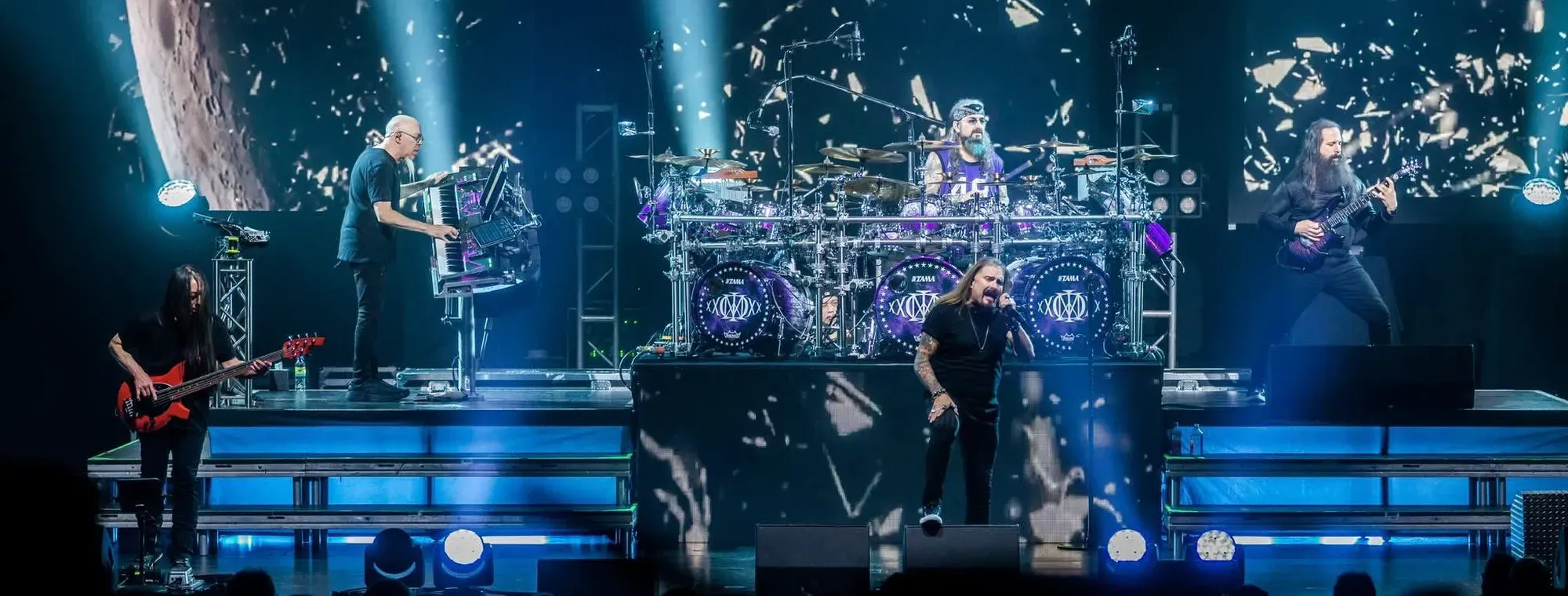
Originally published in Drum! magazine · April 1995
Indescribable Mike Portnoy of Dream Theater Goes His Own Way
InterviewMike Portnoy16 min read
Author: Greg Rule
From the grating grind of Nine Inch Nails to the infectious pop-punk grooves of Green Day, today’s multi-platinum megastars are a far cry from yesterday’s paid-by-the-note shredders. If it’s bloody, muddy, aggressive, or angry, chances are, it has an audience.
And then there’s Dream Theater.
When all current musical trends point toward the above, this Berklee-trained quartet is running full speed in the opposite direction. With _Awake_, their latest on East West Records, they’ve given the slumbering progressive rock giant a swift and serious kick in the pants. As Bass Player magazine so aptly summarized: “Whew -- these guys are licensed to chop!”
And we couldn’t agree more.
But Dream Theater’s music is more than a mere note-fest. Much more. Just when they’ve established a theme in, say, seven, along comes a 16-bar bridge of lethal, Pantera-esque metal that leads into a spacious, half-time synth breakdown. A series of surgically-played drum and guitar flurries ring out like machine gun blasts and, just when you least expect it, the whole band yanks an eighth-note off the end of a bar and launches into a section of nine. “Where’s the frigging 1?!?”
The man responsible for holding it all together is drummer Mike Portnoy. At times reminiscent of Neil Peart, Terry Bozzio, and even the mighty Vinnie Paul, he’s a twin kick master who’s capable of displacing time and uncorking brain-busting polyrhythms with the greatest of ease.
One look is all it takes to realize that this drummer is his own unique beast, though. He sits high. Very high. His drums and cymbals are clustered unusually close to his body. And his calculated, almost stiff-looking motions are not what you’d expect to see from such a fluid-sounding technician. Intrigued? So were we.
When Dream Theater rolled through San Francisco on their most recent world tour, DRUM! was there with notebook, tape recorder, and camcorder in tow, and, much to our enjoyment and enlightenment, our meeting turned out to be anything but ordinary. Backstage, sprawled across his dressing room sofa, Portnoy told us stories of his musical past, took us behind the Dream Theater scenes, and talked about his signing with Mapex drums. But it wasn’t until he led us up to the stage that the sparks really started to fly. With our camcorder rolling, we watched bug-eyed as the drummer picked up his sticks and proceeded to unload.
Here’s what we discovered.
DRUM!: There’s seldom a dull moment listening to Dream Theater. Rush. Yes. Kansas. Malmsteen. At times the band even sounds like Pantera with keyboards. Are they an influence?
Portnoy: Oh yeah. That’s mainly my department, the heavy stuff. We all listen to a lot of different things. As a band, we have a lot of common influences. Those are probably the ones that come out the most in the music. Stuff like the progressive rock bands of the ‘70s: Rush, Yes, Kansas, Zappa, the Dregs. And we combine that with a lot of today’s heavier music -- Metallica, for example -- and a lot of the heavies from the past: Maiden, Sabbath, Judas Priest. Those are the band’s common influences, but individually, we go off on our own tangents. I’m really into the heavy side, like Pantera, Sepultura, and Machine Head. But I also listen to a lot of other music, like rap: Public Enemy, Beastie Boys. That music has just as much influence on my drumming as anything else. I mean, Public Enemy is just programmed drums, but all the different grooves and all the rhythms that they layer on top of each other is just as inspirational to me as listening to Terry Bozzio. The thing is, we’re all very open-minded listeners, and when it comes to writing music, we try to be just as open-minded. One day we’ll be in the mood to write something heavy, and another day we’ll feel like going off into a Peter Gabriel vibe.
DRUM!: What type of regiment did you put yourself through in the early days to reach this level of musicianship?
Portnoy: I had a little bit of training, but I think I’m generally a self-taught drummer. My dad was a rock and roll disc jockey, so immediately I was turned onto the Beatles, the Who, the Doors and Hendrix. I was surrounded by rock and roll. Growing up, I had this enormous record collection. So once I started playing drums, I jammed along with the records. I was a huge Kiss freak at the time. Keith Moon and John Bonham were my first two drum gods. I took a few initial lessons just to learn how to hold the sticks and stuff like that, but that was the extent of it. Basically, I learned by listening to records. But I think the period when I developed the most was when I started getting into music that was more intricate -- when I discovered Rush. Neil Peart turned my world upside down. I became a Rush fanatic. I learned all of their songs backward and forward. That was my first introduction to odd time signatures and the like. Then I discovered Frank Zappa, probably my biggest influence of all time. Terry Bozzio, Vinnie Colaiuta, all those guys introduced me to the world of diversity and polyrhythms. Basically, I think I’ve always listened to a lot of different kinds of music and always tried to learn. I tried to get inside the heads of all those drummers. Another thing is, when I first started to play, my longing to learn went beyond just the drums. When I was in high school, I was taking a lot of music theory classes, and I became obsessed with learning all that stuff. Harmony, theory -- I wanted to become a complete musician, not just a drummer. That training is something that’s really helped with the songwriting in this band because I’m always involved in it now.
DRUM!: You eventually wound up at the Berklee School of Music, right?
Portnoy: Right. I went to Berklee after I graduated high school and just surrounded myself with music theory. I took arranging classes, sight singing, ear training, and all that kind of stuff. That’s where I met John and John (bassist John Myung and guitarist John Petrucci), and that’s when we put the band together.
DRUM!: In addition to drums, were you studying piano or other instruments at Berklee?
Portnoy: No, I pretty much taught myself how to play those; I taught myself how to pick up a bass or a guitar or piano, learn the notes, and that’s when all my music theory training came in. Music is mathematics, really. You’ve got to learn some of the golden rules, and from there you can take it wherever you want. When I was taking all the theory classes, I would go out and pick up transcription books of Yes and all these bands who used odd time signatures and I would look at the notes, figure out the counting, the time signatures and the math.
DRUM!: It’s one thing to understand it, but another thing to manifest it physically.
Portnoy: Yeah, analyzing it is half the battle. For me, getting myself to learn it physically was just a matter of putting on the record and playing along with it.
DRUM!: In other words, you’re one of the naturally-gifted types who most musicians despise?
Portnoy: [Laughs.] The rest of the guys in the band hate me ‘cause they’re constantly practicing, but I’m not as disciplined. In fact, I’m downright lackadaisical about it, at least these days anyway. Years ago, when I was really taking it all in, I used to practice a lot. But these days, I have more things in my life. I’m onstage two hours a night playing drums, and when we’re off tour, the last thing I want to see is my drum set. I want to spend time with my wife, or do other things. But those guys are always on their instrument.
DRUM!: Let’s analyze a few songs from _Awake_, starting with “6:00.” The chorus is in six, and about halfway through, you displace the time.
Portnoy: The keyboard part is doing the same thing throughout, he’s holding down the downbeats, but I’m turning it around. If I remember correctly, I’m moving the downbeat for myself, the guitar, and the bass one 16th-note later than where it was.
DRUM!: Do you usually incorporate those types of tricks on purpose, or do they occur unintentionally sometimes?
Portnoy: In this case it was my doing. They were playing the riff, and I heard it differently than they were hearing it. So we said, “Okay, let’s do it like this the first time around, and like that the second time.” A lot of times when we’re writing stuff, that’s how it is. Someone will have a lick in nine, and one guy will be phrasing it in five and four, and I might be phrasing it in three, three, and three. So a lot of times we’ll try it every possible way. Or, if we’re playing something in four, rather than phrasing it as “one-two-three-four, one-two-three-four,” I might phrase it as “one-two-three, one-two-three, one-two.
DRUM!: What drums are featured on the opening fill of “6:00”?
Portnoy: Those are pseudo-Octabans that Mapex built for me.
DRUM!: The intro groove is in four followed by a Bozzio-esque double bass pattern. What’s your approach to fast double bass footwork?
Portnoy: Single strokes, and I play heel up because I sit so high. I don’t even think my heels would reach the floor. I like my toms to be flat, so I have to sit high in order to reach them without twisting my arms off. That’s one of the reasons I had Mapex make me small toms so I could sit them flat and low to the bass drums. Anyway, that particular section was a bitch to record. It’s weird, because when you’re writing this stuff or playing it live, there are always those types of monster sections, and it’s like, “Okay, here it comes, here it comes.” And you work it out, and that’s it. You don’t have to deal with it until the next night. But when you’re in the studio and you’re doing three or four takes of each song, after a while it gets kind of crazy. I remember that one particular part with those double bass things -- it was a bitch to nail ‘cause it had to be right on the money. After playing it over and over and over in the studio, it starts to wear you down.
DRUM!: Speaking of fast double bass patterns, Vinnie Paul told us he duct-tapes quarters to his bass drum heads so each note will come across cleanly on tape. Do you incorporate any type of special tuning, or similar techniques, to make sure those fast notes won’t end up sounding like a blur?
Portnoy: No, I’m not a sound-monger like Vinnie is. That’s his thing. I don’t really know that much about the recording process. I’m not an engineer type guy. So basically, I go over the sounds with the engineer and producer and make sure everyone is happy. That’s something we didn’t have with _Images and Words_. I hated the drum sounds on that album because the producer shoved the triggering thing down my throat, which is something I was not a fan of. He was a very head-strong producer who did things his way, and that was it. But this time around I wanted to make sure that everything was there, that everything was audible, and that everything was real -- all acoustic.
DRUM!: The song “Caught In A Web” has some nice time changes.
Portnoy: It starts off in three or six, depending on how you count it, and the verse grooves are in four. The thing that pops up occasionally before the chorus has a measure of seven in there. But that whole song was cool because I don’t think I’ve ever done a song where the whole thing was double bass throughout the whole song. The only time the double bass stops is for the choruses and part of the third verse. It was kind of the opposite, because a lot of people will kick into double bass for the choruses for effect, but I did the opposite.
DRUM!: On songs that have long, repetitive figures like that, do you ever catch yourself playing psychological mind games: “It’s only the second verse. Keep it steady. Will I make it?”
Portnoy: When we record, yes. In those situations, everything is under a microscope, so yeah, you become real self-conscious about it. Live, though, I try not to think about it. A big part of us playing live is the natural adrenaline onstage. If the tempo fluctuates, or whatever, that’s okay. I don’t usually get stressed-out over my parts.
DRUM!: “Erotomania” starts with an organ riff in five.
Portnoy: It’s in five, but it ends in 9/8. I bet some people think it’s a mistake, that we’re rushing the beat on the last measure. But it’s actually in 9/8.
DRUM!: How did you phrase that section of nine?
Portnoy: That’s a good example of what I was saying earlier, because most of the time, I’m phrasing it as four and five, but toward the end of the song, I’m phrasing it as three sets of three. It’s all arithmetic. There are so many times when we’re dealing with odd time signatures or polyrhythms and we actually sit there with a pen and paper and figure out where the beats are landing. It’s all a matter of counting and arithmetic, adding things up and making them equal out.
DRUM!: In “The Mirror” you apply a couple of different drum grooves to a steady figure played by the guitar, giving the illusion that the whole riff has changed when, in fact, it hasn’t.
Portnoy: That intro was something I came up with, just changing the beats around under that one rhythm. Without those guys ever changing, I change from a triplet pattern to a 16th-note thing and then I yank one of the eighth-notes off of it and turn it around. That’s just me having fun with numbers.
DRUM!: What drums did you record with?
Portnoy: The Mapex kit.
DRUM!: You used to play Tama. Why the switch?
Portnoy: The Tama kit I played on the last album was my first real kit. I worked three jobs one summer when I was 16 years old, saved up, and bought that kit. So basically, at the end of the last tour, it was like, “Okay, it’s definitely time for something new.” Not because I didn’t like the drums -- they held up great -- but because I wanted to expand my setup. Different sizes, and stuff like that. Mapex was pursuing me strongly at the time, so I went down to their factory in Nashville when we played there and they showed me their drums. My options were open at that point because Tama wasn’t really doing anything for me. So I discussed with Mapex some things I wanted, and they custom-built a kit for me. Once they delivered it and I played it, it was like, “Wow, this sounds great. Let’s do it.”
DRUM!: Do you play the same setup live?
Portnoy: Same one.
DRUM!: On tour, do you find yourself generally sticking to the same grooves and fills each night, or do you mix it up?
Portnoy: I like to change some of my parts live. Obviously I can’t stray too far away from the structure of the song, everything is so nailed down, but within that structure I like to change the fills and the licks and sometimes the phrasings every once in a while. A lot of that stuff happens spontaneously, and if I wasn’t recording the shows, a lot of it would be lost forever. I might pull out some crazy thing that may or may not work, but at least I’ll have it on tape and if I like it, I might end up using it for the rest of the tour.
DRUM!: So you don’t feel too inhibited live, improvisationally?
Portnoy: It’s tough, because this music is so thought-out and interlocked and orchestrated, it’s hard to stray too far from that, but we always have at least one part of the live show that’s a total improvisation. We’ve always tried to put that in the set somewhere.
DRUM!: When you do improvise, do you attempt to detach yourself from your tried-and-true vocabulary of chops, or do you strive to completely break free of that at times?
Portnoy: Every drummer has his or her vocabulary. You learn stuff throughout the years and that becomes part of your arsenal. So you usually find yourself picking and choosing from what you know. But hopefully you have enough to where you can throw it into different contexts. Being able to break free. . .so many of our songs are written like that, where we’ll get together at rehearsal, somebody will come up with a progression, and we’ll go off on it for an hour, taking it into a dozen different places.
DRUM!: So Dream Theater writes as a band.
Portnoy: Generally speaking, everything in this band is collaborative. The method was a little different in the past, because on the the first two albums we had all the time in the world to write. This time around it was a little different. We had a clock hanging over our heads. It was like, “Go. Get in there and do it.” We spent eight hours a night writing. We really had to put our heads together and bang it out. In some cases, we actually wrote a whole song in one eight-hour rehearsal, whereas in the past we’d go for months on end writing one song. We’d spend months dissecting everyone’s parts, making sure every note was perfectly locked-in and orchestrated correctly. There were points where we’d spend six hours of rehearsal on four measures of music. One thing that helped us this time were tapes from old soundchecks. I have my DAT machine out on tour with us and it’s set up at the board at all times. The main groove in “Lie,” for example, was something from a soundcheck in Germany that we listened to and said, “Yeah, let’s use this.” The intro to “Voices” was from a soundcheck in Baltimore. And “Erotomania,” because it was an instrumental, incorporated bits and pieces from a bunch of different soundchecks. “Throw ‘em all in there!”
DRUM!: How comfortable are odd time signatures to you now?
Portnoy: Depends on the situation. If we’re writing something in an odd time signature, I usually have to count it at first. Some of the stuff gets pretty intricate, so we keep a chalkboard at rehearsals and we write it out. But after playing the song a hundred times in rehearsal and then recording it, it usually becomes second nature. It’s like, live -- now that I’m saying this I’ll probably screw up the whole show tonight [laughs] -- but by the time we get on tour, I’m so comfortable with the songs, I can pretty much put myself on automatic-pilot.
DRUM!: Do you focus mentally on any one instrument more than the others when you’re playing?
Portnoy: I’m one of these drummers who plays mostly off of the guitar, whereas most traditional drummers play with the bass. A lot of our music is very intricate rhythmically, and the guitar is usually locked right in there with me. I’ll usually only listen to the guitar in my monitor. I won’t even put bass or vocals in there. Usually, I’m keying in on that, and [bassist] John Myung will key into me or the guitar.
DRUM!: Your physical technique is somewhat unusual -- not the most relaxed or fluid-looking.
Portnoy: If you listen to the record, it might sound like I’m relaxed, but I’m usually pretty stiff and aggressive. Especially live. It’s all aggression.
DRUM!: Do you ever catch yourself tensing up too much?
Portnoy: Sometimes, but I try to glide from section to section. There are parts that call for full-out thrash drumming. But there are other parts where you have to back off in order to nail the syncopations.
DRUM!: If you weren’t playing in Dream Theater, what style of music do you think you’d pursue?
Portnoy: My tastes are so different that I could be happy playing with the Red Hot Chili Peppers, I could be happy playing with Pantera, or I could be happy playing with a band like Jellyfish. But the great thing about this band is the fact that I can incorporate all of those influences. As much as I love the heavy stuff, if I was in Pantera, I would only be doing that, and I would probably feel restricted because most of those bands don’t go off into all these different territories like Dream Theater does. For diversity, this gig is hard to beat.
Portnoy’s Setup
Drums: Mapex
1.24” bass drum
2.14” x 5-1/2” snare drum
3.6” Octabons
4.8” x 8” mounted tom
5.10” x 8” mounted tom
6.12” x 8” mounted tom
7.14” x 10” mounted tom
8.16” x 16” floor tom
9.18” x 16” floor tom
Percussion: LP
10.Bongos
11.Junior congas
12.Tambourine
13.Percussion table: Single-row chimes, bell tree, five wood blocks, tri-bell set, agogo bell set, triangle, Vibra-Slap 2
14.10” timbalitos
15.Ridge Rider cowbell
Cymbals: Sabian
16.10” B8 Pro splash
17.18” AA Chinese
18.14” AAX hi-hats
19.12” AAX splash
20.16” AA medium crash
21.18” AA medium crash
22.8” AAX splash
23.6” CD disc
24.10” AAX splash
25.18” AA medium crash
26.17” HH medium thin crash
27.13” AA Rock hi-hats
28.12” AA Mini Hats
29.22” HH Rock ride
30.12” AA Mini Chinese
31.20” HH thin Chinese
Mike Portnoy also uses DW 5000 Accelerator pedals, Hot sticks, Remo drumheads and DW hi-hat pedals.